TFO historical family guide
TFO’s historical lineup works best as a technique toolbox
The older TFO lineup covered more technique categories than a simple “freshwater versus saltwater” split can explain. It included moderate trout rods, fast heavy-fly tools, entry-oriented outfits, a configurable nymphing rod, fixed-line equipment, benefit models, and several two-handed families. The practical way through that variety is to identify the technique first and ignore every model that solves a different problem.
These are historical names, not a declaration of present production or specifications. Their value lies in the way they divide fishing jobs. Exact configuration and condition must be checked on the individual rod.
Match the tool to the recurring task
| Technique problem | Historical family examples | Primary test |
|---|---|---|
| Delicate trout work | Finesse Trout | Short loading and presentation |
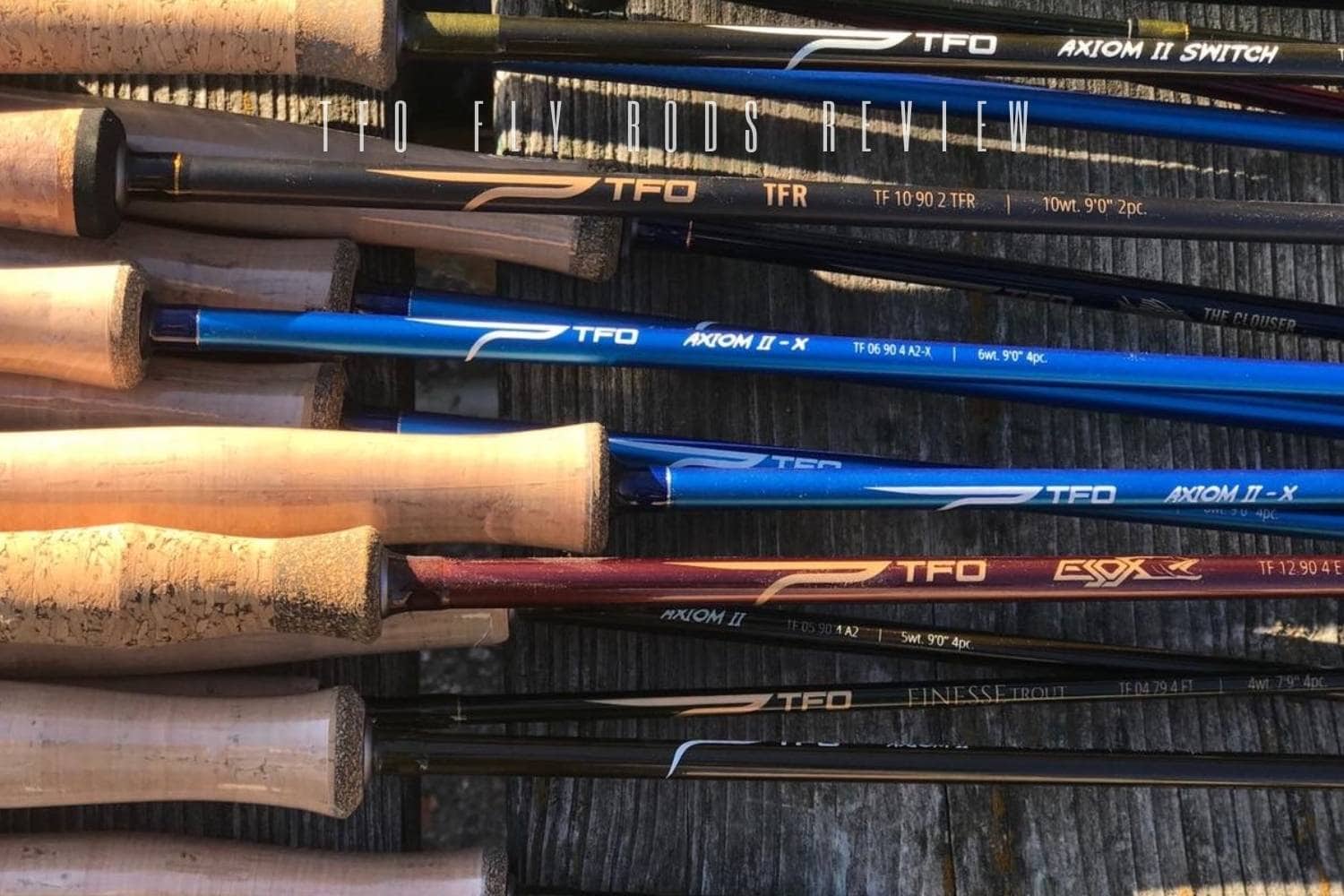
| Fast all-water casting | Axiom II-X, Axiom II | Recovery with a representative fly |
| Bluewater leverage | Bluewater SG | Grip, lift, and heavy line control |
| Accessible general use | NXT Black Label, Pro II, Impact | Ease at ordinary distance |
| Adjustable nymph reach | Drift | Balance at each assembled length |
| Two-handed casting | Axiom II Switch, Pro II Two-Handed, BVK Spey | Head and tip compatibility |
Single-hand families separate finesse, versatility, and force
Finesse Trout: a slower answer for smaller work
Finesse Trout occupied the moderate-action corner of the historical lineup. Its compact lengths and restrained line classes made the family an answer for close trout fishing rather than a distance contest. A deliberate caster may appreciate feeling the load develop; an angler accustomed to forceful acceleration may overpower it. Test with the light leader and fly style that motivates the purchase, because bare line says little about presentation.
Axiom II-X: quick response for demanding casts
Axiom II-X was presented as a fast-action family spanning heavier single-hand work. Its purpose becomes clear when wind, line speed, and more resistant flies are regular rather than exceptional. The right trial includes a pickup, directional change, and turnover of a realistic fly. If the rod only feels alive during maximum-distance casting, it may supply more stiffness than everyday fishing requires.
Axiom II: fast utility with a different tempo
The Axiom II shared the broad Axiom identity but was described with a medium-fast character in the older lineup. That difference is enough to prevent name-based assumptions. Treat II and II-X as distinct historical families and verify the inscription before borrowing any observation. The useful comparison is how each loads at normal range and how much effort it demands during repeated casts.
Bluewater SG: a specialist built around leverage
Bluewater SG belonged to a separate scale of fishing. Heavy line classes, substantial lifting work, and a fighting grip change the evaluation. Its mass is not automatically a flaw if the complete outfit balances and the intended fish require leverage. Conversely, buying such a rod for occasional oversized flies can burden every ordinary cast. Check guides, reel-seat threads, grip integrity, and the lower blank especially carefully on a used example.
NXT Black Label and Bug Launcher: accessible does not mean interchangeable
The historical NXT branch included a general fly rod and a youth-oriented Bug Launcher reference. Those roles should not be merged. For NXT Black Label, prioritize a forgiving setup and ordinary-distance control. For a smaller caster using a Bug Launcher, grip dimensions, total outfit balance, and manageable line length are more important than an adult’s distance impression. Confirm the exact rod because the older lineup’s neighboring labels are not a universal configuration sheet.
Drift: modular length changes the balance question
Drift was the adjustable nymphing concept in the historical group. A rod that can be assembled at different lengths should be evaluated at every intended length, not only in its shortest or lightest-feeling form. Adding sections changes reach, swing weight, joint count, and the leverage felt by the wrist. Rig it with the planned reel and leader, then hold a realistic leading position long enough to expose fatigue.
Pro II and Impact: two historical general-purpose routes
Pro II and Impact appeared among the broader-use families, but their historical action descriptions differed. Compare them by casting both at ordinary fishing distances rather than assuming one action is superior. A moderate or medium-fast tool can be pleasant when learning timing or covering mixed freshwater work; a faster blank can help when a caster already creates a clean stop. Neither approach is universally easier.
Alternative systems deserve their own decision trees
The Tenkara reference: fixed-line fishing is not a reel-less substitute
The earlier lineup included a Tenkara-labeled rod, but fixed-line fishing should be chosen as a complete method. Rod length, collapsed transport, fixed line, leader, fly control, and landing reach interact differently from a conventional reel setup. Confirm that any older rod is actually the intended fishing model and inspect each telescoping section for chips, sticking, or contamination. Never force a nested segment that will not release.
Benefit rods: mission and fishing function are separate
Project Healing Waters, Casting for Recovery, and Reel Recovery appeared as benefit-related names in the historical lineup. Their affiliations provide context, not a substitute for evaluating the physical rod. Identify the exact model, line class, and action, then assess fit just as carefully as any other tool. If the mission matters to the purchase, confirm the relevant arrangement independently rather than assuming an historical relationship remains unchanged.
Axiom II Switch, Pro II Two-Handed, and BVK Spey
The two-handed branch included switch and Spey-oriented families with different action descriptions. Start with river size, casting style, head system, tips, and target fish. Only then choose a blank. An incorrect line can disguise a sound rod’s behavior, while a suitable system can make its loading pattern obvious. Check all ferrules and both grips after casting because two-handed leverage magnifies looseness.
A technique-specific trial beats a generic lawn cast
- For Finesse Trout, make short presentations and line-control moves with a light leader.
- For Axiom and general-purpose families, include a realistic fly, pickup, and off-axis target.
- For Bluewater SG, mount the intended reel and evaluate the grip under controlled leverage.
- For Drift, repeat the balance check at every usable length.
- For two-handers, use the intended head and tip system on a safe casting area.
Before and after the trial, sight along the blank, inspect guide inserts, confirm ferrule engagement, and test the reel seat. Historical warranty wording is not a condition report. An older rod with uncertain joints or damaged guides should not be rescued by a remembered service promise.
Also resist buying by category count. TFO’s historical breadth is useful precisely because it lets you remove irrelevant options quickly. If you never fish fixed line, bluewater, or two-handed tackle, those branches can disappear from the shortlist. If nymph reach defines the season, modular balance deserves more attention than every general-purpose claim combined.
Use exclusion to find the right TFO lane
Eliminate families that require a technique you do not practice. Next remove actions that conflict with your natural tempo. Then confirm the exact line and length needed for the largest fly and fish that are genuinely common. Finally, cast the remaining rod as a complete outfit. This order is faster and more reliable than moving from the most prominent family name downward.
An older TFO can be a useful fishing tool when its specialist intent is still relevant and its condition is sound. It is a poor choice when the buyer expects one rod to behave like Finesse Trout, Axiom II-X, Drift, and a two-hander at once. Those differences are the organizing feature, not an inconvenience.

I purchased a TFO Professional Series Fly Rod, TF 03 76-4P 2 on September 26, 2021 and received the fly rod on October 3, 2021 along with a TFO fly rod hard case. I immediately placed the fly rod in the hard case until it was used on October 9, 2021 in Vail, CO. On the 1st time and 3rd cast the fly rod tip broke off the fly rod. After speaking with TFO I realized I would have to pay the costs to return the fly rod to TFO to be “determined” by only TFO if the fly rod has a defect or it was the customers fault. After 30+ years of fly fishing I am 100% sure it was not my fault and responsibly to return the fly rod to TFO at my costs is unacceptable. If TFO determines it was my fault they require an additional $45. Really? Poor customer service, clearly do not backup their products, and probably need company additional training on the best approach to responding to “their” products not lasting more than 5 minutes by a customer with one of their fly rods. AR