
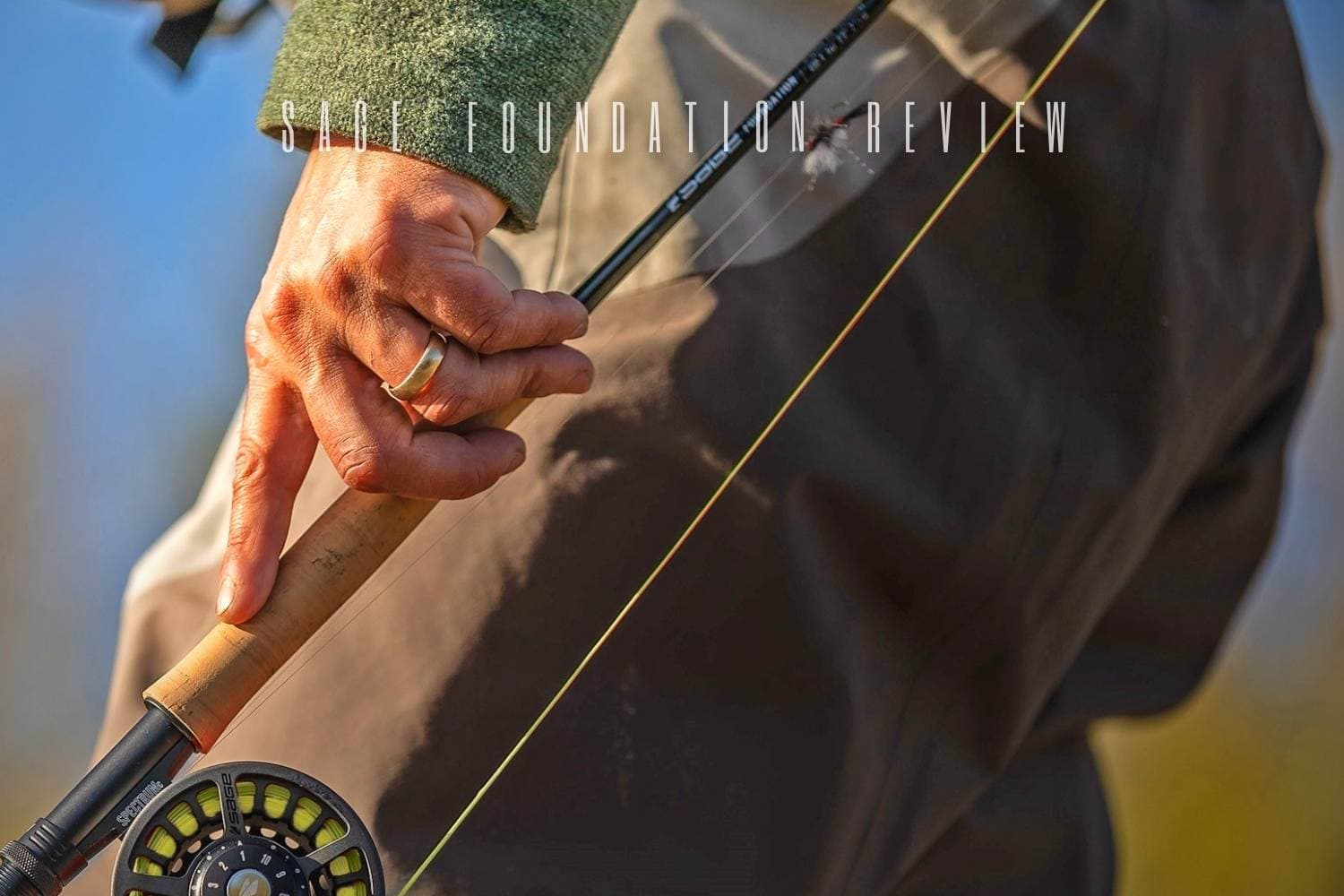
Short answer: A firm all-round rod that combines forgiving middle-distance casting with useful reserve. Foundation offers a direct proposition: a fast graphite rod with enough feedback to forgive an imperfect stroke. The reviewed matte-black generation felt most convincing at the distances where trout fishing usually occurs. It recovered quickly, carried weighted flies with authority, and still allowed a controlled surface presentation. The blank was not exceptionally light and long casts required participation from the caster, but those compromises produced a sturdy, uncomplicated tool rather than a delicate showpiece.
Sage Foundation at a glance
| Category | What applies here |
|---|---|
| Original Foundation range | The four-section Foundation family covered roughly 4–9 weight. |
| Original Foundation length | Most single-hand Graphite IIIe Foundation configurations were 9 feet; verify the exact rod markings because other lengths appeared in the broader family. |
| Original Foundation action | Fast |
| Original Foundation build | Graphite IIIe, black uplocking seat, stainless stripper, hard-chrome guides, half-wells grip |
| Observed emphasis | Smooth powerful stroke, quick recovery, strongest accuracy around 20–45 feet |
The specifications and handling guidance apply only to the matte-black Graphite IIIe Foundation generation. Verify the blank markings and exact configuration before expecting the same fast-action stability, grip shape, and hardware arrangement.
Casting character of this generation
The rod delivered a smooth, powerful stroke and recovered promptly after the stop. Between about 20 and 45 feet, the tip supplied enough sensitivity to place a fly without making the fast action feel severe. Weighted patterns could be moved to 50 feet and beyond, although the caster had to contribute sound hauling and timing. At 3.25 ounces in the discussed example, the rod did not disappear in hand; its swing became more noticeable across a full day.
Foundation needs an honest workload: enough line and fly mass to engage its firm lower blank without turning the cast into a display of maximum effort. Middle-distance recovery is the telling measure.
Blank, grip and hardware
The matte-black Foundation used Graphite IIIe construction, a stainless stripping guide, hard-chrome snake guides, a black single-uplocking seat, and a snub-nose half-wells grip. The restrained finish suits a working rod. Cork quality was reasonable and the grip comfortable. The absence of alignment dots and a hook keeper are small omissions, yet both affect routine use: assembly takes more visual care, and a fly must be secured elsewhere rather than pressed against the blank.
Matte-black hardware and Graphite IIIe identify the original-generation rod, while ferrule fit, straight guides, and an undamaged blank determine whether an existing Foundation still delivers the intended stability.
Where the rod makes sense
The Foundation can handle dries, indicator rigs, nymphs, and streamers when their size matches the chosen line weight. Its firmer lower sections help in wind and with weighted flies, while the tip retains enough control for a measured delivery. Close creek work is less natural because the blank may not load deeply with little line out. On medium rivers and still waters, however, the balance of recovery and reserve makes more sense than a highly specialized soft rod.
Medium rivers, wind, and weighted patterns give the rod meaningful work. Tiny-stream space, close loading, reel balance, and caster stamina decide whether the Foundation's substance remains useful throughout a day.
Tradeoffs that define the design
Long distance is possible but not effortless. The rod asks for competent hauling and a positive stroke, and the higher swing mass can become tiring. Very close casts sacrifice some feel, which matters to anglers who spend the day beneath overhanging branches. The fast label also should not be read as universal suitability: a stiff blank paired with the wrong line can feel unresponsive, while excessive line mass can make recovery untidy. Balance must be tested, not assumed.
Swing mass and reduced close-range sensation are linked to its firm, uncomplicated design. Those costs are acceptable for an angler who values reserve, but they should not be argued away as irrelevant.
A practical choice test
A prospective user should compare the Foundation across the actual 20-to-50-foot range before extending farther. Cast a dry first, then the heaviest normal nymph rig, checking whether the tip recovers without secondary bounce. Hold the assembled rod for several minutes with the intended reel to expose swing imbalance. If its firm rhythm matches the caster, the rod covers many ordinary jobs. If the home water is exclusively tiny and sheltered, a deeper-loading blank is likely more satisfying.
Read and record the Foundation's printed length and line designation because the plain black finish is easy to misidentify. A tube or seller's description is less reliable than the markings on the blank itself.
Setup and condition check
Inspect a used Foundation for guide wear, ferrule scoring, blank impacts, seat-ring damage, and cork deterioration. Because there are no alignment marks, sight carefully down the guides each time it is assembled. Verify the model inscription and do not identify a configuration from the tube alone. Keep the four joints clean and fully seated, and avoid hooking a fly into cork or blank fibers. After a weighted fly strikes the rod, stop and examine the contact point before continuing to load it.
- Verify the Graphite IIIe Foundation identity and printed configuration on the blank itself.
- Seat and inspect every joint on this Graphite IIIe Foundation before applying a full casting load.
- Balance the Graphite IIIe Foundation with the reel, line, leader, and fly intended for its actual job.
- Assess every neighboring Sage model independently instead of extending this Graphite IIIe Foundation verdict by resemblance.
Verdict on the original-generation Sage Foundation
The original-generation Foundation is a capable generalist for anglers who want fast-action stability, uncomplicated hardware, and enough forgiveness to fish rather than constantly manage the rod. Its best work occurs through practical middle distances, with reserve for wind and weighted flies. Swing mass and reduced close-range feel are the honest costs. This conclusion stays with the matte-black Graphite IIIe generation; no newer or neighboring Sage rod inherits the observed casting behavior.

Hi I fish both fresh and saltwater in Australia I used my sage salts as my go to rods but since using a 6 wt foundation for local trout ,I have backed up with 7, 8 and 9wt foundations. For my salt work. Great rods
And yes if you develop your technique will throw as far as there more expensive siblings.
Lee Bedford
Tasmania, Australia
I have Sage Foundation rods in 5, 7, & 8 wt, as well as a few more expensive rods, & always love casting & fishing the Foundations. These rods have a smooth & connected feel, are very accurate in the right hands, and I get the same distance from them, with no more effort or hauling, as with much more expensive rods. Like all fly rods, the right line combination can make a Foundation pure pleasure to cast. They are durable and fish fight very well. IMO the Sage Foundation is one of the great values in fly fishing, even after Sage raised their price to $425.