
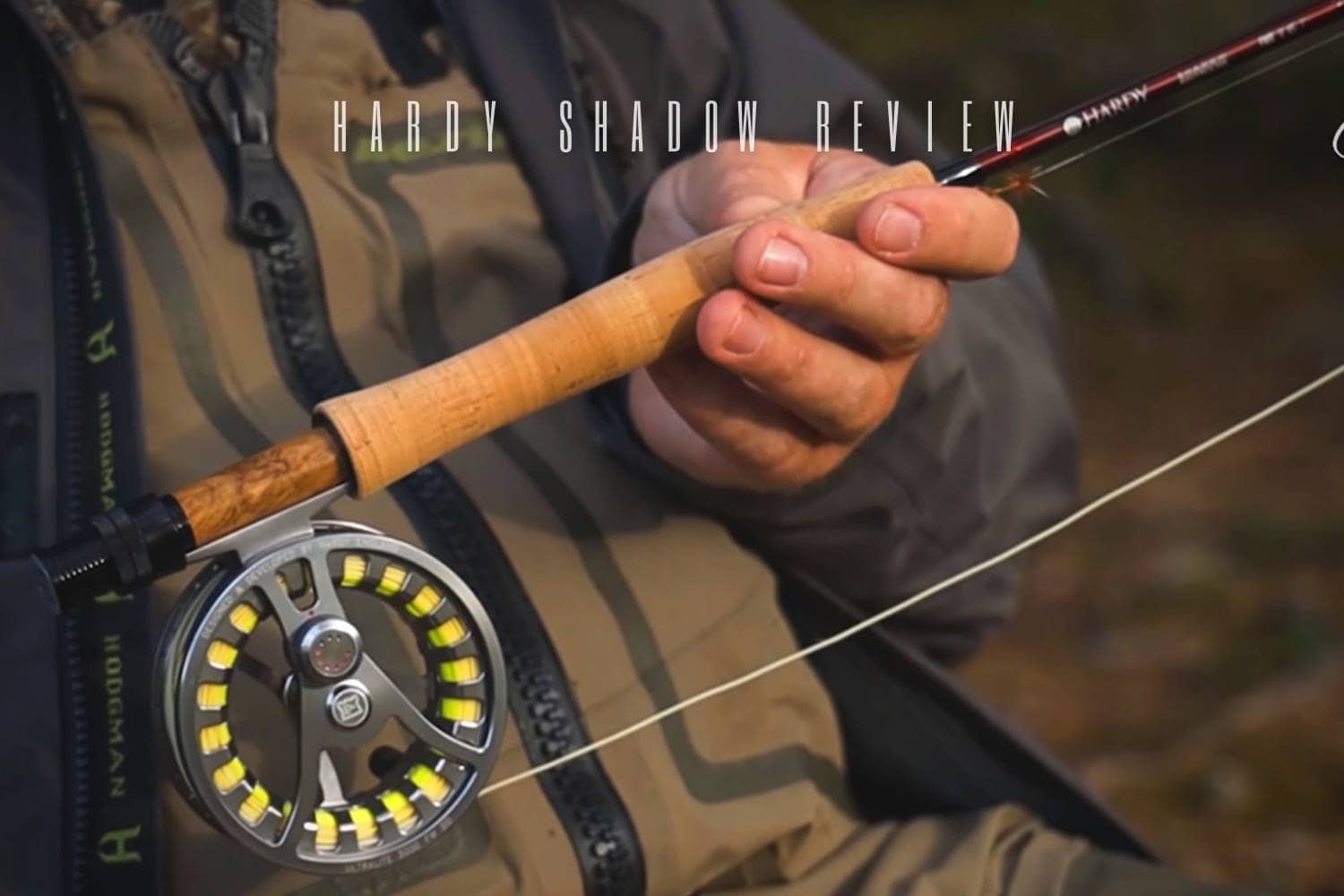
Short answer: A smooth mid-fast family designed around feel and accuracy inside ordinary fishing range. Shadow makes its case through smoothness. The reviewed Sintrix 220 generation bent enough to keep the cast legible, recovered quickly enough to hold a tidy loop, and felt light during repeated freshwater presentations. Its productive range was roughly 20 to 60 feet, where the soft tip could place a fly without demanding a severe stroke. Beyond that zone, effort rose and precision faded, revealing a rod built for normal fishing distances rather than distance contests.
Hardy Shadow at a glance
| Category | What applies here |
|---|---|
| Original Shadow family | The Sintrix 220 Shadow family included both single-hand and double-hand configurations. |
| Original Shadow span | Single-hand examples run from 4 through 9 weight; two-hand examples include 6/7 and 9/10 |
| Original Shadow action | Medium-fast or mid-fast |
| Original Shadow build | Sintrix 220 blank, 6061 aluminum seat, hard-chrome guides, cork grip, hard tube |
| Observed emphasis | Light feel, stable loops from roughly 20–60 feet, softer tip |
The specifications and handling guidance apply only to the deep-red or blue-grey Sintrix 220 Shadow generation. Confirm the hand format, length, and line designation, because the single-hand and double-hand rods perform fundamentally different jobs.
Casting character of this generation
The single-hand rod felt unusually light for its strength and was easy to cast through a long session. At 20 to 60 feet, the softer action revealed the stroke from butt to tip, making corrections easy to understand. Recovery was quick enough for stable loops and precise dry-fly placement. When the cast was pushed past that range, the soft top section demanded more effort and accuracy deteriorated. A highly forceful caster could perceive the rod as too yielding.
Shadow should be loaded within its freshwater center before distance is added. A relaxed cast at 20, 40, and 60 feet shows whether the Sintrix 220 tip feels communicative or too yielding.
Blank, grip and hardware
The Sintrix 220 Shadow used a 6061 aluminum reel seat, tough hard-chrome guides, cork grip, and a fitted hard tube. Hardy described nano-silica resin as part of the Sintrix 220 construction and linked it to reduced mass and increased strength; those figures are manufacturer claims, not independent measurements. The red and blue-grey finishes distinguish examples visually, while the hardware keeps a practical, understated profile.
The aluminum seat, hard-chrome guides, colored finish, and fitted tube define the original Shadow package. Tip damage, ferrule wear, or moisture around the cork can prevent a surviving Shadow from matching that design.
Where the rod makes sense
Light single-hand versions fit dry-fly trout work and ordinary river presentations. Middle weights can address nymphs, lake fishing, and larger streamers when their exact configuration agrees. Heavier single-hand rods and the two-hand branch answer different fish and casting systems. The shared benefit is readable loading, but the technique changes with length and line. A soft 4-weight should never be selected for a job merely because a heavy Shadow appears in the same family list.
Ordinary river range favors the single-hand rod's smooth action. Line taper, fly resistance, caster speed, and whether the model is single- or double-hand decide which Shadow observations are relevant.
Tradeoffs that define the design
The rod’s softness is both the attraction and the boundary. It supports learning and delicate delivery, yet it loses composure as line carry grows. A caster accustomed to a very stiff, high-speed taper may have to slow down or may simply prefer another design. An overweight line can further diminish recovery, so adding mass to force early loading is not automatically helpful. The double-hand models should not be judged by the single-hand distance limitation stated here.
Softness creates both delicate placement and reduced authority at long carry. That is the central exchange to accept or reject, while the two-hand branch remains outside the single-hand distance judgment.
A practical choice test
Use a line close to the stated designation and a taper appropriate to the technique. Cast the single-hand rod at 25, 45, and 60 feet, watching whether loop shape remains stable with a relaxed stroke. Then try the actual fly and leader. The correct match should feel communicative without becoming vague. If the caster repeatedly overdrives the tip or normally fishes beyond the rod’s comfortable band, a firmer blank will provide a cleaner relationship.
Document color, length, hand format, and printed line designation before comparing Shadow accounts. The family list is broad enough that a visually similar example may perform a fundamentally different task.
Setup and condition check
A previously used Shadow should be examined along the slim tip, all guide wraps, the aluminum seat, cork, and every ferrule edge. Confirm whether the rod is single-hand or two-hand and read the printed line designation directly. Do not infer identity from color or tube. Keep joints clean, assemble without twisting, and check that the reel foot seats fully. After fishing, dry the rod outside the hard tube; trapped moisture can mark cork and hardware even when the blank itself remains sound.
- Verify the Sintrix 220 Shadow identity and printed configuration on the blank itself.
- Seat and inspect every joint on this Sintrix 220 Shadow before applying a full casting load.
- Balance the Sintrix 220 Shadow with the reel, line, leader, and fly intended for its actual job.
- Separate later Hardy namesakes and two-hand accounts from conclusions about this exact Sintrix 220 Shadow setup.
Verdict on the original-generation Hardy Shadow
The original-generation Hardy Shadow is an appealing choice for anglers who prioritize touch, low hand load, and accurate short-to-middle-distance casting. Its soft mid-fast character communicates well and protects presentation, while its declining long-range precision keeps expectations realistic. The broad family serves many roles only through different configurations. This conclusion belongs to the Sintrix 220 generation and matching setup, not to a successor Shadow or another Hardy rod with a similar purpose.

I just picked up the 864 used. I went out last weekend and fished a gang of wets on a local tailwater. I threw on a SA GPX 4wt line (130gr) which was a mistake – especially fishing bigger water. I think this was two parts: 1) wrong taper and 2) too heavy.
On Sunday I went out in the yard and messed around with some lines and found the Cortland Spring Creek 3wt (100gr) felt the best for mid-range casts which is where most of my fish are caught. I thought maybe a 110gr line would be best so I threw on a 3-wt SA Sharkskin Trout line but found that the Cortland just felt crisper when casting.
What’s the takeaway? Well, I’m still new to the rod, but I would probably recommend going a line up if you’re considering one of the Shadows. Also, I would consider either a double taper of ‘finesse’ style line. I’ll probably order the Cortland Spring Creek 4wt line just to convince myself that the 100gr is actually the best line for the rod. I’m kind of addicted to the 8′ tip on these lines.
Beyond that, it is an absolutely awesome rod. It is very accurate, has top-notch hardware, the cork is perfect (has give, but isn’t soft), and, most importantly, the rod fishes well. It handles line-on-water really well with responsive mending and pick up power. Also, the rod felt very light in hand and the grip was very comfortable.
Thanks for the review on a rod that is no longer made. I think the new Hardy Aydon is supposed to be replacing the Shadow as an ‘entry level’ Hardy. I guess we’ll have to go check that out now.