
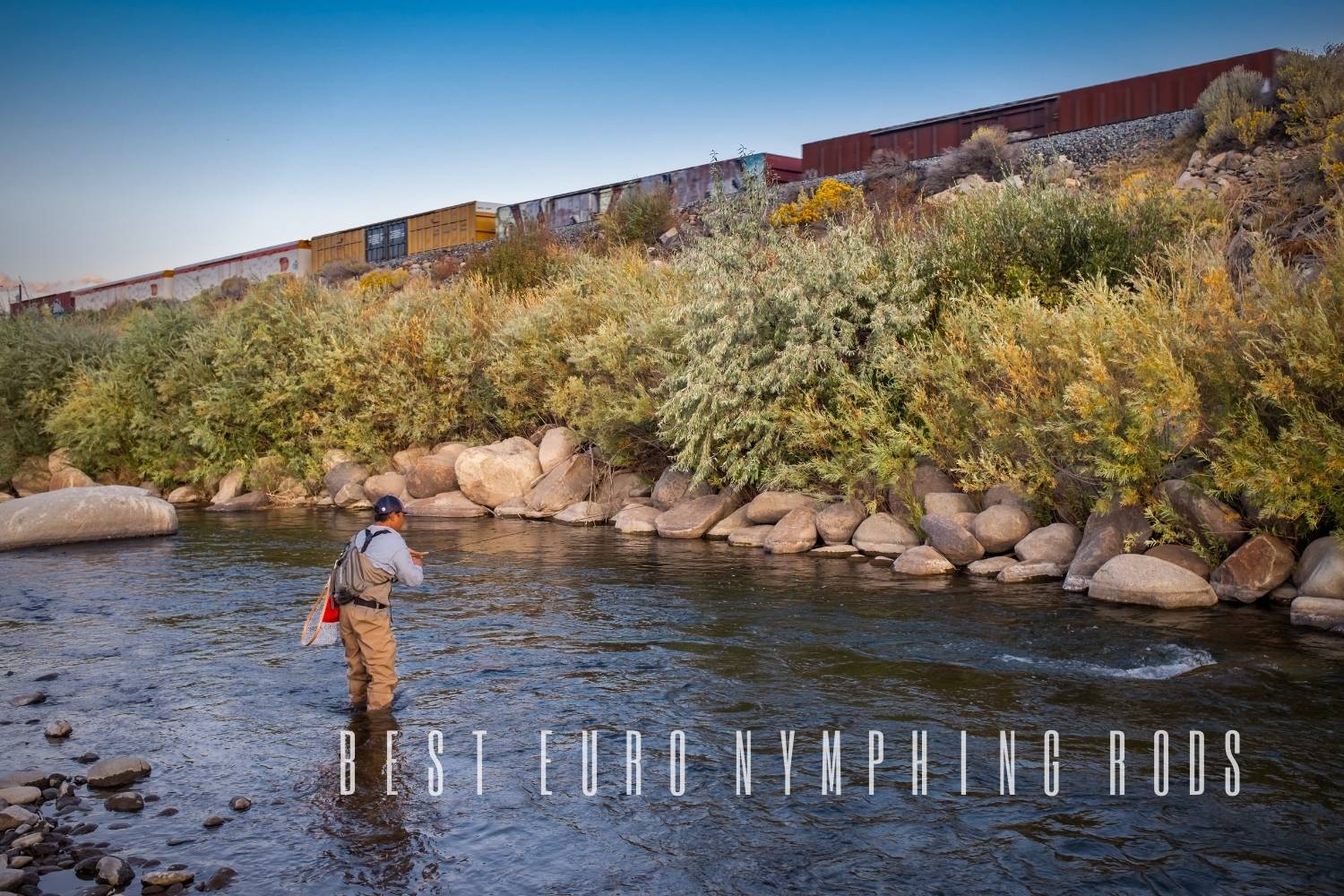
Euro nymphing puts a rod in an unusual working position: extended, elevated, and responsible for maintaining contact with flies that may be little more than leader length away. That changes the buying order. Reach and balance come first, tip behavior follows, and conventional distance-casting sparkle belongs much farther down the list. A sensible shortlist begins with the river width and rig you actually use.
Why a specialist nymphing rod feels different
Tight-line methods aim to keep unnecessary fly line off the water and preserve direct contact through the leader. Extra rod length helps place the rig, follow a seam, and reduce drag from line lying across conflicting currents. A sensitive upper section can communicate light contact, while enough support lower in the blank helps move the rig and control a hooked fish. Those tasks must coexist; a soft tip attached to an exhausting lever is not a complete solution.
The reel seat, grip, and butt shape affect fatigue because the rod spends long periods held away from the body. A fighting butt may offer a useful forearm reference for some anglers, while a down-locking seat can shift mass toward the hand. Neither detail guarantees balance. Mount the reel and leader system you intend to use, extend the rod as if tracking a drift, and notice whether your wrist is constantly resisting a forward pull.
Line weight is a job choice, not a score. A lighter configuration can feel responsive on small creeks and modest fish. A three-weight is a broadly useful middle ground in the article’s technique discussion. A four-weight adds support for larger water, wind, or a secondary dry-dropper role. Local rules and competition restrictions can change, so confirm the requirements that apply where and how you fish rather than treating old rule summaries as permanent.
Build the shortlist around river scale
| Water and rig | Feature to prioritize | Trade-off to test | Article-era examples |
|---|---|---|---|
| Compact creek | Controlled reach and a responsive light-line tip | Too much length can catch cover and feel cumbersome | Sage ESN ten-foot; Maxcatch Nymph Rod ten-foot |
| Typical medium river | Balanced ten-foot three-weight geometry | Sensitivity must not become tip collapse under the normal rig | Orvis Clearwater ten-foot; Sage ESN ten-foot |
| Broad current or added reach | A longer blank with low perceived swing weight | Reach can increase wrist load and reduce close-cover agility | Vision Nymphmaniac eleven-foot; Thomas & Thomas Contact II |
| Nymphing plus occasional conventional casts | More support through the middle and lower blank | Added power may reduce light-rig delicacy | G. Loomis NRX+ four-weight; Echo Carbon XL ten-foot |
Use the table as a set of casting questions rather than a ranking. Can the rod lead a light rig without bouncing? Does it recover cleanly after a tuck or lob? Can it protect fine tippet when the fish changes direction? Most importantly, can you hold it in the working position for several drifts without creeping tension in the wrist and shoulder?
What the article-era models teach
Sage ESN ten-foot
The article-era Sage ESN was described as a medium-paced specialist in light line weights, illustrating a dedicated nymphing layout. That is historical product context, not proof of a current catalog entry or a newly tested generation. Its useful buying lesson is that recovery, shock absorption, and hand feel must be judged together rather than inferred from a premium label.
Thomas & Thomas Contact II
The article-era Contact II section emphasized altered guide spacing, a balancing butt, and a combination of fibers. Those construction details should not be projected onto another generation. The enduring point is simpler: inspect where the stripping guide sits, watch for line wrapping during real leader handling, and test the balance with the reel you own.
Vision Nymphmaniac eleven-foot three-weight
This historical example represented the long-reach specialist. Its section connected a light blank, sensitive tip, damped recovery, and an added butt with sustained contact fishing. For a buyer, that cluster of features matters only if the longer lever remains calm and comfortable in hand. An eleven-foot label by itself does not prove better drift control.
Moonshine The Epiphany ten-foot-six
The article-era Epiphany illustrated an intermediate length and mentioned two tip sections in that version. Treat that as generation-bound context. If spare components matter, inspect what is included with the exact rod being considered rather than assuming an old package carries forward.
Perform a contact-fishing test
- Assemble the rod with the actual reel, leader, and sighter arrangement.
- Hold the tip over an imaginary seam for repeated thirty-second drifts.
- Lead a light rig, then a heavier everyday rig, and watch for unwanted tip oscillation.
- Simulate a short tuck, a bow-and-arrow delivery, a roll pickup, and a controlled change of direction.
- Check whether the grip and butt create pressure points when the forearm is extended.
- Pack the rod exactly as you would for the walk in; long specialist rods still need practical transport.
Maintenance is uncomplicated but specific care still belongs to the manufacturer of the exact rod. Keep ferrules free of grit, protect the fine tip during rigging, and avoid leaning an assembled rod where a door, boot, or pack can trap it. When comparing service policies, verify eligibility, fees, and replacement arrangements at the time of purchase.
The winning rod is the quietest partner in the drift
A Euro nymphing rod succeeds when reach, balance, and tip response preserve contact without making the angler wrestle the tool. Choose river scale before brand, working comfort before catalog language, and a controllable bend before abstract speed. Historical models help define the possibilities, but only a full-outfit test reveals whether the rod follows a seam naturally in your hand. The best outcome is not the longest rod; it is the shortest path between a subtle change in the drift and a controlled response.

How to find best nymph combo?