
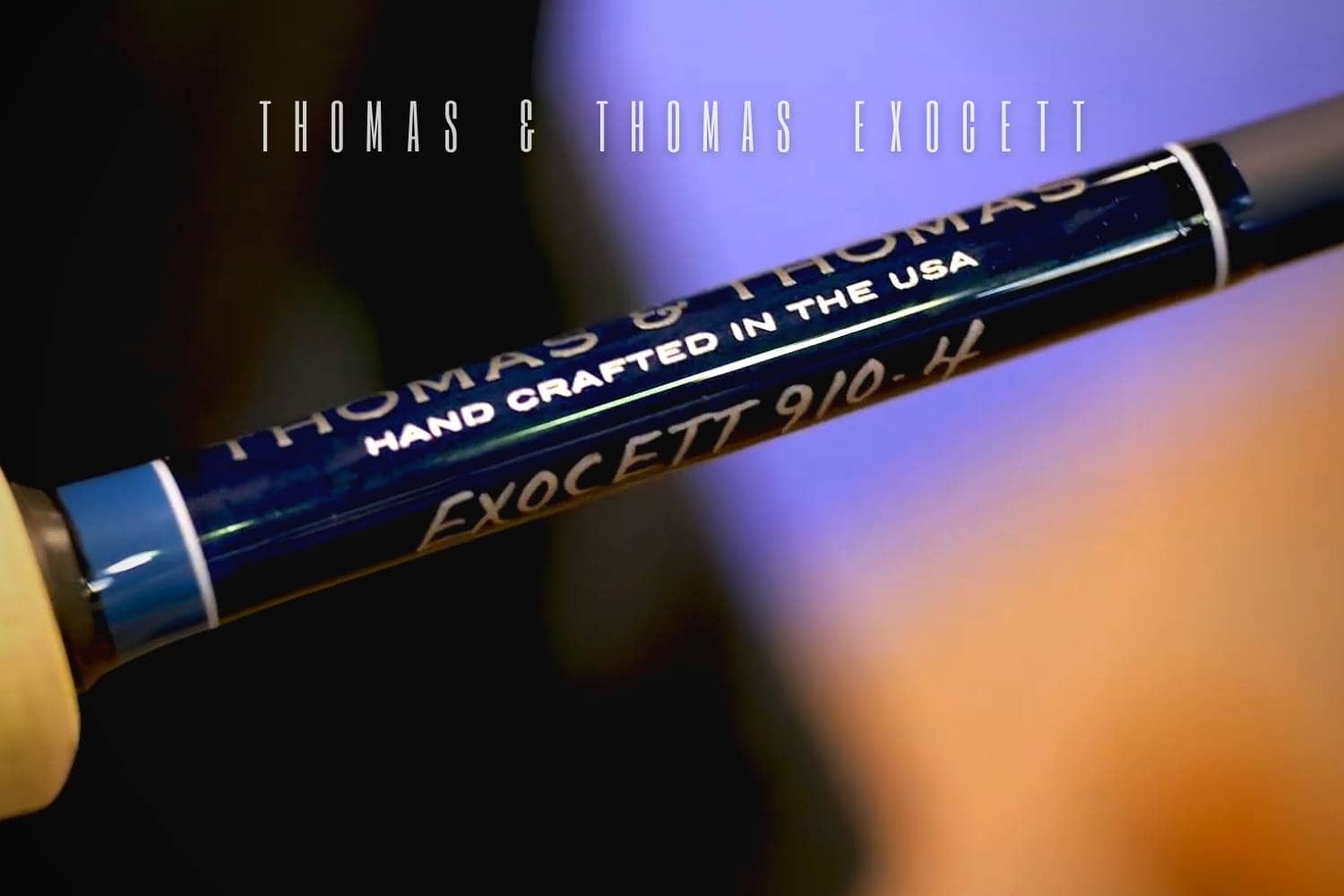
Short answer: A quick, low-swing salt rod built for rapid shots, wind and powerful fish. Exocett is a shot-making rod. The reviewed matte-blue generation was used for years in Seychelles, where wind, powerful fish, and sudden opportunities expose weak recovery quickly. Its low swing load, thin top section, and fast lower blank made it efficient to pick up line, redirect, and send a tight loop toward a moving target. That performance assumes an experienced stroke and careful handling; the same slender tip that helps the cast is not permission to treat the rod roughly.
Thomas & Thomas Exocett at a glance
| Category | What applies here |
|---|---|
| Original Exocett range | 6–12 line weights in the original matte-blue Exocett family. |
| Original Exocett action | Fast |
| Original Exocett build | Four-section graphite/StratoTherm blank, titanium stripping guides, anodized aluminum seat |
| Original Exocett fittings | Full-wells cork, fighting butt, hook keeper and aluminum tube |
| Observed emphasis | Low swing load, long-range accuracy, quick pickup and recast; delicate top section |
The specifications and first-hand observations apply only to the original matte-blue Exocett saltwater generation used in Seychelles. Match the printed line weight and heavy-salt configuration before relying on its pickup, redirection, and long-range behavior.
Casting character of this generation
During repeated flats use, the rod remained a delight to cast because low swing weight reduced effort and the fast blank recovered cleanly. Accuracy stayed convincing beyond 60 feet when the caster supplied the skill. The rod could pick up about 40 feet of line and redirect efficiently for another permit or trevally shot. A medium stroke generated useful line speed. The thin top section required restraint, however; aggressive knocks or careless high-sticking created an avoidable breakage concern.
Exocett must be tested as a saltwater shot tool: pick up managed line, redirect once, and deliver into a safe target lane. That sequence exposes recovery and timing better than repeated empty distance casts.
Blank, grip and hardware
The original matte-blue Exocett combined a graphite/StratoTherm blank with titanium stripping guides, single-foot and snake guides, an anodized aluminum reel seat, premium cork, a hook keeper, fighting butt, and aluminum tube. The matte-blue finish is subdued on bright flats. Each component reduces unnecessary mass or supports salt use. These design claims explain the intended role, but condition still matters: corrosion, guide damage, or an injured tip can erase the advantages of premium materials.
StratoTherm construction and titanium hardware describe the original matte-blue rod. A nicked top section, corroded frame, or rough ferrule can erase the low-swing advantage on a heavily traveled example.
Where the rod makes sense
The Exocett suits an angler who must deliver quickly to permit, tarpon, trevally, or another demanding target with a configuration chosen for that species and fly. A weight-forward salt line can help the rod load and turn over a resistant pattern. The rod’s fast recovery supports tight loops in wind, while the fighting butt provides leverage after hookup. It is less appropriate for a novice who is still learning to feel line position and may overpower a quick blank.
Flats wind and moving targets justify this rod's speed. Fly air resistance, line choice, species load, casting skill, and line management decide which exact Exocett weight can make the required shot.
Tradeoffs that define the design
Speed is the principal filter. A beginner can struggle to find the timing window, and an aggressive caster may punish the delicate upper section. The rod also cannot make a 90-foot presentation accurate without technique; line management, wind reading, and a sound double haul remain necessary. Saltwater family breadth should not blur load limits. A permit-oriented setup and a 12-weight chosen for very large fish are related, not interchangeable.
The thin upper section enables quick recovery while demanding careful treatment. Fast timing may challenge a beginner, and neither premium components nor reputation removes the need for disciplined technique.
A practical choice test
Evaluate the exact rod with the fly and line intended for the trip. Practice a 40-foot pickup, one directional change, and a delivery at realistic range. Notice whether the blank forms speed with a medium stroke or tempts the caster to hit harder. Then rehearse line control at the feet, because fast recovery is wasted when loose line tangles. The Exocett is compelling when the user already has a stable stroke and values reduced fatigue over a week of repeated shots.
Photograph the matte-blue finish, original Exocett name, line weight, and section markings before accepting field comparisons. Surf, SS, and later branches must be checked separately despite related branding.
Setup and condition check
Inspect any used Exocett under bright light. Pay particular attention to the thin tip, ferrule mouths, titanium guide frames, wrap edges, fighting butt, and seat threads. Verify the matte-blue generation and line designation printed on the blank. After each salt day, rinse the rod and reel-seat exterior with gentle fresh water, dry sections separately, and only then return them to the aluminum tube. Never lift a heavy fish with the tip elevated; use the butt and fighting angle the rod was designed to provide.
- Verify the original matte-blue Exocett identity and printed configuration on the blank itself.
- Seat and inspect every joint on this original matte-blue Exocett before applying a full casting load.
- Balance the original matte-blue Exocett with the reel, line, leader, and fly intended for its actual job.
- Evaluate SS, Surf, and newer Exocett branches independently of this original matte-blue heavy-salt configuration.
Verdict on the original-generation Thomas & Thomas Exocett
The original Exocett earns its reputation as a serious saltwater tool through efficient recovery, low swing load, and repeatable accuracy in difficult conditions. First-hand Seychelles use supports its rapid pickup and recast, while the slender tip and fast timing set honest limits. It is most valuable to a skilled angler who can supply technique without abuse. Those observations stop at the matte-blue generation and exact heavy configuration; no sibling or successor receives them by association.
