
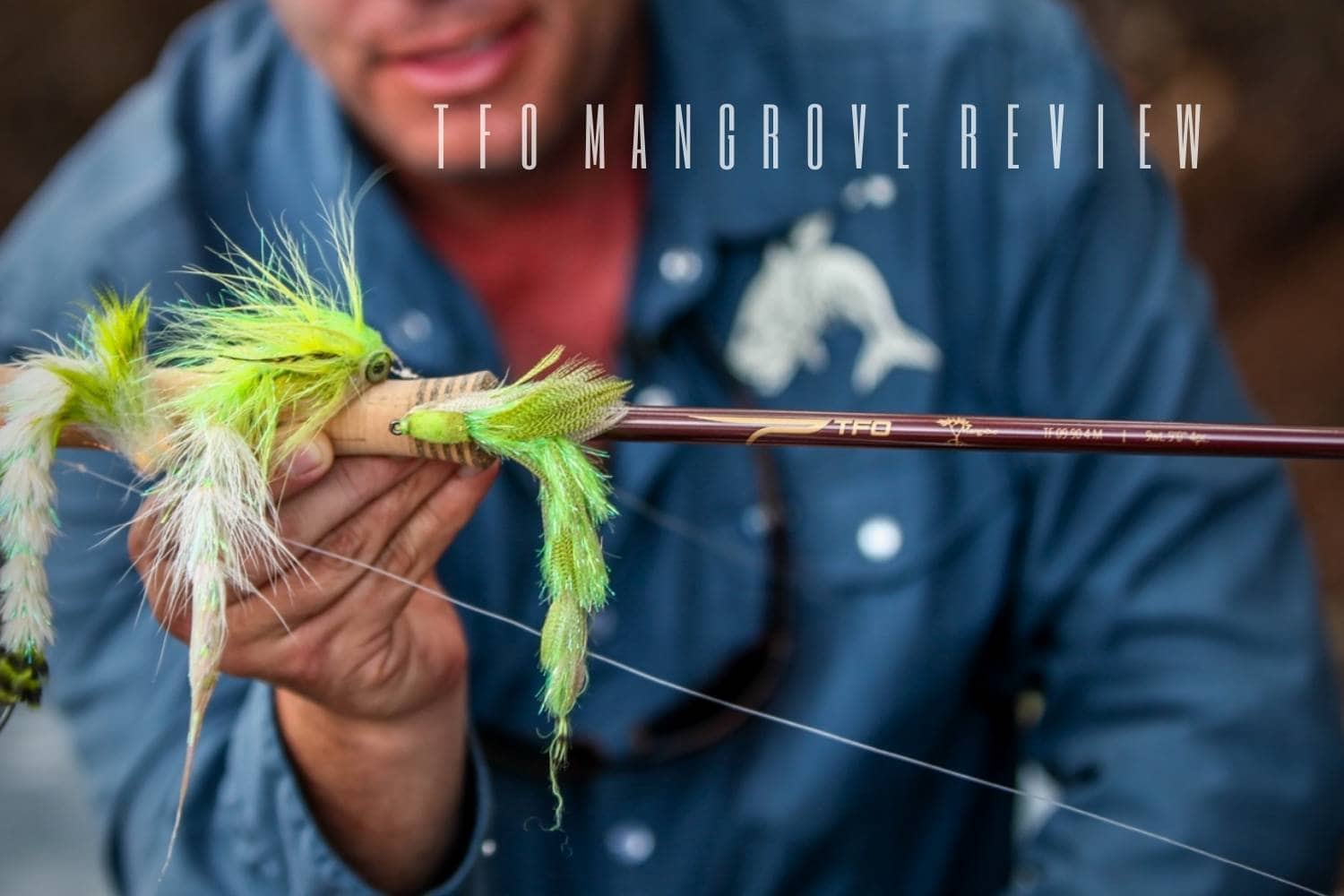
Short answer: A powerful shoreline rod softened enough to communicate the line during repeated casts. Mangrove was shaped around fishing casts rather than a tournament stroke. The reviewed chestnut rod had the backbone to turn over substantial flies, yet its tip was soft enough to let the caster feel the line move. That combination is useful along shorelines, where a shot may require quick pickup, direction change, and another delivery without a full false-casting routine. Power is present, but it arrives through a progressive, readable blank instead of a rigid club.
TFO Mangrove at a glance
| Category | What applies here |
|---|---|
| Original Mangrove range | 5–12 line weights across freshwater and salt-oriented roles |
| Original Mangrove length | 9 feet |
| Original Mangrove action | Described inconsistently as moderate-fast and fast. |
| Original Mangrove build | Four sections, TiCr blank coating, tactical guides, milled aluminum double-uplocking seat |
| Observed emphasis | Strong midsection, softer tip, lighter-than-expected hand feel |
The specifications and casting observations apply only to the chestnut Mangrove series associated with Flip Pallot. Match the exact line weight, grip form, and model inscription, because the family spans very different freshwater and saltwater jobs.
Casting character of this generation
The evaluated character combined a firm midsection with a softer-than-expected tip. It could carry line and turn over larger patterns without producing the dead sensation common to very stiff rods. The line remained perceptible as it traveled through the cast, making the timing accessible even to a developing caster. Hand feel was lighter than the reserve suggested, which reduced fatigue during repetition. The full-wells grip and fighting butt supported a secure hold when the load increased.
Mangrove should be tried through quick fishing sequences: pick up, change direction, and deliver a resistant fly. That exercise exposes whether the soft tip and strong middle cooperate for the caster's tempo.
Blank, grip and hardware
The original Mangrove used a TiCr protective blank coating, tactical stripping and snake guides, AAA-grade cork, and a corrosion-resistant milled aluminum reel seat with two uplocking rings. The smallest listed model used a reverse half-wells grip, while heavier rods used full wells. The appearance is functional rather than ornate. The absence of an included protective tube in the original package is notable because a powerful rod still needs impact protection during travel.
TiCr coating, tactical guides, and double-uplocking hardware identify the original Mangrove. Deep blank strikes, grooved guides, or salt-bound rings can compromise an older rod despite its intentionally rugged specification.
Where the rod makes sense
The 5-weight version was framed for backcountry trout or bass, while heavier members addressed progressively larger freshwater and coastal species. In every case, the line and fly must remain proportionate. The softer tip helps a caster form a fishing loop and adjust direction, while the middle and butt provide turnover and fish control. This makes the family compelling for banks, mangrove edges, and situations where a quick, usable shot matters more than carrying an entire line in the air.
Shoreline shots reward this balance of feel and reserve. Fly profile, line mass, wind angle, target power, and grip shape determine which member of the wide 5-to-12-weight family belongs there.
Tradeoffs that define the design
The original Mangrove carried both moderate-fast and fast action descriptions. Cast and identify the exact rod rather than relying on either label. Hardware is intentionally robust and may not appeal to someone seeking a delicate trout aesthetic. A separate tube is also necessary for secure transport. Most importantly, family breadth can invite overstatement: owning a Mangrove does not make every configuration suitable for every large fish, and the lighter rod should never be assigned the fighting work of the 12-weight.
Mixed fast and moderate-fast labels reflect a taper with genuine strength and a communicative tip. That apparent contradiction should prompt a cast of the exact model instead of a forced family-wide verdict.
A practical choice test
Select by fly resistance first, line weight second, and target fish third. Cast the exact configuration with the intended line and make several pickup-and-redirection shots rather than only straight overhead loops. The right match should let the tip communicate without collapsing and should let the lower blank turn the fly without a violent stroke. Check grip shape as well; the reverse half wells on the light rod and the full wells on heavier versions distribute hand pressure differently.
Record the chestnut finish, grip form, line weight, and model inscription before comparing Mangroves. The light reverse-half-wells rod and heavy full-wells versions share a philosophy, not one transferable experience.
Setup and condition check
Before using an older Mangrove, inspect the coating for deep strikes, every tactical guide for grooves, the fighting butt for looseness, and both locking rings for smooth travel. Verify that the cork shape matches the model designation. Carry the rod in a correctly sized rigid tube even if the original package omitted one. After coastal use, rinse guides and seat gently with fresh water, dry the sections apart, and clean the ferrules before reassembly. Salt crystals under a ring can damage otherwise robust hardware.
- Verify the chestnut Mangrove identity and printed configuration on the blank itself.
- Seat and inspect every joint on this chestnut Mangrove before applying a full casting load.
- Balance the chestnut Mangrove with the reel, line, leader, and fly intended for its actual job.
- Cast later Mangrove namesakes and neighboring TFO rods independently of this chestnut Flip Pallot-associated generation.
Verdict on the original-generation TFO Mangrove
The original-generation TFO Mangrove is persuasive as a practical power rod with genuine feedback. Its firm middle turns over demanding flies, while the softer tip makes a shoreline cast easier to organize and repeat. Utilitarian components, mixed action wording, and family-wide variation require a careful configuration check. Respect those boundaries and the design makes sense. Do not transfer its observed balance or handling to a later Mangrove or a neighboring TFO series without a separate cast.
