
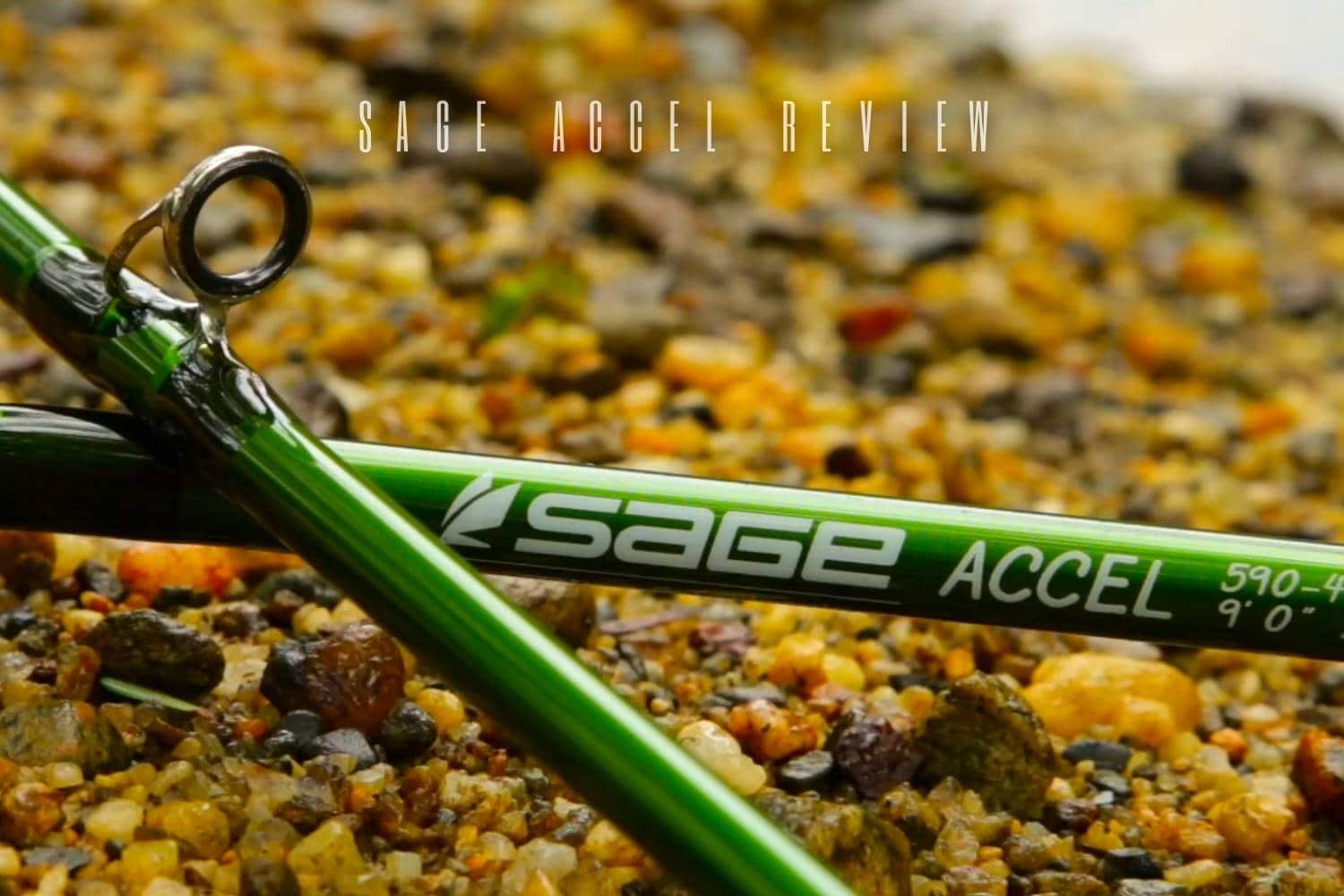
Short answer: A medium-fast trout rod centered on short-range feedback and tight controlled loops. Accel is a rhythm rod. The emerald blank does not ask for the sharpest possible stroke; it rewards a caster who lets the medium-fast taper load and then stops cleanly. In its strongest trout range, the reviewed rod formed tight loops, transmitted useful feedback, and placed a fly precisely at short distance. It had enough reserve to extend farther, but the reason to choose it is control and sensation on smaller water rather than a promise of effortless reach.
Sage Accel at a glance
| Category | What applies here |
|---|---|
| Original Accel family | The Accel family included freshwater, salt-oriented, switch and two-handed configurations |
| Original Accel core range | Core single-hand configurations covered 4–7 line weights and 8 feet 6 inches to 9 feet. |
| Original Accel action | Medium-fast, with some users perceiving a more moderate bend |
| Original Accel build | Generation 5 graphite construction, Fuji ceramic stripper, hard-chromed guides, four sections |
| Observed emphasis | Light feel, distinct loading, accuracy inside roughly 40 feet |
The specifications and casting observations apply only to the emerald Generation 5 Accel. Confirm the single-hand configuration and printed line designation before expecting the same blend of moderate action, accuracy, and reserve.
Casting character of this generation
The tested trout character was light and responsive, with loading easy to detect around 30 to 40 feet. The rod produced tidy loops without demanding an aggressive acceleration. A softer tip helped dry-fly delivery and supplied feel, while nymphs and small streamers remained manageable. Beyond the rod’s comfortable middle, it could send more line, but accuracy declined as the cast approached 60 or 70 feet. Wind made that limitation more apparent.
Accel reveals itself through tempo. Cast it with enough line to feel the Generation 5 blank load, but stop before a distance exercise overwhelms the short-range precision that defines the reviewed trout configuration.
Blank, grip and hardware
The emerald Generation 5 Accel used a narrow graphite shaft, axial-fiber material, an anodized uplocking seat, a wood insert, a ceramic stripping guide, and hard-chromed snakes and tip-top. The bright green finish with darker wraps is distinctive. Component quality was generally strong, although the evaluated reel seat felt less refined than the rest of the rod. That mismatch is worth checking on any older example because seat security affects balance and confidence even when the blank remains sound.
The emerald finish, wood insert, ceramic stripper, and hard-chromed guides identify the original Accel construction. Reel-seat security and tip condition still determine whether a surviving Accel can retain its intended response.
Where the rod makes sense
The Accel’s clearest assignment is a trout river where most presentations happen under 40 feet. Dry flies suit its soft tip and measured turnover; lighter nymphs and modest streamers broaden the day without overwhelming it. It is less convincing on a broad, windy reach where a stiff lower blank and faster recovery would reduce effort. A caster with a naturally patient tempo is more likely to enjoy it than someone who drives every rod with a short, forceful stroke.
Smaller water gives this rod's softer tip room to work. Wind, fly bulk, casting pace, and expected range determine whether its measured recovery feels precise or merely short of power.
Tradeoffs that define the design
Versatility is not the Accel’s primary virtue. Its line speed and directional control fade when distance and wind become the governing problems. Some anglers also interpret its action as moderate rather than medium-fast, so the label should not replace a cast. The softer response may feel alive to one hand and slow to another. That disagreement is a useful warning: this is a rod to cast with a normal fishing line before deciding, especially if the user prefers very fast Sage tapers.
Reduced long-range authority follows from the same responsive bend that makes a 30-foot load obvious. The Accel is most honest when that exchange is treated as deliberate character rather than a flaw to overpower.
A practical choice test
Match the rod to a real trout session. Make several casts with only a dry, then add a compact nymph or streamer and watch when the tip begins to lose composure. Compare 25, 40, and 55 feet instead of chasing the backing knot. If the Accel remains accurate where fishing actually happens and the load is obvious without excess effort, its specialized strengths are relevant. If most days demand wind penetration, the family’s central virtue becomes a handicap.
Note the emerald blank, exact designation, and single-hand format before consulting another Accel account. Specialty and two-hand branches carry the name but cannot substantiate this trout rod's handling.
Setup and condition check
An older Accel deserves a close look at the small stripping guide, snake feet, tip-top, emerald finish, reel-seat insert, and all ferrules. Confirm the printed configuration because family listings span several disciplines. Clean the joints before assembly and seat them with straight pressure. Fit a reel light enough to preserve the rod’s responsive balance. During a trial, listen for ferrule clicks and inspect the tip after any collision with a weighted fly; sensitivity depends on a slim section that should not be abused.
- Verify the emerald Accel identity and printed configuration on the blank itself.
- Seat and inspect every joint on this emerald Accel before applying a full casting load.
- Balance the emerald Accel with the reel, line, leader, and fly intended for its actual job.
- Keep VXP and specialty-branch impressions separate from conclusions about this emerald single-hand Accel configuration.
Verdict on the original-generation Sage Accel
The Generation 5 Accel is at its best when accuracy, feel, and compact trout casts outweigh the desire for maximum power. Its medium-fast rhythm and softer tip make short presentations satisfying, while the loss of authority at longer range keeps the verdict honest. It is neither a universal Sage nor a blank to buy solely for the green finish. Keep every observation with this emerald generation and the equivalent single-hand setup; other Accel branches need their own casting check.
