
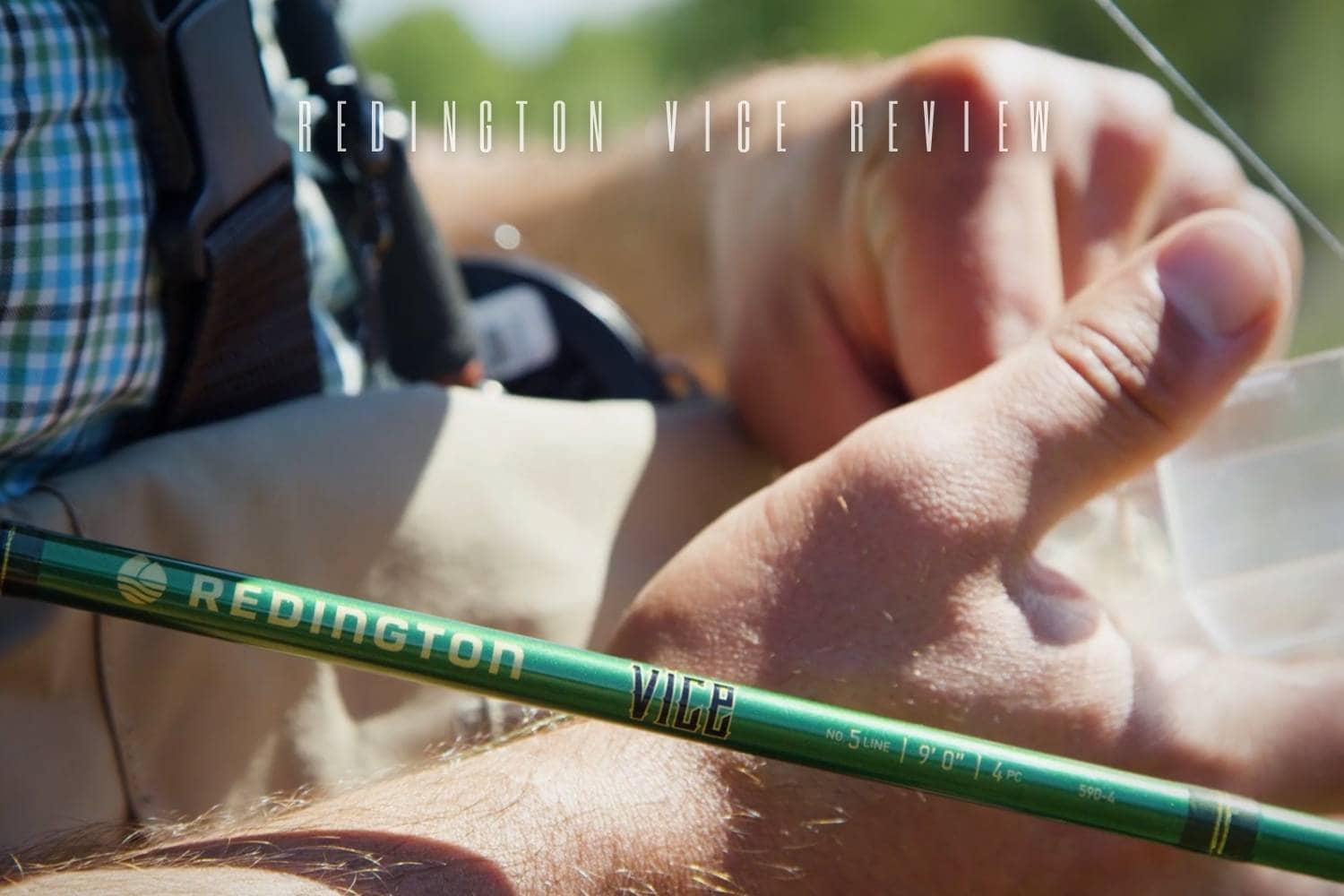
In brief: Redington Vice sits at the point where a caster begins to manage speed rather than merely tolerate it. The earlier-generation family rewards a developed stroke around its middle distance, but close delicacy is not its strongest argument.
Earlier-generation Vice at a glance
- Casting response
- The Vice began to feel settled around forty-five feet, where its fast blank produced tight, useful loops. Beyond the practical mid-range window, accuracy declined before raw power became genuinely useful.
- Earlier-generation components
- A multi-modulus blank, anodized aluminum reel seat, chrome stripping guides, snake guides, cork grip, and Cordura tube; the earlier-generation family ran from a short 3-weight through heavier configurations up to a 9-weight.
- Best fit
- Redington Vice is best considered for an improving caster who wants fast action and mid-distance power without moving into a highly specialized rod, especially on small and medium rivers, lakes, bass water, and occasional exposed conditions.
Where the cast settles
With Redington Vice, the practical casting window matters more than headline distance. The Vice began to feel settled around forty-five feet, where its fast blank produced tight, useful loops. Redington Vice therefore rewards a measured comparison at the range used most often. Short casts reveal feel; middle casts reveal tracking; longer casts reveal how much control remains.
Power without pretending
The useful power of Redington Vice appears in controlled line speed rather than brute force. The blank drove larger bass flies with less collapse than a soft trout rod would invite. This character supports larger flies within the earlier-generation rod’s working range. It does not transform Redington Vice into a delicate spring-creek rod or an unlimited-distance cannon.
The progression question
Redington Vice suits an improving caster who wants fast action and mid-distance power without moving into a highly specialized rod. The blank gives developing timing a clear target without feeling as forgiving as a slow beginner rod. A new caster can use Redington Vice, but an improving caster is more likely to understand why its mid-range speed matters.
Components in context
The earlier-generation Redington Vice used a multi-modulus blank, anodized aluminum reel seat, chrome stripping guides, snake guides, cork grip, and Cordura tube. Condition matters more than the original component list: inspect every surviving part before use. Ferrules, guide feet, cork filler, and reel-seat threads should be inspected on any surviving Redington Vice.
The decision in practical terms
Vice works best for a caster moving beyond a soft beginner taper and learning to manage faster recovery. The earlier-generation Vice felt bulky at short range but came alive around forty-five feet, where the blank produced useful line speed and accuracy. That is a specific trade: the rod rewards timing and a developed stroke, yet offers less delicacy and immediate feedback close in. Its appeal is progression, not automatic improvement.
How to assess this exact rod
The quickest way to misunderstand a Vice is to test it only with very little line or with an unknown taper. Verify the model marking, examine every ferrule and green blank section, and make sure the guides are straight and secure. Check the full-wells grip for filler loss and the anodized seat for clean threads. Then cast the rod with a known line at three distances: a compact presentation, the earlier-generation rod’s forty-five-foot working area, and the longest cast you commonly need. Add one typical nymph or streamer rather than testing with bare leader alone. The middle comparison should reveal whether the rod’s fast recovery suits your timing.
Build the cast around the middle distance
The earlier-generation Vice handled dry flies, larger nymphs, and streamers for trout and bass, but its most credible performance came at mid-range. Try different suitable lines before judging the blank. A matching line can help the rod load without disguising its fast character; an ill-suited taper can make a capable Vice feel either lifeless or overloaded.
Choose the exact earlier-generation Redington Vice configuration by line weight, length, casting range, technique, water type, grip fit, balance, and overall condition
| Decision point | Earlier-generation performance | Reader use |
|---|---|---|
| Short range | The earlier-generation Vice could feel heavy or bulky close in. | Do not choose it mainly for delicate casts with little line outside the tip. |
| Middle range | Around forty-five feet, the earlier-generation Vice showed accuracy and faster line speed. | Compare it at that distance using the flies you actually carry. |
| Long reach | The earlier-generation Vice lost accuracy beyond its comfortable window. | Treat extreme distance as a separate requirement, not proof of versatility. |
Who should choose this Redington Vice
The earlier-generation Vice is most convincing as a progression rod for anglers ready to work with a quicker blank. It offers useful mid-range line speed and enough range to explore several methods, yet it can feel bulky close in and less controlled when pushed far outside its natural window. That is a coherent learning trade, not a universal recommendation. A later Vice or a different weight needs a fresh cast before receiving the same conclusion.
These casting traits belong to the earlier-generation Vice family covered here. A later Vice, another weight, or an adjacent fast Redington must establish its own load, balance, and working range.
