
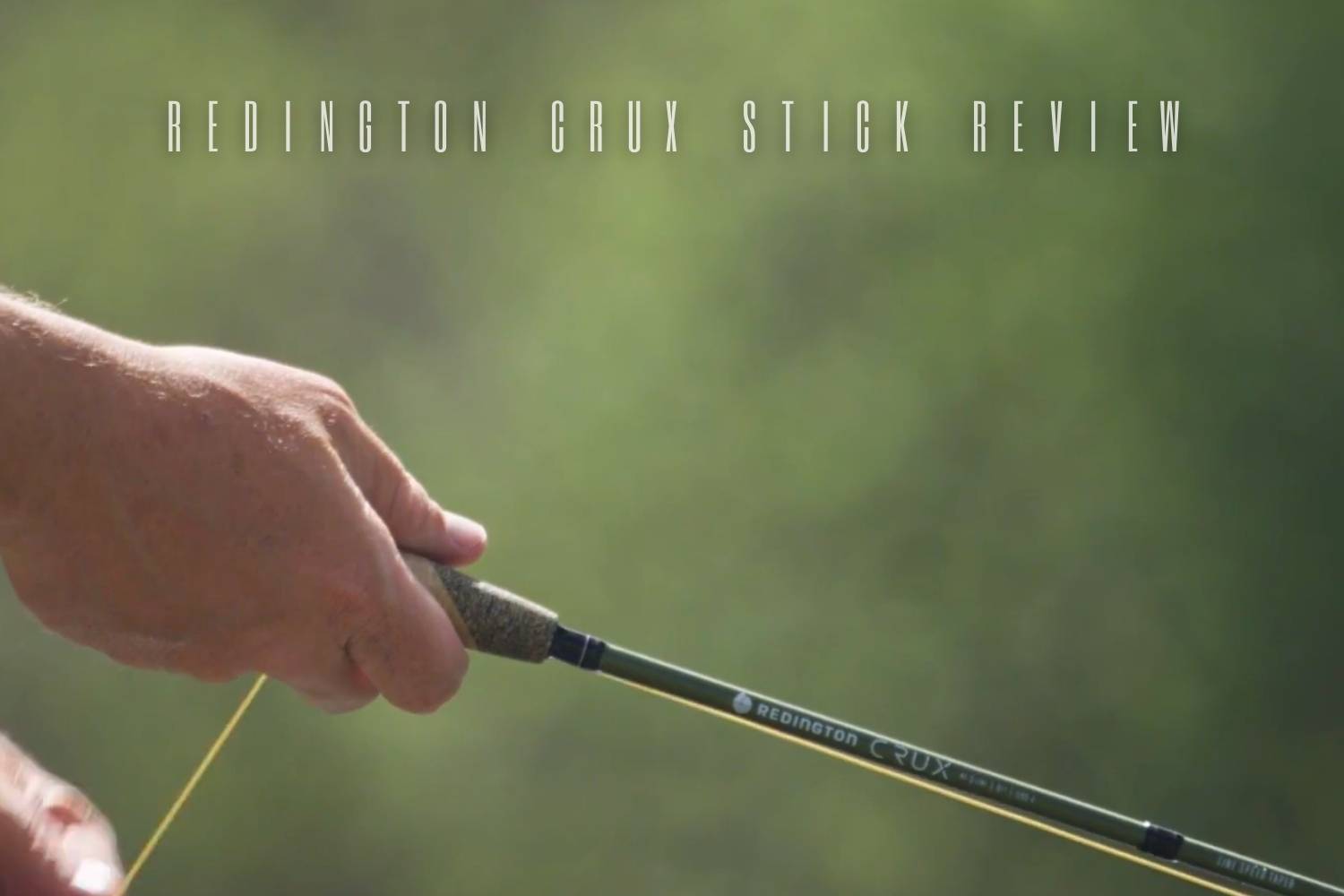
Redington Crux was presented as a fast, purposefully shaped family rather than one anonymous all-rounder. The earlier generation emphasized line speed, an angled key grip, and useful accuracy through common fishing ranges. Those ideas deserve a configuration-by-configuration reading, especially because the family stretched from light trout tools to much heavier rods.
One family, sharply different assignments
Earlier-generation Crux specifications ranged from a short light-line model through a nine-foot heavy configuration, with four sections, fast action, an anodized reel seat, stripping and snake guides, and a protective tube. That range is too broad for one casting verdict. A 3-weight on a compact stream cannot be assessed by the standards of a 10-weight carrying a large fly.
Read the label, determine the intended line, and ask what the rod must move. Trout dries, bass bugs, weighted streamers, and strong fish impose different loads. The Crux name tells you the family; the printed configuration tells you the job. If those two levels are blurred, praise for versatility quickly becomes misleading.
Rod details, hands-on limits, and buyer fit
- Hands-on scope
- Several Redington rods were tested, but the Crux impressions across distances are not tied to one exact marked configuration. They therefore cannot serve as universal hands-on results.
- Earlier-generation model details
- Fast action, Line Speed Taper, Angled Key Grip, four-piece construction, anodized reel-seat hardware, chrome guides, and a Cordura-style tube were tied to the Crux family then described.
- Buyer fit
- The most defensible Crux buyer is a caster who wants a quicker blank for a defined line-weight job and who can evaluate grip shape and swing feel before committing.
The angled grip is a fit question, not a slogan
The Angled Key Grip was central to this Crux generation. A shaped cork surface can influence wrist position and pressure, but no geometry is universally comfortable. Hand size, thumb placement, haul style, and the reel’s balance all affect whether that shape helps or distracts.
Mount the intended reel and make repeated casts rather than a single shop wiggle. Notice whether the heel of the hand stays relaxed, whether the thumb finds a natural position, and whether grip pressure increases as line length grows. A distinctive handle is valuable only when it supports your stroke. If it makes you squeeze, a conventional profile may be the better choice.
Line speed with an honest distance window
The earlier-generation Crux was associated with short-to-middle accuracy and enough stiffness to carry farther. It also contained tension between claims of broad distance ability and comments about greater effort or declining comfort at longer range. That tension should guide a practical test: do not choose from the longest cast mentioned; find the range where the rod remains accurate without forcing.
Start close, where less line exposes tip feedback. Move to normal fishing distance and watch loop shape. Only then add length. If the Crux tracks cleanly in the middle but asks for excessive force beyond it, that is a usable profile for many anglers. It does not show that every configuration excels at every distance or in every wind.
Static weight and swing feel are different
Earlier descriptions called Crux comparatively heavy in its class while also saying its balance could make it feel manageable. Both can be true. A scale measures total mass; the hand feels how that mass is distributed around the grip. Reel choice, line weight, and the length of the rod change the result.
Hold the assembled setup at fishing angle, make mends, and repeat pickups. Fatigue often appears in those motions before it appears in an overhead cast. A rod that balances pleasantly for ten minutes may still become tiring through a full session. Conversely, a slightly heavier blank may feel settled and track well when paired intelligently.
Inspect the working parts
Earlier-generation Crux construction included an anodized reel seat, cork grip, stripping guides, snake guides, four sections, and a protective tube. On an older example, examine the grip where its angles meet, because filler loss or compression can change comfort. Check reel-seat threads for grit and damage, and inspect guide feet for cracks hidden beneath wraps.
Ferrules must seat evenly and remain secure after casting. Sight down the blank for twist or impact marks. A hard case protects against travel damage only if all sections fit properly and the interior has not trapped grit. Condition should carry more weight than cosmetic finish or broad claims about brand craftsmanship.
Crux selection table
| Decision | Earlier-generation indication | Practical test |
|---|---|---|
| Line-weight job | Family extended from light trout to heavy configurations | Confirm model code and cast the actual fly class |
| Grip comfort | Angled Key Grip shaped hand position | Repeat casts and mends with the intended reel |
| Distance | Fast character and line-speed emphasis | Find the accurate range before adding force |
| Condition | Four-piece rod with protective tube | Inspect ferrules, blank, guides, cork, and hardware |
Who gets the clearest benefit
A practiced caster with a defined need for speed is more likely to appreciate Crux than someone buying solely from a family reputation. The lighter side may suit focused trout or panfish work; larger versions can address bigger flies and stronger fish. Each step up changes balance, grip demand, and the amount of line the rod must control.
Beginners are not excluded, but a fast rod can hide poor timing behind force. A learner should compare it with a more moderate alternative. If the Crux produces repeatable loops without excess effort, it may support progression. If every good cast depends on aggressive acceleration, the rod is asking for a stroke the angler does not yet own.
Final verdict on the earlier-generation Redington Crux
The Crux proposition is specific: fast response, a distinctive grip, and configurations intended to cover very different targets. Its attraction is controlled line speed in the exact weight that fits the water. Its caution is that family-wide claims conceal meaningful differences in swing feel, range, and handling.
Choose an earlier-generation Crux after confirming the model, testing the grip, and casting at realistic distance. Do not transfer these conclusions to another Redington, a later Crux, or a sibling that merely shares a similar role. Each generation must establish its own construction and behavior.
