
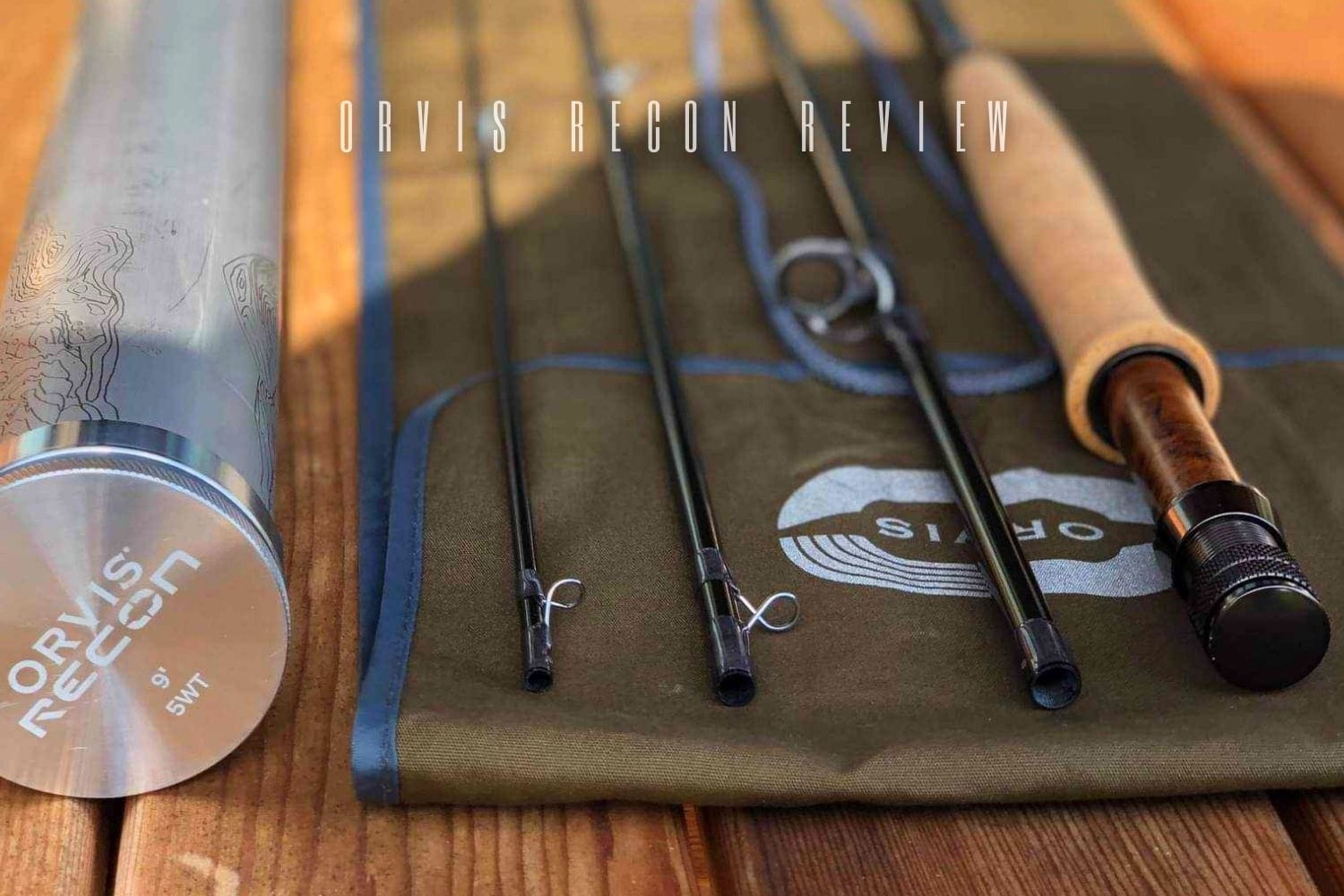
Short answer: A broad-use fast rod with a soft enough tip to retain feel at normal distances. Recon is most persuasive when it is allowed to be a versatile fishing rod rather than a cheaper imitation of a flagship. The reviewed shadow-green generation combines a fast lower blank with enough tip softness to communicate the cast. At common river distances it felt balanced, accurate, and willing to change from dries to nymphs or moderate streamers. Its appeal is range of use, not a claim that one configuration can cover every species or every water type.
Orvis Recon at a glance
| Category | What applies here |
|---|---|
| Original shadow-green Recon range | Configurations ranged from light-trout rods to heavier applications. |
| Original shadow-green Recon lengths | Roughly 7 feet 11 inches through 10 feet across the original family |
| Original shadow-green Recon action | Fast, with configuration-specific tapers |
| Original shadow-green Recon build | Four sections, dark hardware, graphite/resin blend, cloth bag and protective tube |
| Observed emphasis | Light balance, mid-range accuracy, useful power with retained tip feel |
The specifications and casting observations apply only to the shadow-green Recon generation that replaced the Access series. Confirm the finish, hardware, length, and line designation before expecting the same balance of tip feel and lower-blank power.
Casting character of this generation
The rod felt light and properly balanced with a matching reel. Its fast action produced useful line speed, while the softer tip kept the cast from feeling dead. Accuracy was strongest through the middle distances; the blank still had enough reserve to extend a cast, though precision gradually became more dependent on timing. The combination allowed easy transitions among a dry, a nymph rig, and a moderate streamer without making every change feel like a compromise.
Recon earns its all-purpose label only when the exact setup stays composed through realistic changes of fly. A useful cast moves from dry to indicator or streamer without hiding the tip feedback that distinguishes this generation.
Blank, grip and hardware
The shadow-green Recon combined multiple graphite moduli and resins with a revised ferrule arrangement, dark nickel hardware, a wood insert, and silver stripping and snake guides. The subdued blank and fittings are visually practical, although color alone does not prevent fish from seeing a poor approach. Orvis said each length and weight received its own taper rather than one blank simply being scaled. That is important: a light trout Recon and a heavier salt-oriented configuration belong to the family but answer different loads.
Dark nickel fittings and the mixed-modulus blank describe the shadow-green generation at launch. On an older Recon, joint security and guide condition matter more than whether the subdued finish still looks pristine.
Where the rod makes sense
On a trout river, the Recon’s useful center is a controlled cast from about 35 feet outward, where the tip can form a stable loop and the lower blank supplies reserve. It can place a dry, manage an indicator, or move a streamer when fly size remains proportionate to the chosen weight. Heavier configurations broaden the species range, but that does not make a light model a salt rod. Select the exact configuration around fly mass, wind, leader, and fish size.
This taper fits medium rivers and varied techniques when configuration matches load. Fly resistance, target fish, salt exposure, wind, and casting range decide which Recon is appropriate within the unusually broad family.
Tradeoffs that define the design
The reviewed rod became less exact as the cast was stretched toward its extreme. Some casters may also perceive more tip flex than expected from the fast-action label. Those are not contradictions: action describes where a rod bends, while recovery, line match, and caster tempo decide how it feels. An angler seeking the stiffest possible stroke may find the Recon too communicative; someone wanting a deeply flexing creek rod may find its lower blank too assertive.
Its softer tip necessarily shapes the limits. A forceful caster may see bounce and an extreme-distance cast may lose precision, even while the same response improves feel throughout the useful middle range.
A practical choice test
Test the Recon with the actual workload. Begin with a normal dry-fly cast, add the indicator or streamer used most often, and compare the shape of the loop rather than chasing a lawn maximum. Notice whether the soft tip improves feedback or introduces bounce for your stroke. A good match should remain comfortable after many casts and should not require an over-heavy line to wake up. Configuration choice is the key decision, especially across the family’s broad line-weight span.
Confirm shadow-green color, model inscription, length, and line weight before accepting a Recon comparison. Later namesakes can occupy a similar role while using a different blank recipe and casting rhythm.
Setup and condition check
For an older shadow-green rod, examine the four ferrule stations for scoring, the tip section for impacts, and every guide wrap for lifting varnish. Turn the reel-seat ring through its full travel and inspect the wood insert for swelling. Confirm that the bag and tube fit the exact rod, not another Recon. Assemble with clean joints and an even push, then mark any section that loosens during casting. A small ferrule issue should be corrected before a powerful stroke makes it worse.
- Verify the shadow-green Recon identity and printed configuration on the blank itself.
- Seat and inspect every joint on this shadow-green Recon before applying a full casting load.
- Balance the shadow-green Recon with the reel, line, leader, and fly intended for its actual job.
- Require a separate casting check before extending this shadow-green Recon verdict to another Recon or Orvis family.
Verdict on the original-generation Orvis Recon
The original-generation Recon is a convincing all-purpose choice for an angler who wants fast-action authority without surrendering all feedback. It is light in hand, strongest through practical middle distances, and adaptable across several fly types when the line weight is chosen honestly. Its softer tip and declining extreme-range precision define the tradeoff. Keep this verdict tied to the shadow-green generation; a later Recon may share intent, but it does not inherit these exact impressions.
