
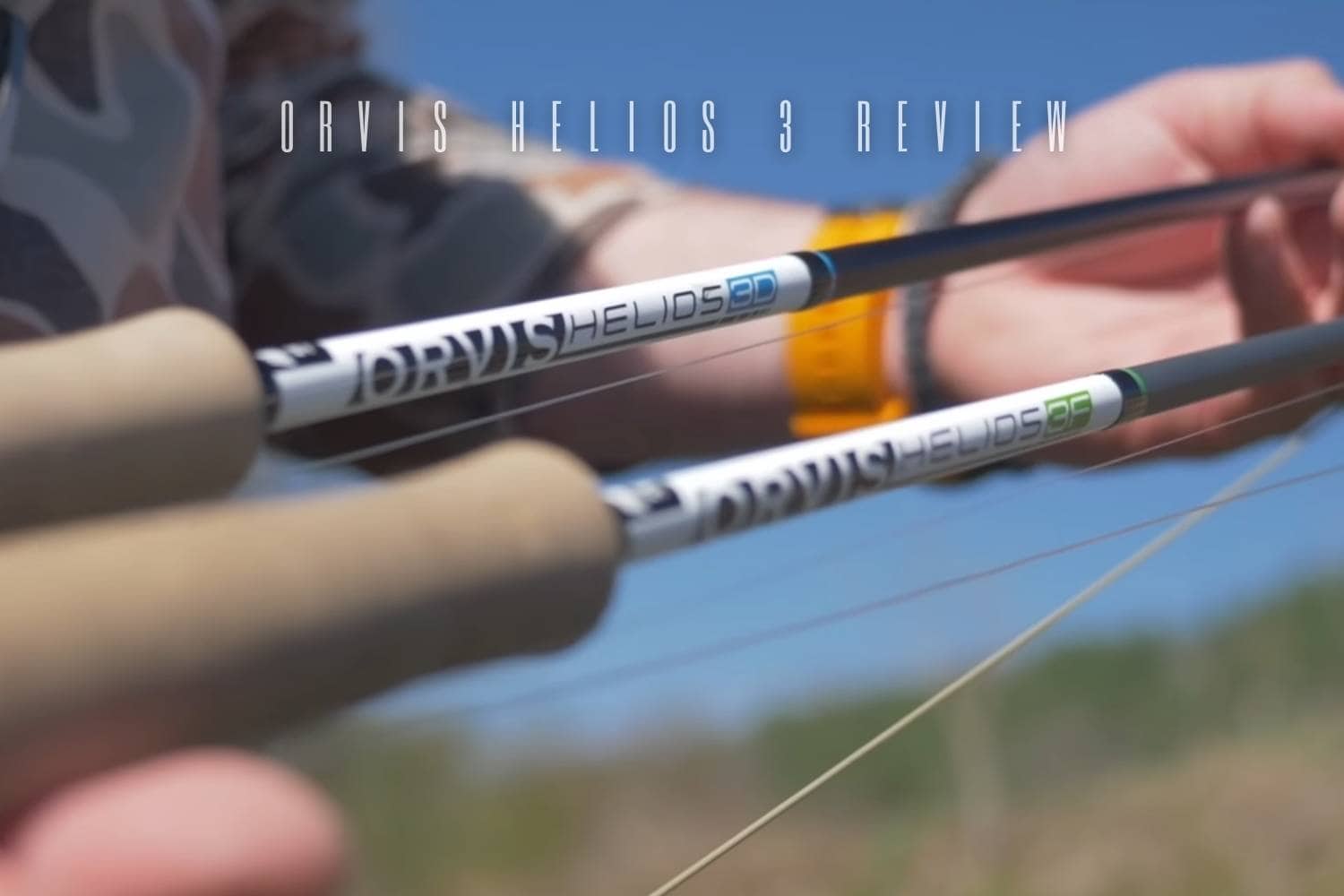
Short answer: A two-branch precision rod whose useful identity depends on choosing distance or feel. Helios 3 is not one undifferentiated casting tool. Its defining idea is a deliberate split: 3D for higher line speed and distance, 3F for feel and finesse. That division matters more than the logo, because it changes the useful casting window, the feedback through the stroke, and the flies each branch handles most naturally. An angler who treats the two labels as decoration can choose the wrong rod even while choosing the right family.
Orvis Helios 3 at a glance
| Category | What applies here |
|---|---|
| Original Helios 3 range | 3D: 4–12 line weights; the preserved 3F configurations begin at 4 weight. |
| Original Helios 3 lengths | 3D: 9–10 feet; 3F: 8–10 feet |
| Original Helios 3 action | 3D fast; 3F fast to medium |
| Original Helios 3 build | Four sections, aluminum tube, anodized aluminum reel seat; 3F lists SiC/titanium stripping guides |
| Observed emphasis | 3D reserve and tracking at distance; 3F sensitivity and softer presentation |
The specifications and casting observations apply only to the original Helios 3 generation with its separate 3D and 3F branches. Match the branch, length, and printed line weight before using this guidance to choose a rod.
Casting character of this generation
The evaluated 3D character was stiff, quick, and willing to hold direction when more line was carried. Its reserve made windy, open-water casts easier to organize, particularly once the cast moved beyond the close range. The 3F supplied a different sensation. It communicated loading more clearly, encouraged a less abrupt stroke, and made a soft dry-fly delivery easier at restrained distances. These are branch-specific impressions, not proof that every line-weight behaves identically.
For Helios 3, the decisive trial separates the branches: carry enough line to expose 3D recovery, then shorten the cast enough to feel whether 3F communicates the load and protects presentation.
Blank, grip and hardware
The original Helios 3 used uniform carbon-fiber sections and thermoplastic resin. Orvis said this construction reduced tip oscillation and resisted blank ovalization; those claims are not independent measurements. In fishing terms, the relevant question is whether the rod stops cleanly enough to preserve the loop shape the caster creates. The white label above the grip is conspicuous, while the darker blanks, carbon insert, anodized seat, and full-wells arrangements give the rest of the rod a restrained appearance.
Carbon, resin, guides, and seat hardware define the original build, but a surviving Helios 3 must still prove that its thin tip, ferrules, inserts, and wraps remain intact.
Where the rod makes sense
Choose the 3D side when the day is organized around open banks, heavier wind, longer carries, or flies that need firmer turnover. Choose the 3F side when the cast begins closer, the target is a pocket or seam, and presentation matters more than maximum line speed. Neither branch removes the need for a sound stroke. The 3D can punish hurried timing, while the 3F gives up some reserve when the task becomes a long, forceful delivery.
Open-water authority points toward 3D; pocket work and quieter leaders point toward 3F. Wind, fly resistance, and casting tempo should settle the branch decision before cosmetics or family reputation enter it.
Tradeoffs that define the design
The Helios 3 name can tempt a buyer to expect automatic accuracy. A rod cannot create a straight tracking path by itself, and the fastest option is not automatically the most suitable. The 3D may feel unnecessarily demanding on confined water; the 3F can feel short of authority when the cast is extended into wind. The prominent white branding is also a genuine aesthetic decision rather than a performance feature.
Helios 3's specialization is intentional. A 3D that feels demanding in a confined stream and a 3F that runs out of reserve on an exposed flat are revealing their proper boundaries, not failing a universal standard.
A practical choice test
Start with the normal fishing distance, then decide how often wind and bulky flies are present. A caster who usually works broad rivers should compare the 3D at realistic line carries, checking recovery and hand comfort. Someone who fishes dries to close targets should load the 3F with the intended line and watch how quietly it delivers a leader. The family makes sense only after that branch choice has been made deliberately.
Photograph the 3D or 3F marking, line designation, and length before comparing notes. Those identifiers prevent an appealing comment about one branch from being misapplied to the other.
Setup and condition check
On an older Helios 3, inspect the thin tip, all four ferrule stations, guide wraps, stripping-guide inserts, seat threads, and cork. Confirm that the painted branch marking and line designation are readable. Assemble the sections without forcing them, align the guides, and test with the actual reel and line. Lawn distance alone is a poor test for the 3F, while a few close casts reveal too little about the 3D's reserve. Use the distance band each branch was intended to address.
- Verify the Helios 3 branch identity and printed configuration on the blank itself.
- Seat and inspect every joint on this Helios 3 branch before applying a full casting load.
- Balance the Helios 3 branch with the reel, line, leader, and fly intended for its actual job.
- Keep comments about any later Helios or the other branch separate from conclusions about this exact Helios 3 configuration.
Verdict on the original-generation Orvis Helios 3
The original Helios 3 remains a coherent design because 3D and 3F answer different casting problems instead of pretending one taper is ideal everywhere. The 3D earns attention for directional stability, reserve, and open-water authority. The 3F is the more communicative choice for closer targets and controlled presentation. The best outcome comes from respecting that split, not from collapsing both rods into one reputation. No later Helios inherits these impressions without its own evaluation.
