
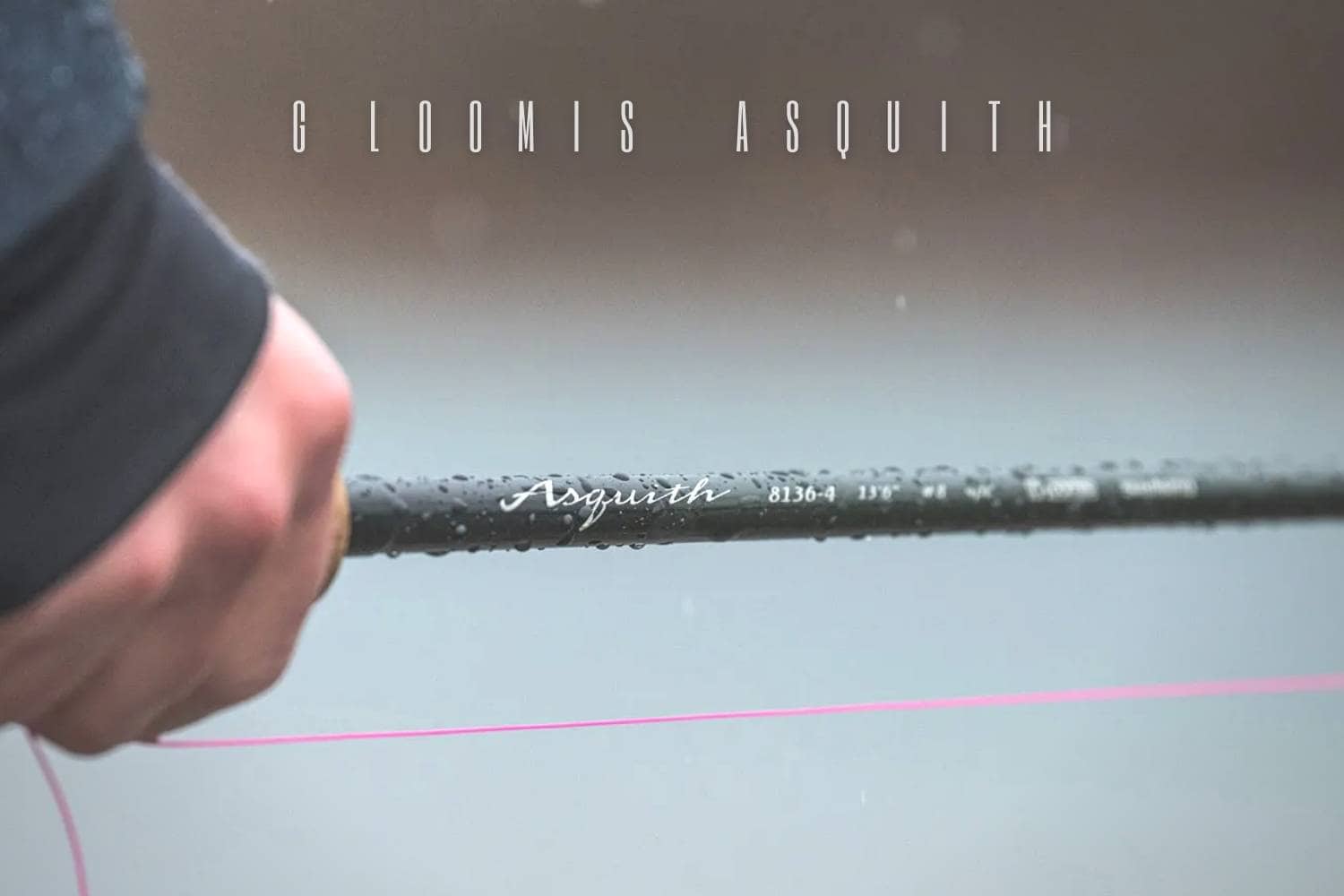
The earlier-generation G. Loomis Asquith combined low swing feel with substantial power. That ambitious character spanned freshwater and saltwater configurations, so a responsible verdict begins with exact line weight and action rather than the prestige of the name.
Two roles inside one family
Earlier-generation Asquith specifications separated lighter freshwater models from heavier saltwater versions, with a change in action between them. The family included nine-foot lengths, four sections, titanium guide hardware, an aluminum reel seat with a CI4+ insert, and fighting butts where appropriate. A freshwater 4-weight and a saltwater 12-weight share engineering lineage, not one casting job.
Confirm the model inscription and handle arrangement before using any family-level description. Water, fly, leader, and fish pressure must suit the line designation. A flagship reputation cannot make an inappropriate configuration sensible.
Hands-on limits and buyer fit
- Hands-on scope
- No exact Asquith configuration has a completed hands-on finding in this body. Treat the performance discussion as earlier-generation attribution and verify it by casting the exact marked rod.
- Earlier-generation model details
- Earlier-generation Asquith details included Spiral X construction, low swing-weight emphasis, titanium stripping and snake guides, custom reel-seat hardware, four sections, nine-foot length, and separate freshwater and saltwater action roles.
- Buyer fit
- An earlier-generation Asquith should be chosen by a demanding caster who can perceive recovery and tracking differences in the exact configuration, not by someone expecting prestige to compensate for limited technique or infrequent use.
What the construction claim means
Shimano Spiral X construction was intended to limit unwanted twist while preserving low mass and power. That mechanism claim applies only to the earlier generation. A buyer does not need to prove the layup in hand; the meaningful test is whether the blank tracks cleanly, recovers promptly, and remains comfortable through repeated casts.
Technology labels can explain design intent, but they do not establish condition. Impact damage, ferrule wear, loose guides, or a mismatched section can overwhelm the original engineering. Inspect the physical rod before assigning value to the construction name.
Recovery, line speed, and accuracy
The earlier-generation Asquith emphasized efficient energy transfer, rapid recovery, high line speed, and low swing weight. Those qualities can support tight loops and wind penetration when the caster maintains a clean path. They can also expose poor timing. A fast response does not generate accuracy independently of the stroke.
Cast at three useful ranges: close enough to test feedback, normal fishing distance, and the farthest controlled presentation regularly needed. Look for stable loops and a settled tip at each point. Stop when added power reduces control. The best rod is not the one that produces the longest isolated cast; it is the one that repeats the required one.
Line matching without mythology
Scientific Anglers Amplitude is a broad line family, not an exact taper prescription for every Asquith model and technique. “Amplitude” alone is not a complete line prescription. Head shape, grain distribution, temperature, fly size, and target matter.
Begin with the rod’s designated weight and compare tapers appropriate to the job. A freshwater presentation line and a saltwater line built for heat or larger flies behave differently even when the number matches. Use the line that allows the exact Asquith to load and recover naturally rather than forcing the rod into a character it does not have.
Freshwater and saltwater priorities diverge
Lighter freshwater versions had a more moderate action than the faster saltwater range. For freshwater, assess close feedback, presentation, mending, and tippet control. For saltwater, emphasize quick loading, stable turnover, wind, corrosion-conscious hardware, and pressure on stronger fish.
Do not carry saltwater power claims down to lighter rods or freshwater delicacy upward to heavy models. Family prestige cannot erase tackle physics. Each configuration earns its verdict against peers serving the same line weight and use.
Premium hardware still needs inspection
Titanium guides and custom reel-seat details were part of the earlier-generation appeal. Inspect guide surfaces for grooves, wraps for cracks, and feet for movement. Operate the locking hardware, check any fighting butt, and mount the actual reel. Examine the blank in strong oblique light around every ferrule.
Low swing feel depends on the complete system. A reel that is too light or too heavy can alter leverage, while a bulky line can change how the rod loads. Make repeated casts and fishing motions rather than trusting a static balance point.
Asquith evaluation table
| Area | Earlier-generation proposition | Required check |
|---|---|---|
| Configuration | Freshwater and saltwater roles within one family | Exact model, action, line weight, and handle |
| Recovery | Rapid blank return and line-speed emphasis | Repeatable loop shape at fishing distances |
| Swing feel | Low-mass, efficient character | Complete setup with intended reel and line |
| Construction | Spiral X and premium component story | Physical condition overrides technology labels |
Performance must justify the commitment
The earlier-generation Asquith was exceptionally expensive, so its performance advantage must be repeatable in the exact configuration. The useful question is whether the difference can be felt and used. Cast it beside strong alternatives in the same configuration with comparable lines.
An angler fishing frequently in demanding conditions may value small gains in recovery, fatigue, and tracking. Someone who fishes occasionally or cannot distinguish those changes may gain more from instruction, a well-matched line, or a less specialized rod. Neither answer diminishes the tool; it aligns investment with use.
Condition is part of performance
Assemble all four sections and verify that markings, finish, and ferrule fit remain consistent. Sight along the guides, then cast under controlled load and recheck alignment. A rotating section or damaged guide can destroy tracking regardless of the blank’s original quality.
Examine cork, reel-seat threads, insert, fighting butt where fitted, and the protective tube. A complete presentation is welcome, yet structural integrity determines whether the rod can still express its intended character.
Final verdict on the earlier-generation G. Loomis Asquith
The Asquith case rests on disciplined performance: light swing character, quick recovery, substantial authority, and distinct freshwater and saltwater configurations. It should be evaluated against exact peers with the same tackle and real fishing casts. Reputation is not a substitute for that comparison.
Choose an earlier-generation Asquith only when its exact model produces a repeatable advantage you can use and its condition is sound. A successor, sibling, or another Asquith generation does not inherit the earlier generation’s observations, component claims, or value judgment.
