
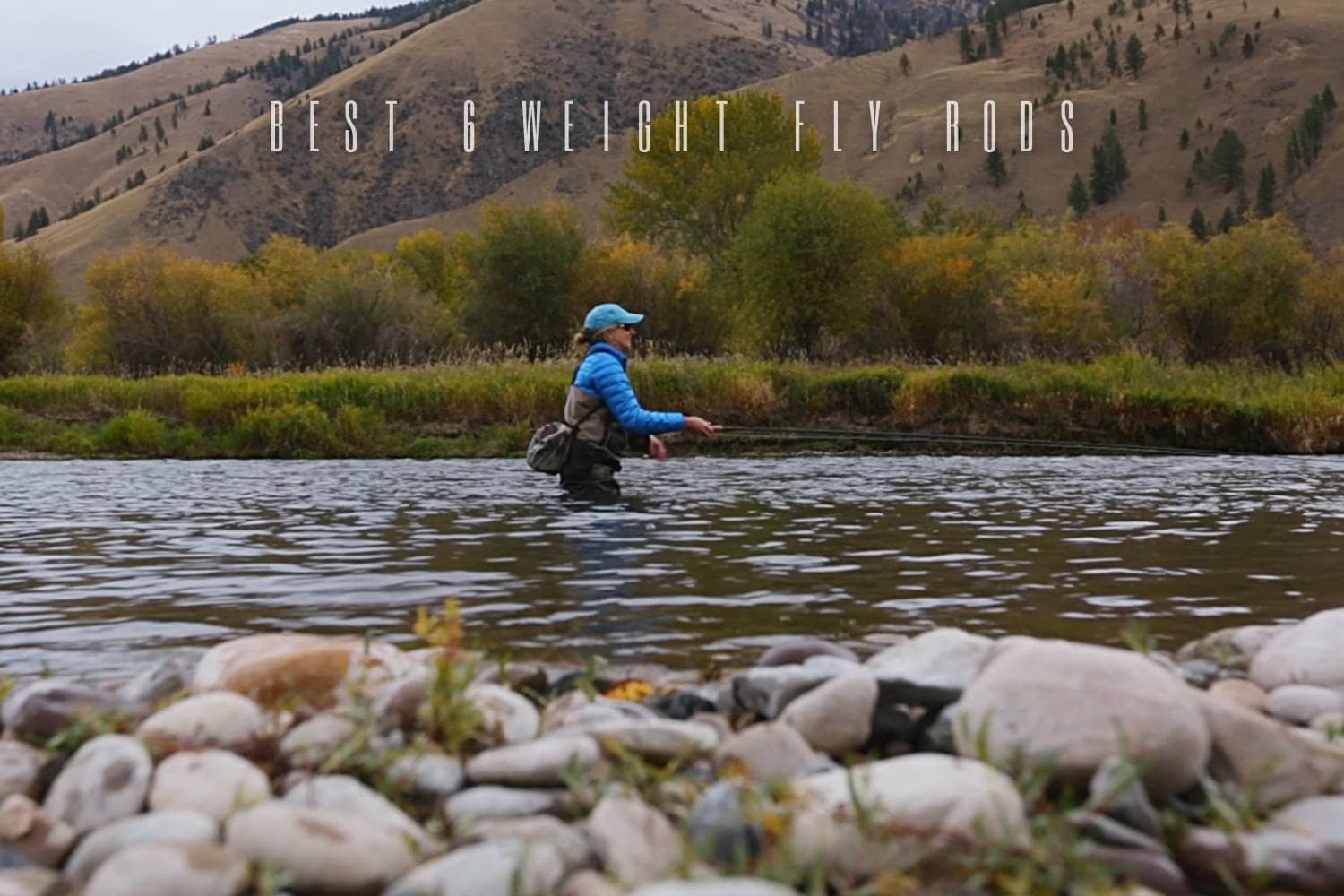
A six-weight earns its place when a trout rod must do more than place a small dry. It is the line class for anglers who regularly turn over weighted nymphs, move streamers, mend across broad currents, or face enough breeze to make a lighter outfit feel fussy. The useful question is not which old model won a ranking. It is which six-weight shape matches the water you fish and the casting tempo you can repeat without strain.
Decide what the rod must carry
A six-weight makes the strongest case when the fly or rig, rather than the fish alone, demands extra authority. Medium streamers, heavier stonefly patterns, tandem nymph rigs, and wind-resistant indicators create air resistance. A rod that forms a stable loop with that payload is more useful than one chosen for prestige. Write down the largest rig you honestly fish, the usual casting distance, and whether most casts begin from a boat, a bank, or moving water.
River anglers should give mending and pickup equal weight with distance. A rod may feel lively in a parking-lot cast yet struggle when asked to lift line and reset a drift. Lake anglers often benefit from added reach, but only if the longer lever remains comfortable through repeated casts. Light-surf use adds another demand: verify that the exact rod’s fittings, finish, and care instructions suit that environment rather than assuming an article-era model is salt-ready.
Do not oversize simply because a six sounds more capable. Small flies on sheltered creeks usually gain little from the heavier outfit, while presentation and fish feel may suffer. The six-weight sweet spot starts where a five-weight becomes overworked: larger flies, more wind, broader water, or fish that call for firmer pressure.
Match geometry to your water
| Primary job | Geometry to inspect | Buyer consequence | Article-era examples |
|---|---|---|---|
| Boat and mixed river work | A conventional nine-foot layout with manageable swing weight | Easier line pickup, compact boat handling, and broad technique coverage | Sage X; Thomas & Thomas Avantt; Scott Centric |
| Lake mending and longer reach | A longer configuration that still balances with your reel | More reach for drift control, with greater leverage on the wrist | Sage X ten-foot; Avantt ten-foot |
| Streamer power for an expert caster | Fast recovery and a grip that supports forceful hauling | Tighter loops with bulky flies, but less forgiving timing | G. Loomis Asquith; Orvis Helios 3D |
| Learning or backup duty | A medium-fast bend with clear loading feedback | A wider timing window and less punishment for imperfect stops | Orvis Clearwater; Scott Flex |
Length changes more than reach. A shorter rod is easier around a drift-boat gunwale and can help keep loops compact. Extra length supports mends and elevated line control, but it also magnifies tip weight. Action describes where the blank bends; it does not guarantee that two rods carrying the same label will feel alike. A very fast blank can reward precise acceleration and an abrupt stop while frustrating a caster who relies on deeper loading cues.
What the article-era rods illustrate
G. Loomis Asquith: speed with a demanding side
The article-era Asquith section described one of the fastest actions the writer had felt. That exact observation belongs to that rod and generation. Its practical lesson is durable: extreme speed can produce tight loops and powerful pickups in skilled hands, yet it raises the timing requirement. A buyer should not treat maximum stiffness as an automatic upgrade.
Orvis Helios 3D: a fishing tool that disappeared in use
The writer reported spending days with the article-era Helios 3D and appreciated that it suited his style without demanding constant attention. Keep that observation with the Helios 3D rather than transferring it to another Helios generation. For selection, the useful test is whether a rod settles quickly after the stop and lets you concentrate on the target instead of correcting the blank.
Thomas & Thomas Zone: reach versus versatility
In the article-era Zone range, the writer found the nine-foot version more versatile and the longer one more helpful for mending and drift control. That comparison shows why configuration matters inside a family. Never assume the same verdict applies to a differently built model carrying a related name.
Cast the complete outfit before choosing
- Bring the reel and the exact line you plan to fish. Line taper can change loading more than a spec label suggests.
- Cast the heaviest normal rig, not an easy yarn fly that hides the job you need done.
- Make pickup, roll, reach, and mend movements as well as overhead casts.
- Repeat the test after your arm is warm; a rod that impresses for three casts may tire you over a day.
- Inspect ferrules, guides, grip fit, tube, and repair terms for the exact configuration before committing.
Transport also belongs in the decision. A four-piece layout is convenient for ordinary travel, but section count alone says nothing about durability. Keep ferrules clean, seat them correctly, and check alignment during the day. After dirty or brackish use, follow the maker’s care instructions for the exact rod rather than relying on a universal treatment.
A six-weight should solve a real problem
The right six-weight is the one that takes the awkward edge off your most common heavy rig while remaining pleasant for the casts you make all day. Begin with payload and environment, narrow by length, then reject any action that fights your natural tempo. Article-era names can clarify these trade-offs, but they are not current shopping endorsements. When the complete outfit turns over your real fly, controls the drift, and still feels composed late in the session, the shortlist has done its job.
