
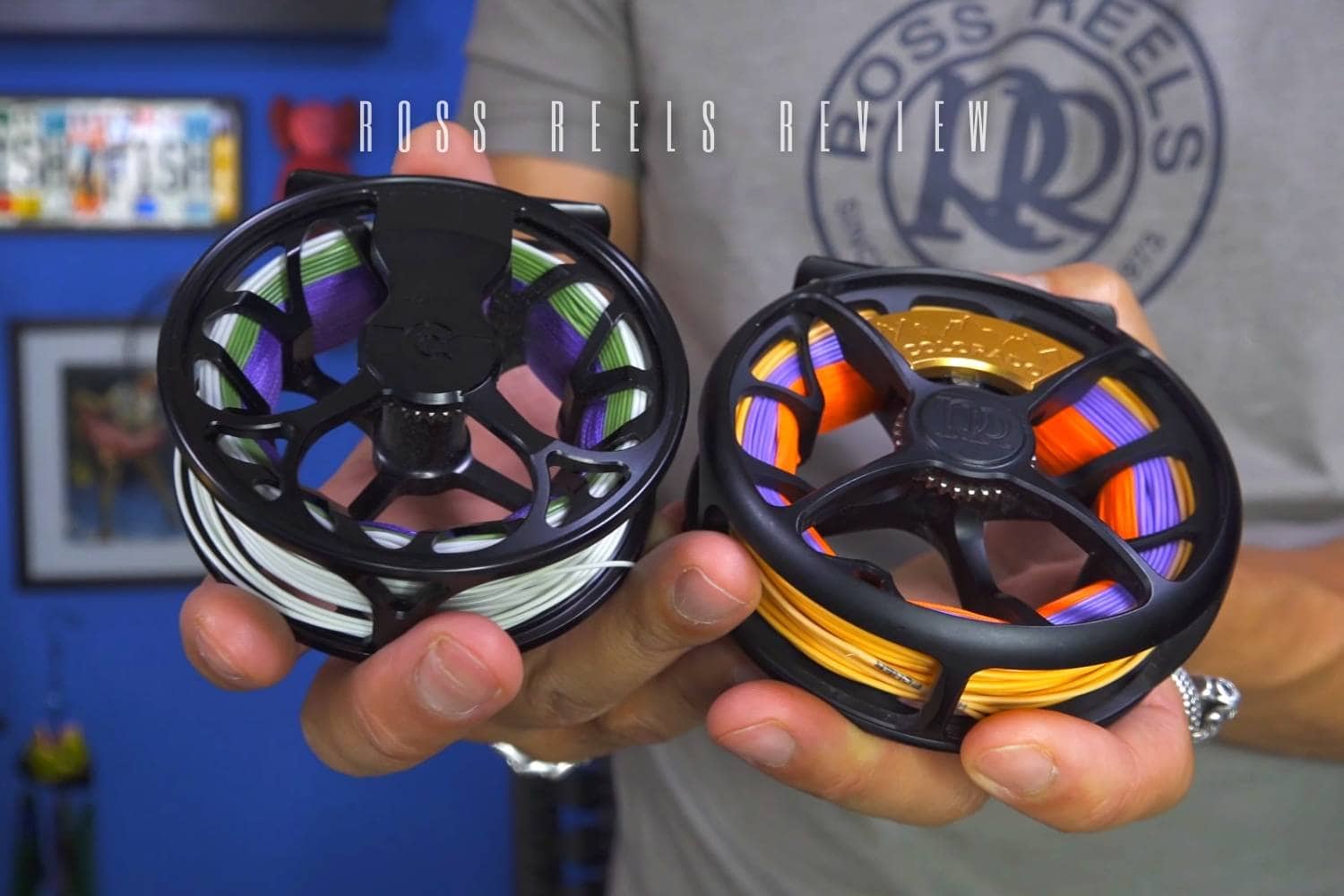
Quick answer: Ross currently offers ten core fly-reel families. Start with Colorado or Cimarron Creek if you want click-pawl mechanics; compare Animas, Evolution LTX and Evolution R for common trout and midweight line classes; look at Evolution FS for broader freshwater-to-saltwater sizing; and begin with Evolution R Salt for heavier dedicated saltwater configurations. The right match depends on drag type, line class, backing capacity and the balance of your completed setup.
For the most versatile starting point, choose the Ross Animas.
Three legacy distinctions matter when shopping: the current San Miguel is a redesign, Gunnison is retired with no verified successor, and today’s Colorado is a changed successor to Colorado LT. Identify a used reel by its exact generation and markings rather than by a familiar family name alone.
Affiliate disclosure: The Trident Fly Fishing links in this guide are affiliate links. If you buy through one, Fly Fisher Pro may earn a commission at no extra cost to you.
Quick terms: A reel’s drag is the resistance applied as a fish pulls line. A click-pawl uses a spring-loaded pawl engaging a toothed gear; it is mechanically different from an adjustable disc drag. A large arbor is a relatively wide spool core that gathers more line per turn and reduces tight line coils. Backing is the reserve line wound behind the fly line. A label such as 5/6 identifies the intended fly-line weight range, not the reel’s physical weight. “WF5 + 80 yd” means a weight-forward 5-weight line plus 80 yards of the specified backing basis.
Current Ross reels at a glance
| Family | Primary design role | Sizes | Drag format | Listed weight range | Action |
|---|---|---|---|---|---|
| Cimarron Creek | Light-line, configurable click-pawl use | 2/3, 4/5, 5/6 | Customizable dual-pawl click system | 4.1–4.9 oz | Check Trident Price |
| Colorado | Lightweight click-pawl fishing | 2/3, 4/5 | Unidirectional click-pawl | 3.2–3.5 oz | Check Trident Price |
| Cimarron | Animas-based disc-drag platform | 4/5, 5/6, 7/8 | Composite drag based on Animas | 5.8–6.8 oz | Check Trident Price |
| Cimarron LT | Lighter ported disc-drag option | 4/5, 5/6, 7/8 | Adjustable composite-disc system | 4.9–5.7 oz | Check Trident Price |
| Animas | Large-arbor multi-use platform | 4/5, 5/6, 7/8 | Upgraded composite system | 4.1–4.74 oz | Check Trident Price |
| Evolution LTX | Light disc-drag range across 3–8 weights | 3/4, 4/5, 5/6, 7/8 | Stacked-disc system | 4.2–4.91 oz | Check Trident Price |
| Evolution R | Sealed freshwater-oriented disc-drag range | 4/5, 5/6, 7/8 | Sealed carbon/stainless disc stack | 4.82–5.18 oz | Check Trident Price |
| Evolution FS | Robust fresh- and saltwater crossover range | 4/5, 5/6, 7/8, 9/10 | Stacked hybrid of LTX and Animas features | 5.9–7.7 oz | Check Trident Price |
| Evolution R Salt | Sealed saltwater-oriented range | 7/8, 9/10, 11/12 | Sealed 16-disc system | 7.51–8.85 oz | Check Trident Price |
| San Miguel | Current redesigned sealed-drag family | 3/4, 4/5, 5/6, 7/8 | Sealed carbon/stainless system | 5.8–7.3 oz | Check Trident Price |
How to choose a Ross reel
Begin with the line, not the family name. Match the intended fly line to an exact size row, then inspect backing capacity. A 4/5 reel may provide different reserve-line room depending on whether it carries WF4 or WF5. Ross says its general capacity tables use floating lines with 20-pound backing unless another basis is shown; switching to 30-pound backing reduces capacity by about 20 percent. Treat the published row as a setup reference, not a promise that every line taper will occupy identical volume.
Decide whether you want click-pawl simplicity or an adjustable disc drag. Cimarron Creek and Colorado are the dedicated current click-pawl choices. Cimarron Creek adds removable and replaceable pawls, while Colorado uses a unidirectional system. The other current families use composite or stacked-disc designs with a drag knob. Our guide to fly-reel drag systems explains those mechanisms in more detail.
Separate light weight from light-duty assumptions. Animas, Evolution LTX and Evolution R all stay below roughly 5.2 ounces in their listed current sizes, but they use different drag architectures and capacity tables. Cimarron LT also reduces weight through aggressive frame porting while retaining an adjustable composite-disc drag. Compare the completed rod-and-reel setup rather than assuming the lightest number automatically produces the preferred balance.
For broader fresh/salt crossover sizing, examine Evolution FS; for dedicated heavier saltwater line classes, examine Evolution R Salt. Ross describes Evolution FS as combining LTX and Animas features, with sizes extending from 4/5 to 9/10. Evolution R Salt starts at 7/8 and uses a separate sealed 16-disc system. Neither role makes ordinary rinsing optional after saltwater exposure.
Use lineage labels carefully when shopping used. The current San Miguel is a redesign, not simply the earlier-generation reel in a new finish. The current Colorado is Ross’s documented successor to Colorado LT, but dimensions, capacities, construction and some size labels changed. Gunnison has no verified successor. For comparisons beyond one brand, see our broader fly-reel guide.
The current Ross reel lineup
Cimarron Creek
Cimarron Creek emphasizes configurable click-pawl mechanics. Its dual-pawl system uses removable, replaceable pawls, and Ross documents up to ten possible pawl arrangements. Changing an arrangement changes the click-system setup; it does not turn the reel into an adjustable disc-drag model. Tool-free spool removal and a large arbor round out the design.
The manufacturer lists 2/3, 4/5 and 5/6 sizes at 4.1, 4.5 and 4.9 ounces. All three have a 1.215-inch width; diameters rise from 3.0 to 3.5 inches. Capacity runs from WF2 plus 75 yards or WF3 plus 50 yards on the 2/3 to WF5 plus 80 yards or WF6 plus 60 yards on the 5/6.
Colorado
Colorado is Ross’s other current click-pawl family and the lighter of the two by listed weight. It uses a unidirectional click-pawl drag, a semi-caged frame, an all-metal external clicker and a Vesconite bushing. Current sizes are 2/3 and 4/5, at 3.2 and 3.5 ounces.
The 2/3 capacity is WF2 plus 75 yards or WF3 plus 50 yards. The current 4/5 table lists WF4 plus 80 yards or WF5 plus 70 yards. Those current figures should not be replaced with older Colorado listings or the specifications of Colorado LT. Ross explicitly calls Colorado LT the predecessor, but the present Colorado is a changed product rather than a renamed LT.
Cimarron
The current Cimarron revisits a Ross name introduced in the 1980s, while its drag system is based on the Animas platform. Ross documents a fully anodized frame and spool plus a Cerakote drag knob and escapement cover. This heritage does not make an unidentified older Cimarron mechanically identical to the current reel.
Sizes are 4/5, 5/6 and 7/8, weighing 5.8, 6.2 and 6.8 ounces. The 4/5 lists WF4 plus 65 yards or WF5 plus 50 yards; the 5/6 lists WF5 plus 80 yards or WF6 plus 60 yards; and the 7/8 lists WF7 plus 180 yards or WF8 plus 160 yards. It occupies common trout-to-heavier-freshwater line classes in a somewhat heavier package than Animas or Cimarron LT.
Cimarron LT
Cimarron LT pairs an adjustable composite-disc drag with a stainless-steel interface, a large arbor and an aggressively ported frame. The “LT” belongs to the Cimarron family name here; it does not indicate that this model replaced Colorado LT or Gunnison. Ross documents neither succession.
The current range covers 4/5, 5/6 and 7/8 at 4.9, 5.3 and 5.7 ounces. Capacities are WF4 plus 65 yards or WF5 plus 50 yards; WF5 plus 80 yards or WF6 plus 60 yards; and WF7 plus 180 yards or WF8 plus 160 yards. Those capacity rows mirror the current Cimarron figures, but the reels differ in weight and construction.
Animas

Animas uses an upgraded composite drag, an ultra-large bell-shaped arbor and a maintenance-free spool release. Ross currently lists 4/5, 5/6 and 7/8 sizes. Use the current capacity table to match line and backing; the condition and feel of a used reel still depend on its own age and use.
Listed weights are 4.1, 4.43 and 4.74 ounces. Capacity is line-specific: WF4 plus 70 yards or WF5 plus 50 yards on 4/5; WF5 plus 100 yards or WF6 plus 75 yards on 5/6; and WF7 plus 180 yards or WF8 plus 160 yards on 7/8.
Evolution LTX

Evolution LTX covers 3/4, 4/5, 5/6 and 7/8 while keeping each listed configuration below five ounces. Its stacked-disc system is based on the Evolution R architecture, paired with a bell-shaped large arbor. Ross’s 2018 and current tables list the same dimensions, weights and capacities for these sizes.
Weights run from 4.2 to 4.91 ounces, while diameter grows from 3.42 to 4.03 inches. The exact capacity row still matters: 3/4 lists WF3 plus 60 yards or WF4 plus 50 yards; 4/5 lists WF4 plus 85 yards or WF5 plus 70 yards; 5/6 lists WF5 plus 115 yards or WF6 plus 95 yards; and 7/8 lists WF7 plus 175 yards or WF8 plus 150 yards.
Evolution R

Evolution R uses a fully sealed proprietary disc stack combining carbon-fiber/carbon-fluoropolymer and stainless-steel components, along with an ultra-large arbor and quick-release spool. It covers 4/5, 5/6 and 7/8, and the current and archived first-party specification tables agree.
The listed weights are 4.82, 5.03 and 5.18 ounces. Capacity is WF4 plus 100 yards or WF5 plus 75 yards on 4/5; WF5 plus 115 yards or WF6 plus 90 yards on 5/6; and WF7 plus 180 yards or WF8 plus 150 yards on 7/8. Choose it over LTX when this sealed Evolution R architecture is the intended feature; choose by exact row rather than treating their overlapping sizes as equivalent.
Evolution FS
Evolution FS is Ross’s robust crossover family, documented for both fresh- and saltwater roles. Its stacked drag combines features associated with Evolution LTX and Animas, and its semi-caged frame is intended to help control line within the reel. That design history makes it a hybrid in Ross’s own description—not a Gunnison successor.
The family spans 4/5, 5/6, 7/8 and 9/10 at 5.9, 6.4, 6.9 and 7.7 ounces. Capacity rises from WF4 plus 115 yards or WF5 plus 100 yards at 4/5 to WF9 plus 225 yards or WF10 plus 200 yards of 30-pound backing at 9/10. Consider it when you want a single current family spanning ordinary freshwater line classes through a 9/10 configuration, but still match the model-specific size and care instructions.
Evolution R Salt

Evolution R Salt is the dedicated heavier-line saltwater-oriented family. Ross documents a sealed 16-disc stainless-steel and carbon-fluoropolymer drag plus dual mini counterbalances. Ross’s archived and current tables list the same specifications for the 7/8, 9/10 and 11/12 sizes. The photo still cannot identify a particular size or production revision.
Listed weights are 7.51, 8.0 and 8.85 ounces. Capacity is WF7 plus 235 yards or WF8 plus 215 yards on 7/8; WF9 plus 325 yards or WF10 plus 275 yards on 9/10; and WF11 plus 300 yards or WF12 plus 250 yards of 30-pound backing on 11/12. The larger backing allowances and saltwater positioning distinguish it from the overlapping 7/8 sizes elsewhere in the catalog.
San Miguel: the current redesign
The current San Miguel must be treated as a redesigned generation. Ross documents a redesigned frame and spool, a new standard drag knob with a separate press-fit oversized knob, a sealed carbon-and-stainless drag, and push-button spool release. Current sizes are 3/4, 4/5, 5/6 and 7/8—one more size than the legacy three-size generation.
Current listed weights are 5.8, 6.1, 6.4 and 7.3 ounces. Capacities are WF3 plus 50 yards or WF4 plus 50 yards; WF4 plus 70 yards or WF5 plus 60 yards; WF5 plus 90 yards or WF6 plus 80 yards; and WF7 plus 110 yards or WF8 plus 90 yards. Even where a size label overlaps the earlier San Miguel, changed variants, weights, capacities and construction prevent generation transfer.
Legacy Ross models and today’s alternatives
Use legacy specifications to identify an older reel, not to describe a current product. San Miguel kept its name through a redesign, Gunnison retired without a verified successor, and Colorado LT has a documented but changed successor. Condition, serviceability and parts support still depend on the exact reel.
Legacy San Miguel: same name, earlier generation

Ross listed this three-size San Miguel in 2020, and an archived 2023 page shows the same generation. It came in 3/4, 4/5 and 5/6, with listed weights of 5.4, 5.8 and 6.0 ounces. Its capacities were WF3 plus 65 yards or WF4 plus 50 yards; WF4 plus 90 yards or WF5 plus 75 yards; and WF5 plus 100 yards or WF6 plus 80 yards.
The current San Miguel overlaps those three size labels but changes the product. Its frame, spool, drag-knob arrangement, variants, weights and capacities differ, and it adds a 7/8. The legacy photo and specifications therefore belong only to the earlier generation. A used listing should be identified by the exact reel and its markings rather than by the San Miguel name alone.
Gunnison: retired, with no verified successor

The archived all-new-for-2018 Gunnison generation used a drag based on Evolution LTX and came in 4/5, 5/6 and 7/8. Listed weights were 6.29, 6.7 and 7.36 ounces. The correct capacities were measured in backing yards: WF4 plus 85 yards or WF5 plus 70 yards; WF5 plus 115 yards or WF6 plus 95 yards; and WF7 plus 175 yards or WF8 plus 150 yards.
Ross no longer listed Gunnison in its current catalog when this guide was checked on August 6, 2026; the exact discontinuation date is unknown. Evolution FS and Cimarron LT can overlap some of its former fishing roles, but Ross does not call either model its successor. Neither should be treated as a Gunnison with a new name.
Colorado LT to Colorado: a documented, changed succession

Legacy Colorado LT came in 0/3, 3/4 and 4/5. The archived table lists weights of 2.86, 2.91 and 2.98 ounces, with 0.87-inch widths. Capacity was WF3 plus 55 yards on 0/3, WF4 plus 55 yards on 3/4, and WF5 plus 55 yards on 4/5. The image here visibly identifies a Colorado LT 4/5, not a current Colorado.
Ross explicitly identifies Colorado LT as the predecessor to Colorado, but the transition changed the frame, bushing, porting, dimensions, weight and capacity. Current Colorado comes in 2/3 and 4/5; the old 0/3 and 3/4 labels have no exact same-label current configuration. Even the overlapping 4/5 is a changed reel, so buyers should not assume shared parts, dimensions or on-water feel.
Care, warranty and where Ross reels are made
Rinse, dry and follow the model-specific instructions
Ross’s current care guidance says to rinse a reel after each use, especially after saltwater or alkali exposure. For deeper cleaning, remove the spool, rinse or soak appropriate components in fresh or distilled water, then let everything air-dry completely before reassembly. Store the reel dry. Spool removal and retrieve conversion differ by model, so the instructions for the exact reel control; do not force a procedure from one family onto another.
The current warranty has eligibility and lifecycle limits
Ross’s detailed current policy applies to Ross-branded reels bought through an authorized dealer by the original, non-transferable owner, for as long as the product is on the market. It excludes normal wear and circumstances including negligence, loss, theft and discontinued products; Ross determines repair or replacement and may substitute a newer model in some discontinued-product cases. Service also requires the stated form and freight-paid shipment. A legacy or secondhand reel therefore needs case-specific confirmation—its age, brand name or an older warranty statement does not establish present coverage.
Current Ross production is documented in Montrose, Colorado
Ross currently says every Ross reel is designed, machined and assembled in Montrose, Colorado. Its manufacturing page describes machining from aerospace-grade 6061-T6 aluminum and domestic material sourcing. This is a current brand-level statement, not purchase-era proof for every unidentified historical reel. Ross and Abel are presented as distinct brands within the Mayfly group, so their model lines and specifications should not be merged.
Ross reels FAQ
What Ross reel families are current?
The ten core families listed by Ross on August 6, 2026 were Animas, Cimarron, Cimarron Creek, Cimarron LT, Colorado, Evolution FS, Evolution LTX, Evolution R, Evolution R Salt and San Miguel. Individual sizes or finishes may not always be orderable.
Which current Ross reels use click-pawl systems?
Cimarron Creek and Colorado are the two dedicated current click-pawl families in this guide. Cimarron Creek uses a configurable dual-pawl setup with removable pawls in 2/3, 4/5 and 5/6. Colorado uses a unidirectional click-pawl in 2/3 and 4/5. The remaining current families use composite or stacked-disc drag systems.
Is the current San Miguel the same reel as the older San Miguel?
No. The current San Miguel is a redesigned generation with changed frame, spool, drag-knob arrangement, variants, weights and capacities, plus a new 7/8 size. The earlier three-size reel, its photo and its historical specifications cannot be used as evidence about the current redesign.
Did Colorado replace Colorado LT?
Ross identifies Colorado LT as Colorado’s predecessor, so this is a documented succession. It is still a changed product: current Colorado has 2/3 and 4/5 configurations, while Colorado LT had 0/3, 3/4 and 4/5. Construction and specifications changed, and the shared 4/5 label does not make those reels identical.
What replaced the Ross Gunnison?
No exact successor is verified. Evolution FS and Cimarron LT can serve some overlapping current roles, but Ross does not identify either as the Gunnison’s successor. Do not assume shared dimensions, spools, parts or inherited performance.
How do Animas, Evolution LTX and Evolution R differ?
All cover common midweight line classes, but the architectures differ. Animas uses an upgraded composite drag and ultra-large bell-shaped arbor. Evolution LTX uses a stacked-disc system based on Evolution R and adds a 3/4 size. Evolution R uses a fully sealed carbon-based and stainless-steel disc stack. Compare the exact line, backing and weight row rather than choosing by family reputation alone.
Which Ross family is intended for saltwater?
Evolution R Salt is the dedicated heavier-line saltwater-oriented family in 7/8, 9/10 and 11/12. Evolution FS is documented for fresh- and saltwater crossover use from 4/5 through 9/10. Both still require rinsing and drying under Ross’s care guidance, especially after saltwater exposure.
Are Ross reels made in the USA?
Ross’s current brand and manufacturing pages say its reels are designed, machined and assembled in Montrose, Colorado, using domestically sourced materials. For an older reel, confirm manufacturing details from documentation for its own generation rather than assuming today’s statement covers every historical model.
Are Ross Reels and Abel Reels the same brand?
No. Mayfly Outdoors presents Ross Reels and Abel Reels as distinct brands. Shared group context does not make their reel families, specifications, parts or model histories interchangeable.
Does the Ross warranty transfer with a used reel?
The detailed current policy is limited to the original non-transferable owner and an authorized-dealer purchase, with additional product-market and exclusion terms. A used or discontinued reel does not automatically carry present coverage; ask Ross about the exact model and circumstances.
Final recommendation
Our final recommendation is the Ross Animas.
First-party sources
Ross and Mayfly Outdoors provide the current lineup, specifications, care, warranty and manufacturing details below. Archived Ross pages document legacy generations. Size and finish availability varies by retailer.
- Ross Reels brand and current family overview
- Ross Animas
- Ross Cimarron
- Ross Cimarron Creek
- Ross Cimarron LT
- Ross Colorado
- Ross Evolution FS
- Ross Evolution LTX
- Ross Evolution R
- Ross Evolution R Salt
- Ross San Miguel, current redesign
- Ross reel care
- Ross warranty and repairs
- Ross manufacturing
- Archived Ross San Miguel legacy-generation page
- Archived Ross Gunnison page
- Archived Ross Colorado LT page
- Archived Ross Colorado successor page
