
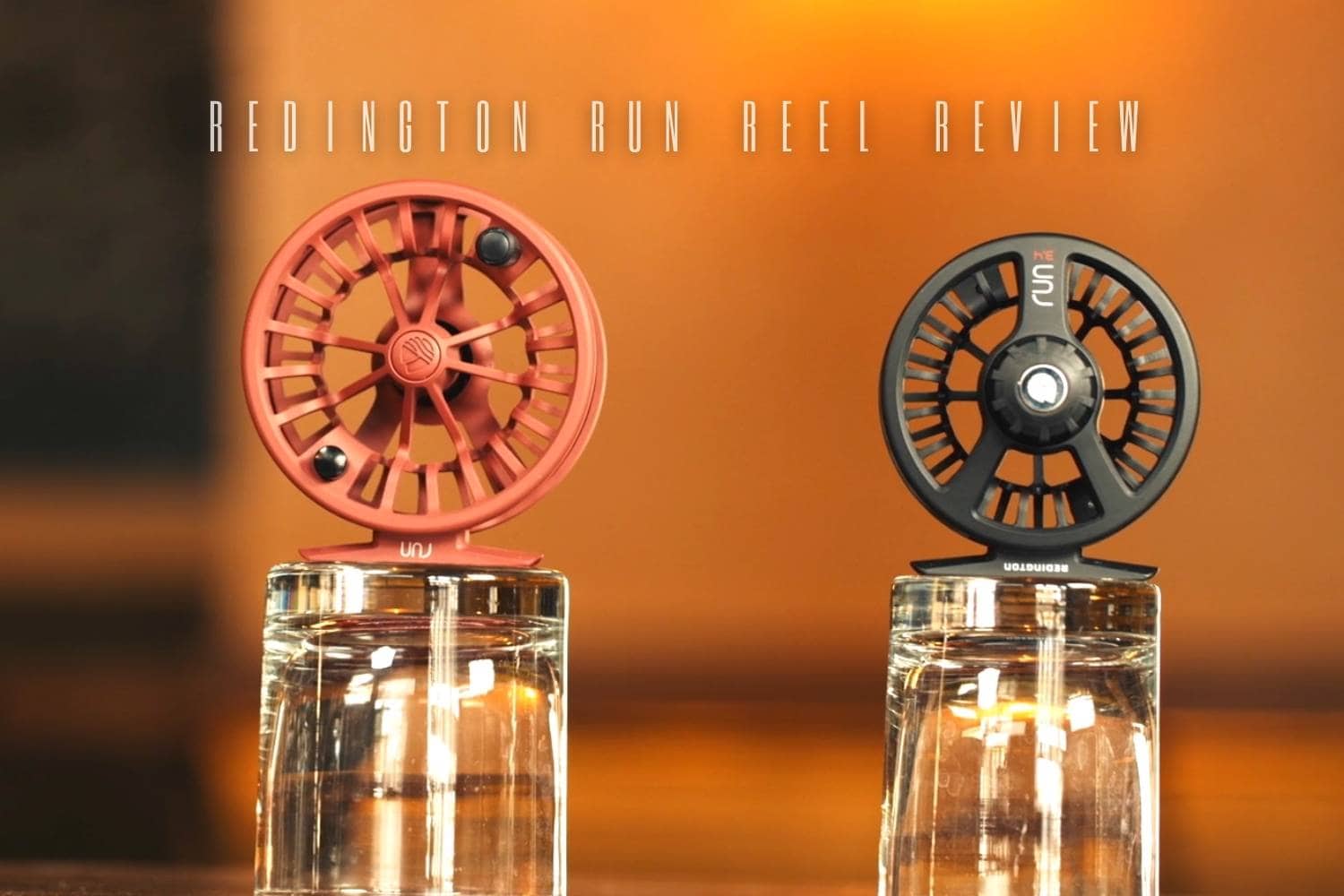
What this review covers
This hands-on review covers the article-era Redington RUN that we tested. A current RUN listing exists, but exact technical continuity has not been established here. Do not transfer these observations, sizes or compatibility assumptions to a current reel without checking its own specifications.

RUN design and handling
The reviewed RUN used a ported, die-cast frame, a large arbor and a compact carbon-fiber drag. In our test, the open frame kept the reel light and the large arbor picked up line quickly. The soft-touch handle was comfortable, and the push-button spool release made changes simple.
The recessed drag knob was intended to reduce line snags. It was easy to adjust, although it still projected far enough that an angler should check clearance and line management for their own setup. The cast finish showed minor imperfections, which were cosmetic on our unit rather than an operational problem.

Drag performance
The drag was the strongest part of our article-era evaluation. It started smoothly, with little detectable startup inertia, and the adjustment produced clear clicks. The sound on outgoing line and retrieval also gave useful feedback. The drag was only partly protected rather than fully sealed, so we would be cautious around grit and salt and would inspect a used reel closely.
The original article compared the RUN with the RISE and claimed spool interchangeability. That compatibility is not repeated as buying advice because the evidence does not establish it for a current RUN or RISE III. A similarly named spool is not enough; verify the exact part with the manufacturer before purchasing.
Durability and ownership
Die-cast construction can deliver a light, functional reel, but a hard impact may damage it more readily than a machined frame. Check the reel foot, spool rim, release button and ported areas for cracks or distortion. Rotate the spool under light drag and listen for rubbing. Maintenance should follow the instructions for the exact reel and environment.

Pros and cons
Pros
- Light, quick-retrieving large-arbor design
- Smooth startup on our tested article-era reel
- Simple push-button spool release
- Comfortable soft-touch handle
Cons
- Current-generation continuity is not established
- Drag is not treated as fully sealed
- Cast frame and prominent knob deserve careful inspection
- No spool compatibility claim is carried forward
Verdict
The article-era RUN was a straightforward reel with a notably smooth drag, quick pickup and comfortable controls. Those are valid observations about the reel we tested, not a blanket verdict on every later RUN. For a used example, prioritize smooth rotation, an undamaged cast frame and a secure spool release. For a current listing, compare the exact specifications independently and do not assume that old sizes, parts or RISE compatibility still apply.
