
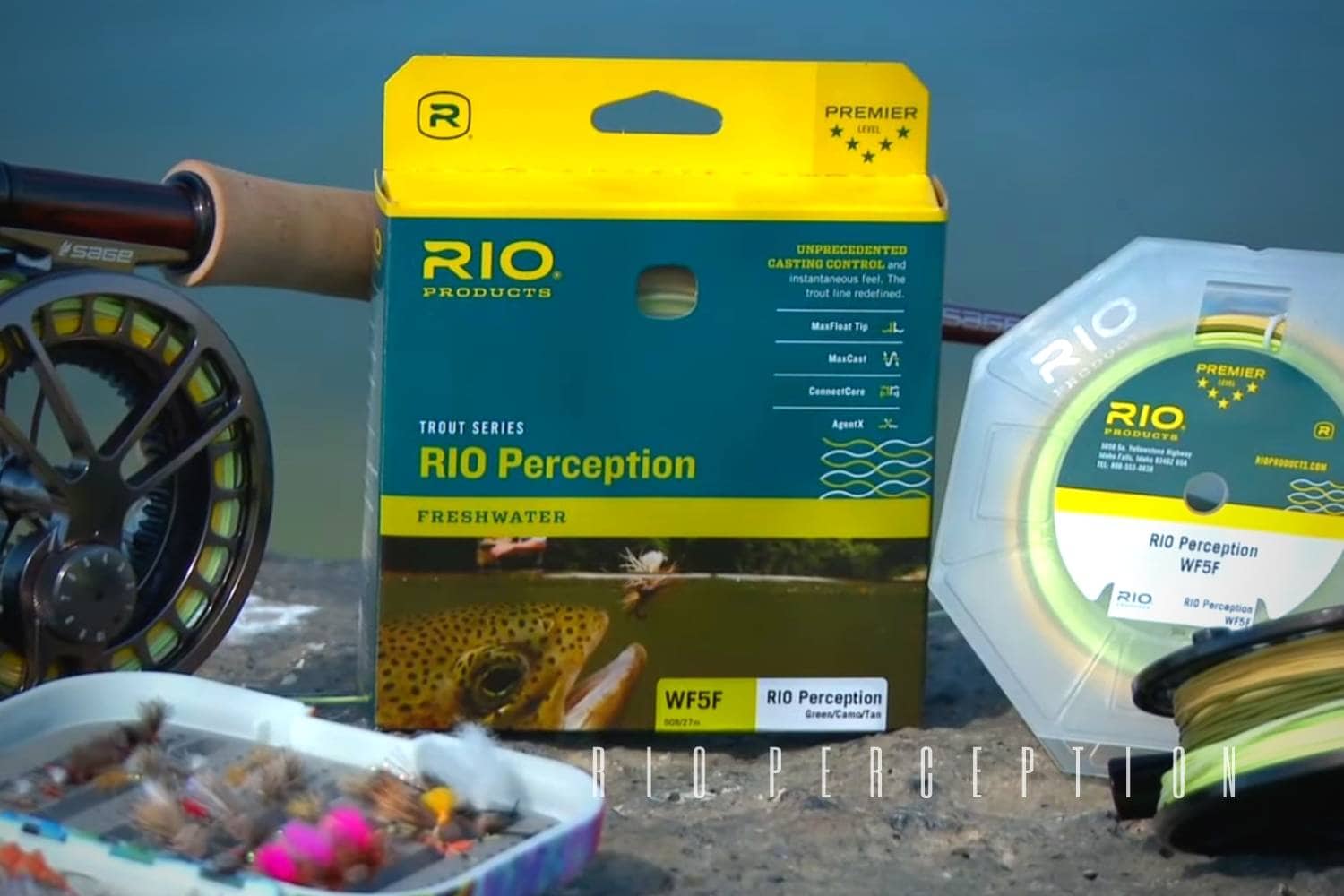
Quick answer: the RIO Perception was a capable cold-water floating trout line with a short, weight-forward head, low-stretch core and useful three-color handling markers. In our use, it loaded faster-action rods readily, handled short casts well and made it easy to see where the head ended. Its main limitation was long-range mending. It is not listed in RIO’s current catalog, so this is a legacy review rather than a current buying recommendation.
If you already own a Perception in good condition, there is no reason to retire it just because the model has left the catalog. Inspect the coating and loops, clean the line, and judge it by how well it still matches your rod and fishing. If you are buying new, compare the taper, temperature rating and application of products in the current RIO fly-line catalog rather than assuming another RIO line is a direct replacement.
Is the RIO Perception still current?
No current Perception product appears in the RIO product collection or Far Bank’s current product sitemaps, and the exact Far Bank product route returns a not-found page. The old RIO product URL now resolves to the general RIO storefront rather than a Perception page.
Treat the Perception as a legacy line. Its absence from the current catalog does not establish when RIO stopped selling it or which current line, if any, RIO considers its official successor. A similar color, taper description or product tier does not make two line generations interchangeable.
Perception is therefore not ranked or linked here as a current product to buy.
RIO Perception at a glance
| Feature | Reviewed line | Practical effect |
|---|---|---|
| Line type | Cold-water floating trout line | Best suited to rivers, streams and stillwaters where a floating presentation covers most of the day |
| Line weights | 3–8 in the reviewed range | Covered light trout rods through heavier freshwater setups; the line still needed to match the rod rating |
| Head | Approximately 36 feet | Loaded quickly and supported short-to-medium casts, but was less comfortable for long-line control |
| Tapers | Approximately 8-foot front taper and 6-foot rear taper | Turned over a broad range of trout flies without behaving like an extreme shooting-head design |
| Core | ConnectCore low-stretch construction | Improved contact and made timing, takes and hook sets feel more direct |
| Coating | SlickCast with a buoyant tip treatment on the reviewed generation | Reduced friction and helped the tip remain visible and manageable on the surface |
| Color system | Green, camo and gray sections | Made the head and running-line transition easier to recognize while casting |
These are generation-specific details retained from the line reviewed on Fly Fisher Pro. They should not be copied onto a current RIO product page unless that product’s own specifications confirm them.
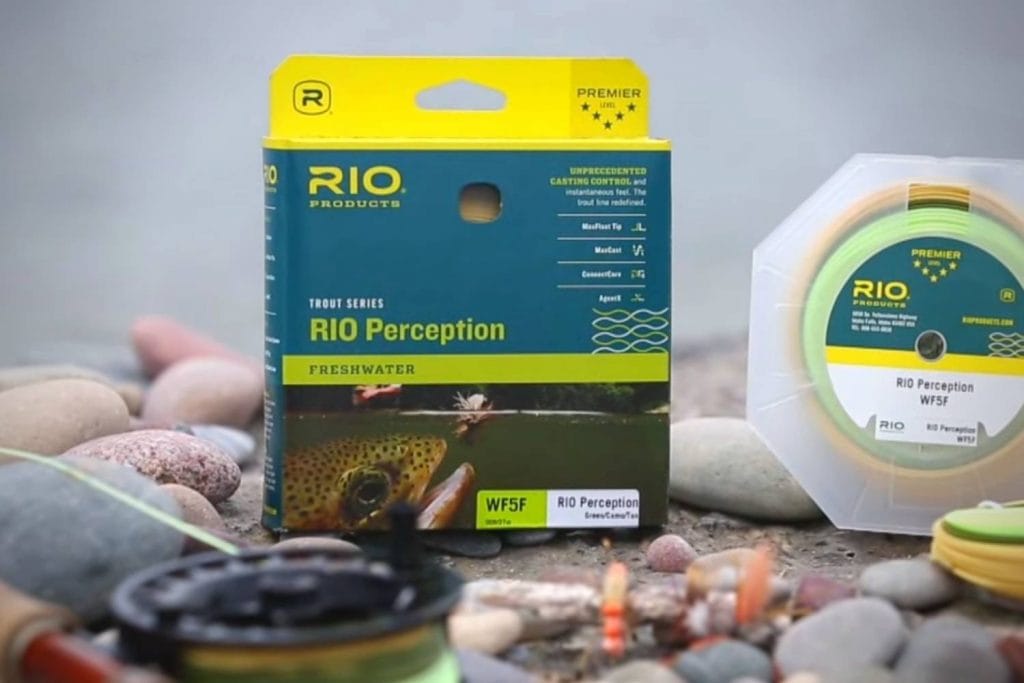
How the Perception cast
A short head that loaded readily
The roughly 36-foot head was the defining feature. On smaller water, where the cast often begins with relatively little line outside the rod tip, the Perception loaded readily and got to work quickly. It also roll-cast competently and suited the repeated short-to-medium presentations common on streams and compact stillwaters.
The head carried enough weight to work with faster-action rods. That made the line approachable when turning over more than a tiny dry fly, but it was not a substitute for matching the printed line weight to the rod. Deliberately over-lining a rod changes its feel and should be a conscious setup choice, not an assumption based on a review.
Useful turnover without an extreme front load
The reviewed taper transferred energy smoothly enough to cover small dry flies, nymph rigs and larger trout patterns. We found it accurate and predictable at the distances for which the head was designed. The line was less convincing once a long section of running line was outside the rod tip.
The main trade-off: long-range mending
The same compact head that helped on smaller water became a constraint when controlling a long drift. Once the head and rear taper had traveled far through the guides, mending from the thinner running line was less effective. Anglers who regularly hold or reposition a long aerialized line on broad rivers should prioritize a longer head and rear taper when comparing current products.
Coating, core and handling
Slick surface and easy shooting
The Perception generation we used had a low-friction coating that moved cleanly through the guides. It shot without excessive resistance, and routine cleaning helped preserve that behavior. As with any older PVC fly line, condition now matters more than the original marketing description: cracking, a rough surface, damaged loops or a tip that persistently sinks can outweigh the line’s original strengths.
Low stretch changed the feel
The low-stretch core made the system feel more direct. Cast timing, subtle takes and hook sets transmitted with less cushioning than on a stretchier line. That can improve contact, but it also asks for measured strike pressure and sensible tippet choice. Low stretch does not eliminate the need for the rod, leader and tippet to protect a light connection.
Color changes were genuinely useful
The green, camo and gray sections were more than decoration. We liked being able to identify the front and rear portions of the head and see when the running line reached the guides. That visual reference helped repeat a productive casting length instead of guessing at the pickup point.
Who the RIO Perception suited
Best fit
- Anglers who already own a sound Perception and fish mostly cold-water trout rivers, streams or smaller lakes.
- Short-to-medium presentations where quick loading is more valuable than managing a very long head.
- Mixed trout-fly days that move among dries, nymphs and modest streamers.
- Faster-action rods that benefit from a line with a compact, purposeful head.
Less suitable
- Long casts followed by repeated long-range mends.
- Hot tropical conditions, because the reviewed line was designed for cold-water use.
- Dedicated deep-water work that calls for a sinking line or sink tip.
- An angler who wants a clearly supported current model with readily verifiable sizes and retailer availability.
How to choose a current alternative
Do not shop by the word “RIO” alone. Start with the behavior you need from the Perception and compare that with the exact current product:
- Match the environment. Confirm cold, warm or tropical temperature compatibility.
- Match the rod. Check the exact line weight and whether the taper is standard, deliberately heavy or role-specific.
- Choose head length deliberately. A shorter head favors quick loading and compact casting; a longer head can improve carrying and mending.
- Choose the fly and presentation. Delicate dries, indicator rigs and larger streamers place different demands on the front taper and mass distribution.
- Verify the exact generation. Elite, Premier, Max, XP and other family labels can indicate materially different constructions. Read the exact product specifications rather than borrowing facts from this legacy review.
For broader comparisons, use our best fly line guide. If you are specifically comparing current Gold variants, our RIO Gold review keeps those generations separate.
Verdict
The RIO Perception was a practical all-round floating trout line for shorter water and mixed fly sizes. Its compact head loaded readily, the low-stretch core increased contact, and the three-color system made the casting point easy to repeat. We also found its weakness clear: it was not the line we would choose for managing long drifts and large mends.
That remains useful guidance for anglers who own one. It is not a reason to chase an uncertain old listing or to pretend a current RIO line is the same product. Keep fishing a healthy Perception if it suits your setup; when replacement time comes, choose a current line by temperature, taper, head length, fly size and rod fit.
