
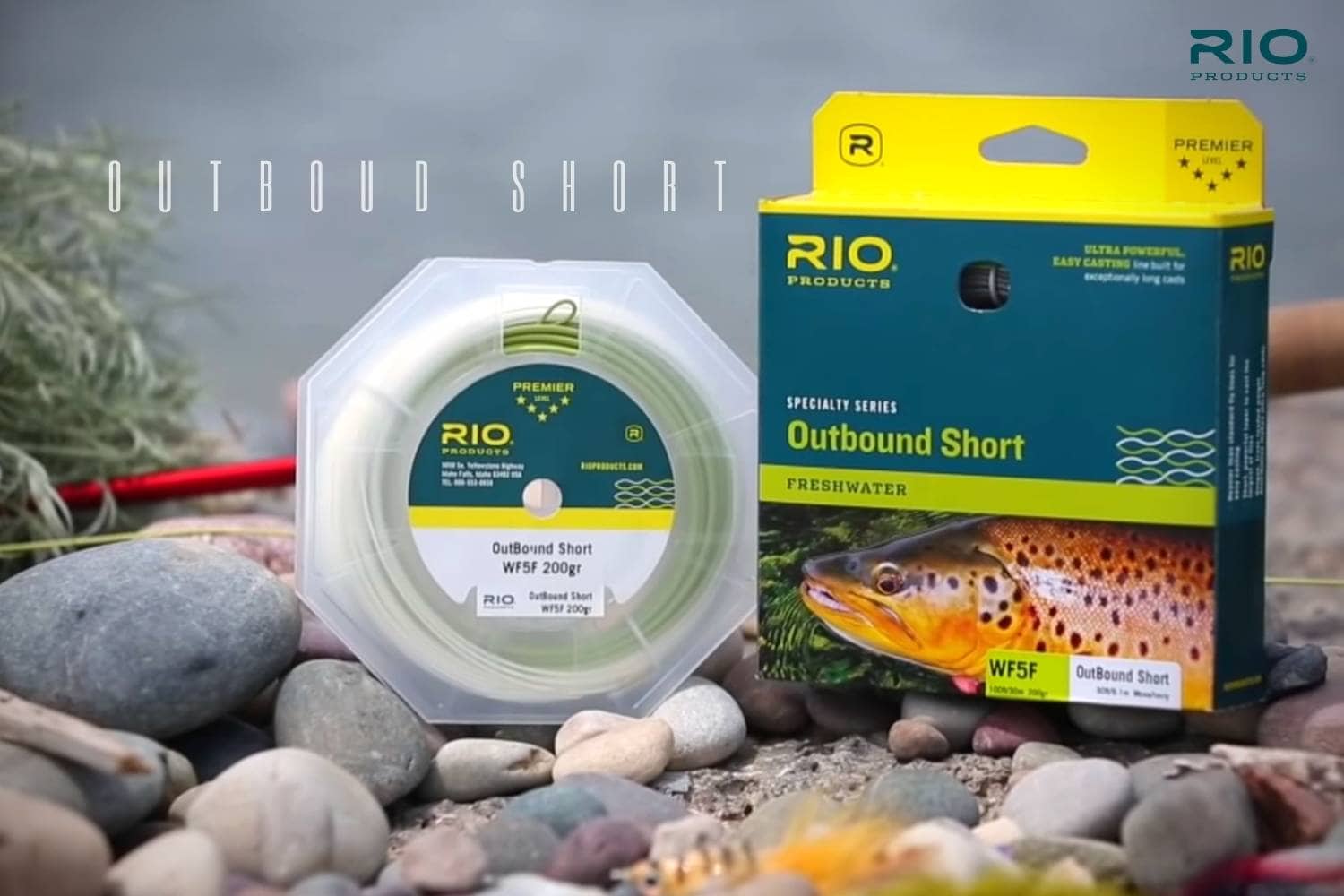
Quick answer: RIO OutBound is the power-and-distance family for large flies, quick loading and fewer false casts. The earlier OutBound Short became a go-to line in our tackle bag when a heavy fly needed to travel accurately, and its low-stretch feel and head marker were genuinely useful. Today’s catalog splits that job among Premier OutBound Short, OutBound Short Shooting Head, Elite Tropical OutBound Short and Elite Musky OutBound. They are not one universal line.
For the broadest current single-hand range, start with Premier OutBound Short and choose the exact density, line weight and water temperature. Choose the separate shooting head only if you want a head system. Elite Tropical is built for tropical conditions and heavy saltwater flies; Elite Musky is a dedicated big-fly sinking tool for the heaviest freshwater setups.
Current RIO OutBound family compared
| Current product | Current sizes/densities sampled | Best fit | Do not confuse it with |
|---|---|---|---|
| Premier OutBound Short | 5–12wt across floating, intermediate and multi-density options; exact size range varies by density | Large flies, quick loading and distance across freshwater and non-tropical applications matched to the exact coating/density | A universal tropical line or separate shooting head |
| OutBound Short Shooting Head | 7–10wt; floating, intermediate, medium-sink and fast-sink heads | Anglers building a shooting-head system and changing heads by depth | An integrated full fly line |
| Elite Tropical OutBound Short | 8–12wt; floating, intermediate and multi-density options | Large tropical saltwater flies, warm conditions and hard strip sets | The cold-water Premier line |
| Elite Musky OutBound | 11wt, 12wt, 600gr and T-27; sinking head with intermediate running line | Musky-scale flies, heavy rods and deep retrieves | A general trout, bass or flats line |
Size and density ranges differ by product, and a shop may carry only part of the family. Confirm the exact SKU, line weight and density before buying.
What we observed from the reviewed OutBound Short generation
Fly Fisher Pro reviewed an earlier integrated OutBound Short generation with a roughly 30-foot front-loaded head. The line lived in the author’s tackle bag and became a preferred tool for sending heavy flies accurately with little false casting. Its low-stretch core felt direct, and the color change near the head/running-line transition made the loading point easy to repeat.
That experience supports the core OutBound idea: compact mass turns over bulky flies and shoots line efficiently. It does not prove hands-on use of every current Premier, Tropical, Musky or shooting-head variant. Current specifications below come from Far Bank’s exact product records, not from transferred testing claims.

Head, taper and casting behavior
Why a short front-loaded head works
A compact head concentrates enough mass outside the rod tip to load quickly and move a large or wind-resistant fly. That reduces false casts and helps when the boat, bank or vegetation leaves little room for a long carry. The trade-off is presentation: concentrated mass and a short front taper will not land like a dedicated technical dry-fly line.
The reviewed generation turned over streamers and bass flies well and shot beyond the head without demanding a perfect long carry. We also liked knowing exactly where the rear taper met the running line. A visual or tactile head marker lets the caster place the loading point outside the tip and repeat a productive pickup length.
Rod match still matters
“Loads quickly” does not mean every OutBound variant fits every rod. Front-loaded designs can feel forceful on softer rods, and grain-based musky or shooting-head sizes require more than matching a printed weight number. Follow the exact product’s grain and rod guidance, especially with two-handed or nonstandard setups.
Distance is not automatic
The short head makes shooting easier, but line management, hauling, leader design and fly aerodynamics still determine the result. A bulky fly with a poor leader will not become stable because the line is powerful. Use a leader that transfers energy without creating an unsafe or uncontrollable casting loop.
Density, temperature and species fit
Premier OutBound Short
The current Premier product spans floating, intermediate and several multi-density combinations. The available line weights depend on the density: the floating and hover/intermediate options begin lighter than some deeper-sinking configurations, while the fastest sinking option is concentrated in heavier sizes. Treat each density as a separate setup rather than assuming every size exists in every sink profile.
It is the logical starting point for trout streamers, bass, stripers and other large-fly applications when its exact temperature rating and density suit the water. The old review’s blanket claim that one OutBound transitions from cold to tropical water should not be carried forward to every current variant.
Elite Tropical OutBound Short
The Tropical product is explicitly for warm conditions and heavy saltwater work. Current records list 8- through 12-weight options with floating, intermediate and multi-density configurations. Its stiffer tropical design and low-stretch construction suit fast shots, large flies and solid strip sets. It is not the line to choose for delicate bonefish presentations merely because it is tropical.
OutBound Short Shooting Head
The shooting head is a separate head rather than an integrated full line. Current records list 7- through 10-weight heads in floating, intermediate, medium-sink and fast-sink versions. It suits anglers who understand running-line compatibility and want to swap heads. A beginner seeking a simple one-piece setup should usually choose an integrated line.
Elite Musky OutBound
The Musky version is purpose-built around giant flies and heavy tackle. Its current options include 11wt, 12wt, 600-grain and T-27, with a Type 5 sinking head and intermediate running line. The T-27 head can be cut to a required length and weight, a setup step that demands accurate rod and grain matching.
Durability and handling
The reviewed line’s coating shot cleanly, while wear and cold-condition coiling were potential weaknesses. Those observations apply to that earlier line, not every current SlickCast product. Current coatings and cores differ across tiers and environments.
Any powerful shooting line benefits from maintenance. Rinse it after saltwater, clean it with the manufacturer-recommended method, inspect the loops and coating, and remove twists before they become running-line tangles. A cracked or rough head will not shoot as designed, while a damaged loop can fail under the high loads these lines target.
Which current OutBound should you choose?
- Choose Premier OutBound Short for an integrated power line and the broadest current mix of freshwater/non-tropical sizes and densities.
- Choose the OutBound Short Shooting Head when you intentionally want interchangeable heads and already have a compatible running line.
- Choose Elite Tropical OutBound Short for warm saltwater, heavy flies and 8- to 12-weight rods.
- Choose Elite Musky OutBound for giant musky flies, heavy rods and deep retrieves—not as a general bass or trout line.
- Choose another family for delicate dries, long leaders, Euro nymphing or subtle flats presentations.
For broader role comparisons, see our best fly line guide, sinking fly line guide and saltwater fly line guide.
Frequently asked questions
Is RIO OutBound Short a full line or a shooting head?
Both product types exist. Premier OutBound Short and Elite Tropical OutBound Short are integrated fly lines. OutBound Short Shooting Head is a separate head that needs a compatible running line.
Can one OutBound line handle cold and tropical water?
Do not assume so. Choose the exact current product for the temperature. Elite Tropical OutBound Short is explicitly warm-water focused; other variants have different coatings and roles.
Is it suitable for bonefish?
The family’s aggressive turnover can move heavy flies, but technical bonefish work often favors a line designed for accurate, quieter flats presentations. Match the exact fly, wind and water temperature rather than choosing OutBound solely because it casts far.
What does multi-density mean?
Different sections of the head sink at different rates. That can produce a straighter subsurface connection and control the fly’s path, but the exact rate sequence varies by SKU. Read the full density label before buying.
Verdict
The OutBound Short we reviewed earned its place in our tackle bag by making large-fly distance work easier and more repeatable. Its compact head, low-stretch feel and visible loading point were real strengths. That experience explains why the family remains relevant, but it cannot be stretched across every current product.
Premier OutBound Short is the broad integrated starting point. The shooting head is for modular systems, Elite Tropical is for warm saltwater, and Elite Musky is a heavy sinking specialist. Choose by fly size, water temperature, density and rod—not by family name alone.
