

Quick answer: the usual connection sequence is fly line → leader → tippet → fly. The leader transfers energy from the thick fly line toward the fly. Tippet is the finest terminal part of that system—the material tied directly to the fly. A new tapered leader already has a thin terminal section, so you do not always need to add separate tippet before fishing it.
Backing sits behind the fly line on the reel. It is not where the leader attaches. The leader connects to the front end of the fly line, while the fly attaches at the opposite end.
What is a fly-fishing leader?
A leader is the clear or low-visibility section between the fly line and the fly. Its thick butt receives energy from the fly line, and its taper reduces diameter toward the terminal end. That change in diameter helps the cast unroll while placing less bulky material near the fly.
A leader is not simply an extension of the backing. In a complete setup, the order from the reel outward is backing, fly line, leader, terminal tippet and fly. Backing normally remains on the reel until a strong fish pulls out the fly line.
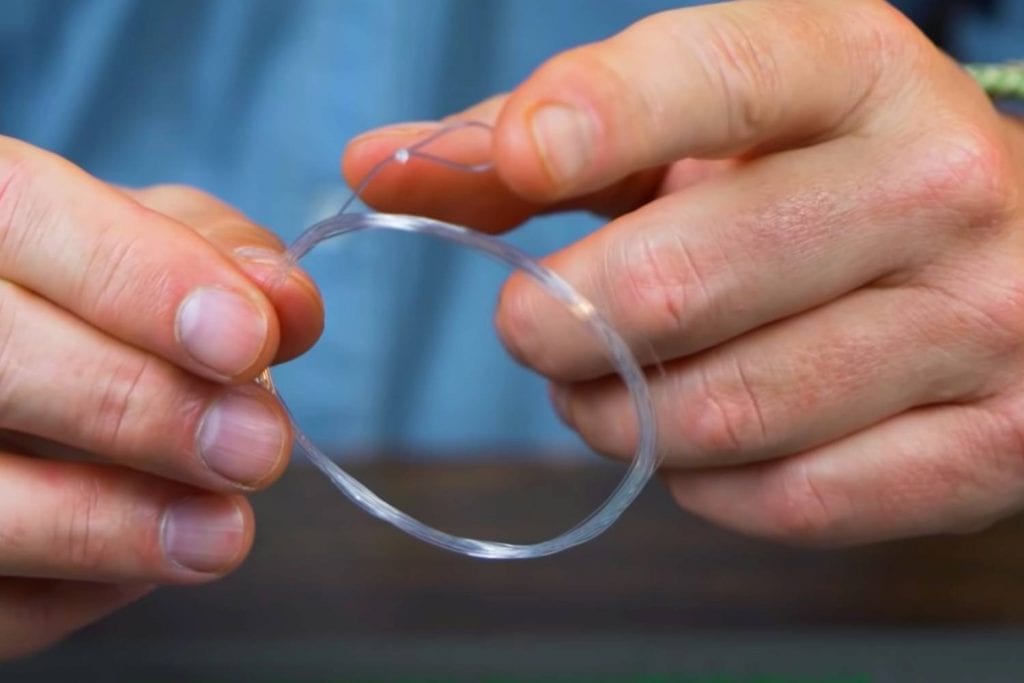
Common leader types
- Knotless tapered leader: one continuous piece that changes diameter from butt to tip. It is convenient and has no section-to-section knots.
- Knotted leader: separate diameters joined to build a chosen taper. It is adjustable, but every knot must be tied, trimmed and tested carefully.
- Braided or furled leader: a reusable woven or twisted body that normally needs a separate terminal section. Construction, stretch and flotation vary by product.
- Specialty leader: a design made for a particular job, such as sinking presentations, indicators, large flies or saltwater use. Follow the maker’s intended line weight and use rather than treating every specialty leader alike.
If you want to build one from sections, use the separate guide to make a tapered leader. Construction recipes belong there because butt stiffness, section lengths and knots need more detail than a general leader-and-tippet explainer can provide.
How long should a leader be?
There is no single correct length. Nine feet is a useful general starting point for many trout setups, but the best length depends on whether the rig will turn over, the fly’s size and air resistance, water clarity and speed, wind, casting space and the presentation you need.
- A shorter, stronger leader can make heavy or wind-resistant flies easier to turn over.
- A longer leader can create more separation from the fly line and allow a gentler presentation, but it is usually harder to control in wind.
- Clear, calm water may reward extra length only if the caster can still straighten the leader.
- Nymphing systems may use long terminal sections for depth or drift control, but their design is different from a conventional dry-fly leader.
Choose the shortest leader that gives the required presentation, then lengthen it only while turnover and accuracy remain reliable. Species alone does not determine the answer.
What is tippet?
Tippet is the fine terminal material that connects the rest of the leader to the fly. The word can describe the thin end already built into a tapered leader, or replacement material supplied on a spool. Adding fresh tippet lets you change flies without steadily cutting into the leader’s taper.
A new knotless tapered leader normally arrives with a terminal section already sized to its label. You can tie on a suitable fly and fish it as supplied. Add separate tippet when you need to replace a shortened tip, change diameter or material, lengthen the terminal section, or preserve more of the leader.
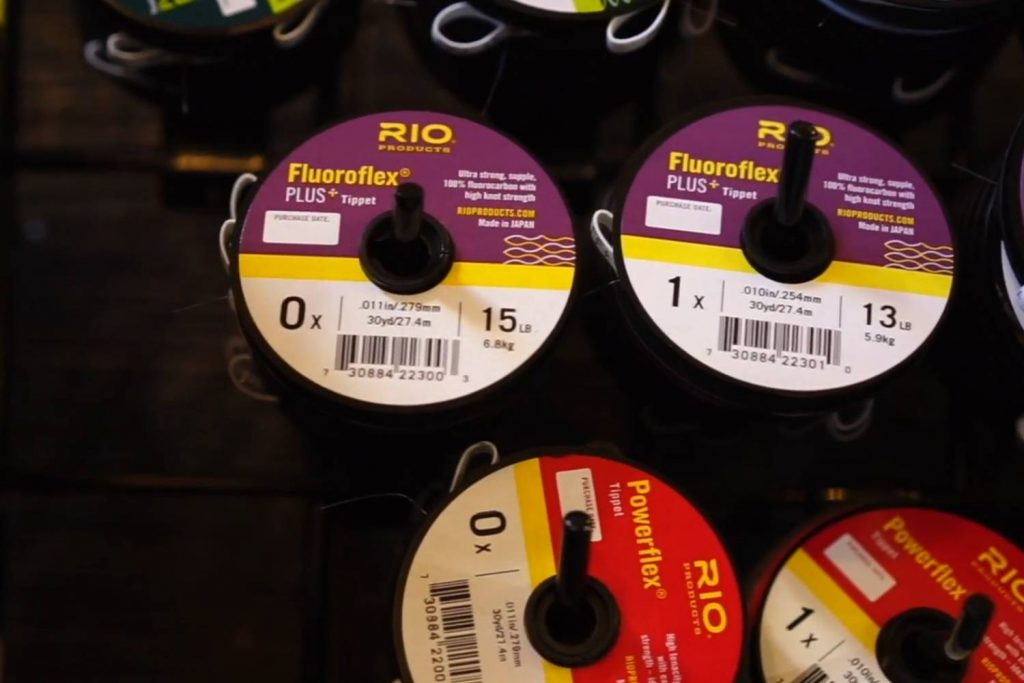
Nylon or fluorocarbon tippet?
Neither material is universally better. Fluorocarbon is not literally invisible underwater, and nylon is not automatically weaker or less abrasion-resistant. Strength, diameter, stiffness, abrasion resistance, knot performance and sink behavior all vary with the exact product and size.
| Factor | Nylon | Fluorocarbon |
|---|---|---|
| Visibility | Visible properties vary with finish, diameter, light and water | Often chosen for lower underwater visibility, but not invisible |
| Stiffness | Often more supple, though formulas differ | Often stiffer, though formulas and diameters differ |
| Surface and sink behavior | Often preferred when keeping a dry-fly terminal section near the surface matters | Often preferred for subsurface work; actual behavior depends on the whole rig |
| Knots | Use a knot proven for the exact material and diameter | Seat knots carefully and follow the product maker’s guidance |
| Abrasion and strength | Compare like-for-like products and diameters; the material name alone does not settle either property | |
For a dry fly, many anglers start with nylon because it is generally easier to keep in the surface film. For nymphs or other subsurface presentations, fluorocarbon may be useful. Those are practical starting points, not rules: fly weight, current, leader treatment, diameter and product design can change the result.
Understanding tippet size and the X system
On common trout tippet, a higher X number means a smaller diameter: 3X is thicker than 5X, and 5X is thicker than 7X. The X rating is principally a diameter convention, not a universal promise of breaking strength. Two products marked with the same X may differ in stated strength, stiffness and knot behavior.
The familiar “rule of three”—divide the fly size by three to estimate an X size—is only a starting guideline. A size 12 fly points roughly toward 4X; a size 18 points roughly toward 6X. Then adjust for the actual fly, fish and conditions.
A practical selection order
- Start with the fly. The tippet must pass through the eye and let the fly move and turn over appropriately.
- Protect the fish and land it promptly. Use enough strength for the expected fish, current and cover rather than choosing the finest material possible.
- Account for fly resistance. Large, weighted or bushy flies usually need stiffer or thicker terminal material than a sparse small fly.
- Check the water and wind. Clear water may call for a finer or longer terminal section, while wind and tight casting space may favor a shorter, stronger one.
- Test the knots. Published straight-pull strength does not guarantee the strength of your chosen knot.
Make small changes. If the leader will not straighten, the tippet may be too long or too fine for the fly. If presentation is too heavy, reduce diameter or adjust length without dropping below a responsible landing strength.
How fly line, leader and tippet connect
- Fly line to leader: loop-to-loop is common when both parts have sound loops. A nail-knot-style or other approved connection may be needed when a loop is absent. Inspect any welded loop for cracking or separation.
- Leader to added tippet: a surgeon’s knot, blood knot or another line-to-line knot can work when it suits both diameters and materials. Large diameter jumps and poorly seated wraps reduce reliability.
- Tippet to fly: choose a knot that suits the hook eye, material and presentation. Moisten where appropriate, tighten smoothly, trim the tag and pull-test the finished knot.
A tippet ring is an optional alternative at the leader-to-tippet junction. It can preserve leader length and simplify repeated changes, but it adds two knots and must be sized for the rig. For placement and tying steps, see how to use tippet rings.

Care and disposal
Run the leader and tippet between your fingers to find nicks, flat spots and wind knots. Replace damaged material, and retest every connection after a snag or hard pull. Keep clipped nylon and fluorocarbon in a closed pocket or line-waste container and take it home; loose strands can entangle wildlife.
Leader and tippet FAQs
Do you need both a leader and tippet?
You need a leader between fly line and fly, and you need a fine terminal section at the fly. On a new tapered leader, that terminal section is already part of the leader, so a separate added piece of tippet is optional until the tip needs changing or extending.
Do you add tippet to a new leader?
Not always. First check the leader’s labeled terminal size and condition. Add tippet only when you need a different material or diameter, extra length, or a replaceable section that preserves the taper.
What comes first: leader or tippet?
Starting at the fly line, the leader comes first, then the terminal tippet, then the fly. Backing is behind the fly line on the reel.
How long should the tippet section be?
There is no fixed two- or four-foot requirement. Use enough to achieve the needed presentation while retaining turnover, control and responsible landing strength. Fly size and resistance, water, wind and the leader’s existing taper all matter.
Can fluorocarbon be used for dry flies?
It can, but it may make it harder to keep the terminal section at the surface than a comparable nylon setup. Use the material that gives the required presentation, and do not treat either category as universally superior.
Putting it together
Begin with the correct sequence—fly line, leader, tippet, fly—then choose the leader for turnover and presentation. Treat nine feet and the rule of three as starting points, not laws. Match the terminal material and diameter to the actual fly, fish, water and wind, and test every knot before casting.
