
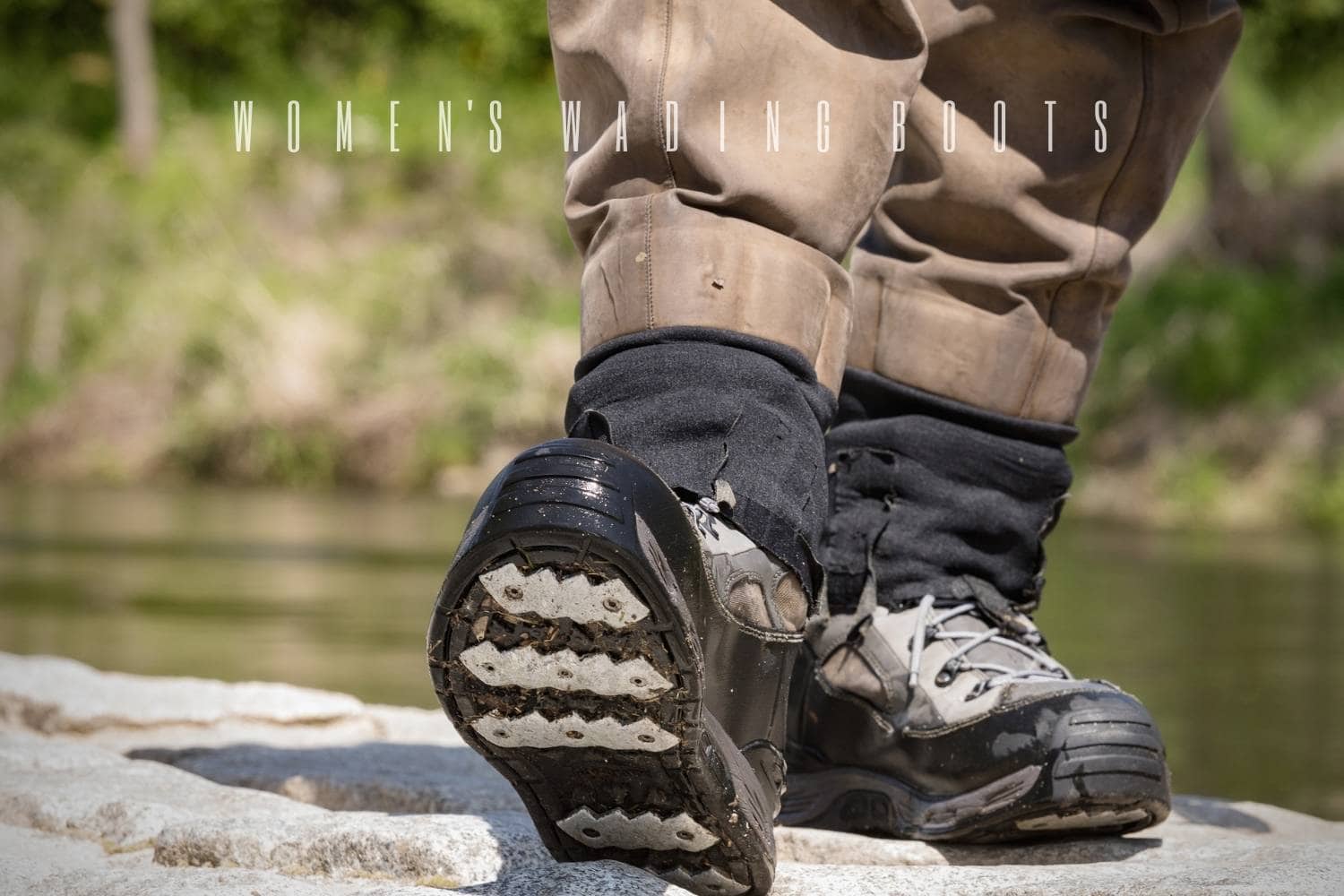
A wading boot determines how securely you can move over wet rock, how much support you have on uneven ground, and how well the footwear drains after immersion.
Our top recommendation is the Simms Women's Freestone.
The current women’s-specific choices differ most in sole package, closure, weight and fit range. The Simms Freestone offers separate felt and rubber models, the Orvis Ultralight prioritizes lower published weight, and the Korkers Darkhorse provides interchangeable soles. Redington no longer lists the SIREN.
Current model status and generation notes
Confirm the exact current model before buying, because familiar names now cover changed specifications or discontinued products.
- Simms Women’s Freestone: the current models run in women’s sizes 5–12; Simms lists 54 oz per pair for felt and 51 oz for rubber at size 8.
- Orvis Women’s Ultralight: the current boot uses a recycled ripstop polyester upper, laminated TPU mudguard and Michelin rubber outsole. It is a different generation from the discontinued Clarino/Vibram version.
- Korkers Women’s Darkhorse: the current boot uses a Boa M4 dial. Earlier Boa M2 versions are a different closure generation.
- Redington Women’s SIREN: Redington no longer lists this boot in either its general wading collection or its women’s collection.
Match the item, construction, sole and closure shown on the current manufacturer page; a familiar model name alone does not establish that the boot is unchanged.
Women's wading boots at a glance
| Boot | Sole options | Sizes | Stated weight | Closure | Suited to | Action |
|---|---|---|---|---|---|---|
| Simms Women's Freestone | Felt, or rubber as a separate model | 5–12 | 54 oz per pair, felt, size 8 | Laces | Conventional felt or rubber configurations | Check Trident Price |
| Orvis Women's Ultralight | Rubber only, stud compatible | 6–11 whole | 38 oz per pair | Laces | Lower dry weight, long approaches | Check Trident Price |
| Korkers Women's Darkhorse | Two interchangeable sets in the box | 5–11 | 3 lb 3 oz per pair, felt | Boa M4 dial | Changing sole requirements | Check Trident Price |
| Orvis Women's Clearwater | Felt or rubber, separate models | 6–11 whole | Not published | Laces | Documented wider footbed | Check Trident Price |
Quick verdicts
- Simms Women's Freestone — conventional felt or rubber choice. The separate felt and rubber models share a women's size range of 5–12. On the felt outsole, Simms permits studs only, not star cleats.
- Orvis Women's Ultralight — lowest published dry weight here. Orvis states 38 oz per pair and describes it as the lightest boot the company has offered. It is rubber only and stud compatible.
- Korkers Women's Darkhorse — interchangeable sole system. Each package contains two sole sets, allowing the same boot to use different compatible OmniTrax outsoles. It is the heaviest current main pick by published dry weight.
- Redington Women’s SIREN — discontinued. It is absent from Redington’s current collections; see the lifecycle note and current alternatives.
The picks in detail
Simms Women's Freestone Wading Boot
Simms builds the Freestone around a synthetic scratch leather upper with toe and heel reinforcement, a partial neoprene lining and a dual-density EVA midsole. The felt model uses a 12 mm felt outsole and is published at 54 oz per pair at a women's size 8; the rubber model of the same boot comes in at 51 oz. Both run women's sizes 5 to 12.
The partial neoprene lining distinguishes its construction from the other main picks and adds a soft interface around the stockingfoot. It does not make the boot waterproof: wading boots are designed to admit and drain water.
One constraint is easy to miss: Simms lists the felt version as studs only, with star cleats available on the rubber outsole instead. If you want aggressive add-on traction, the rubber model accepts more.
Orvis Women's Ultralight Boots
The current version uses 100% recycled ripstop polyester uppers and a laminated TPU mudguard over a stud-compatible Michelin rubber outsole, on EVA midsoles, in women’s whole sizes 6 to 11. Orvis states 38 oz per pair and calls it the lightest boot the company has offered.
Its published dry weight is 16 oz below the felt Freestone figure. Manufacturer weights are not controlled laboratory comparisons and may use different reference sizes, but the gap still makes the Ultralight the clearest low-weight option in this set for travel and longer approaches.
What you give up is sole choice: there is no felt option on this nameplate, though the outsole takes studs.
Korkers Women's Darkhorse
The Darkhorse is the flexible one. Korkers ships two sole sets in the box using its OmniTrax interchangeable system — either felt paired with a Kling-on sticky rubber sole, or a studded Kling-on paired with a plain one, depending on the package. Confirm the exact included package before ordering.
It is a 9 inch boot on a Boa M4 dial, published at 3 lb 3 oz per pair with felt fitted, in women's sizes 5 to 11. The upper is a hydrophobic abrasion-resistant material with a moulded TPU toe cap, and Korkers describes water flowing "thru internal channels then out midsole ports, removing excess water and weight".
Korkers is unusually direct about the fit, describing the boot as "re-engineered to actually fit a woman's foot instead of forcing it onto a smaller men's model". The women's model runs from 5 to 11, while the men's runs from 7 to 15. Those ranges overlap, so the evidence for a women's-specific build is Korkers' explicit construction statement, not an inference from size numbers. Our Korkers wading boots review covers the sole system across the range.
Redington Women's SIREN — discontinued
Redington names no successor to the SIREN. Its current women’s boots are rubber-soled and are not described as like-for-like replacements, so shoppers who need felt should compare the Orvis Clearwater Felt or Simms Freestone Felt instead.
Buy by requirement instead. For a felt sole at a similar position in the range, the Orvis Women's Clearwater felt boot is women's-specific in whole sizes 6 to 11, with a full synthetic leather upper, a rubber toe bumper, a phylon midsole and an ESS plate for stud retention. For felt on a longer size band, the Simms Freestone above starts at a 5.

What "women's specific" actually means on these boots
The phrase gets used loosely. What manufacturers publish is not a claim about women's feet in general — it is a claim about their own construction.
Korkers says the Women's Darkhorse was "re-engineered to actually fit a woman's foot instead of forcing it onto a smaller men's model". Orvis says the Ultralight is "built and sized specifically for women", and describes the Clearwater as "specifically designed and built for a woman's foot" with an EVA footbed offering "all-day comfort and a wider fit". Orvis draws the line the other way too: its PRO BOA boot is listed as unisex, fitting both men and women. Simms sells its women's Freestone as a distinct product with its own size band and quotes weight at a women's size 8.
What none of them publish is a last-volume figure or instep measurement. The manufacturers do document women-specific construction or positioning on these models, and Orvis documents a wider footbed on the Clearwater. How any boot suits your particular foot is a fitting-room question, not a specification question.
Sizing over a stockingfoot
Wading boots are sized to be worn over the neoprene stockingfoot of a pair of waders, not over a sock. Simms's guidance for its own boots is to "use your regular street shoe size when ordering wading boots", adding that "if you are a half size, then you should size up to the next full size". That half-size rule matters more than it sounds, because two of the boots here are sold in whole sizes only.
Boot and wader compatibility
These boots are intended for stockingfoot waders, but the usable volume depends on the boot, the neoprene stockingfoot and the socks underneath it. Fit the boots over the exact waders and socks you plan to use; our Simms Freestone waders review covers that half of the pairing. Bootfoot waders need no separate boot. For boats, flats or other fishing that does not require a wading boot, see our guide to comfortable fishing shoes.
Choosing a sole: felt, rubber and studs
The traction tradeoff
Felt can grip well on algae-coated submerged rock. Its trade-offs are poor performance on mud, snow and many dry approaches, slower drying, and legal restrictions in some destinations.
Rubber is the practical default for mixed terrain and travel. Compatible studs or cleats can improve grip on some rock, but performance depends on the outsole, hardware, rock and installation. Metal traction can damage boat decks and may be restricted in some settings. Check both the destination rules and what the exact boot accepts: Simms permits studs but not star cleats on its felt outsole, while the rubber version accepts both.

Where felt is restricted
Felt is prohibited in fresh water in a number of jurisdictions, and the rules are set locally, so check the water you actually fish before you buy. Alaska is the clearest example: the Alaska Department of Fish and Game states that "effective January 1, 2013, felt-soled waders and wading boots will no longer be legal" footwear when hunting in the state's fresh water, alongside an existing sport fishing prohibition.
The reasoning is specific rather than general caution. ADF&G's position is that absorbent felt traps sediment and living organisms — including whirling disease spores, Didymo cells and invertebrate larvae — deep in the fibres, and that "viable invasive organisms could be found within the fibers of felt soles even after various decontamination protocols were implemented". The problem with felt is not that it is hard to clean; it is that cleaning may not be enough.
For a state-by-state picture, see our article on where felt wading boots are banned. Rules change, so confirm with the local agency.
Cleaning, drying and invasive species care
Whatever sole you choose, the between-waters routine is the same. ADF&G publishes four steps: clean — "rinse and remove any mud, sediment, and/or plant debris from all gear"; drain — "empty all water" and wring out gear; dry — "completely dry gear between waterbodies or trips"; and decontaminate — freeze gear until solid, or wash it in 140 °F hot water while scrubbing with a stiff bristle brush.
Drying is the step people skip and the hardest with boots. In my experience wading boots take dramatically longer to dry than waders — waders are close to dry by the time the car is packed, and boots can still be damp days later. That is a real argument for good drainage and a lighter synthetic upper.
Which boot suits which angler
Fish one river system where felt is legal, over rounded algae-covered freestone rock? The Simms Women's Freestone in felt is the most direct answer, with the neoprene lining earning its keep in cold water. Take the rubber version if you want star cleats as well as studs.
Long walk in, or boots that travel in a bag? The Orvis Women's Ultralight is the one to beat on weight, and rubber-only is no handicap on felt-restricted water.
Crossing state lines, or simply wanting more than one compatible traction option? The Korkers Women's Darkhorse provides two sole sets in each package. It is the heaviest of the three main picks by published dry weight. If you want a manufacturer-described wider footbed, the Orvis Women's Clearwater comes in separate felt and rubber models.

Questions we get asked
Do I size up for wading boots?
Not as a universal rule. Simms's guidance for its own boots is to order your regular street-shoe size, rounding up to the next full size only if you are a half size. Follow the exact model's chart and try it with your stockingfoot and fishing socks.
Can I put studs in any of these?
No. Use only the hardware or sole package approved for the exact boot. Simms lists its women's Freestone felt outsole as studs only, while the rubber version accepts studs and star cleats. The Orvis Ultralight is stud compatible, and Korkers offers a studded interchangeable sole package.
What happened to the Redington SIREN?
It is absent from Redington's current catalogue after the brand's storefront was consolidated under Far Bank. Third-party listings can persist, but the manufacturer no longer lists the model and has named no replacement.
Are women's wading boots just smaller men's boots?
It depends on the model. Korkers says the Women's Darkhorse was re-engineered rather than downsized, while Orvis lists its Ultralight and Clearwater as women's-specific and its PRO BOA as unisex. The useful evidence is the manufacturer's construction and fit guidance, not the product name alone.
Do I need wading boots if I already have hiking boots?
For routine wading with stockingfoot waders, use footwear designed for immersion, drainage, wet traction and the volume of a neoprene stockingfoot. I have waded in ordinary shoes; my feet were cold and that pair deteriorated within about a week.
Related reading
- The best wading boots overall
- Korkers wading boots review
- Which states have banned felt sole wading boots
- Simms Freestone waders review
- Best fishing shoes
Final recommendation
Our final recommendation is the Simms Women's Freestone.
Sources
Specifications, size bands and lifecycle status come from manufacturer records checked in August 2026. Prices and availability change constantly and are deliberately not quoted here.
- Simms — Women's Freestone Wading Boot, Felt Sole
- Simms — Women's Freestone Wading Boot, Rubber Sole
- Orvis — Women's Ultralight Boots
- Orvis — Women's Clearwater Wading Boots, Felt Sole
- Korkers — Women's Darkhorse
- Far Bank — Redington women's wading collection
- Alaska Department of Fish and Game — preventing invasive species
