
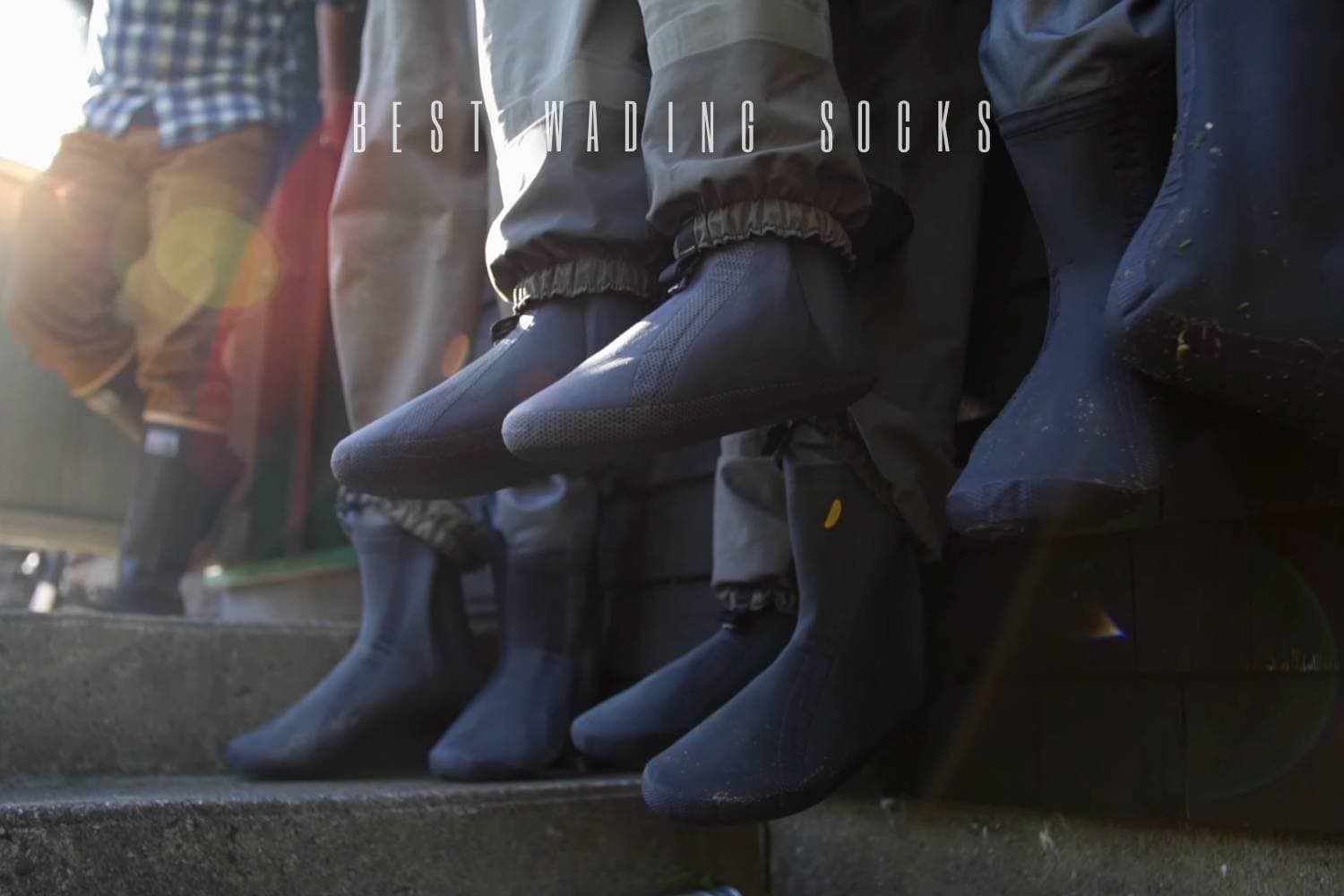
Bottom line: “wading sock” is an umbrella term, not one product class. For wet wading in separate boots, choose a neoprene sock that restores boot volume and matches the water temperature. Add an integrated gravel guard if you regularly collect grit around the laces. For cold-weather fishing in waterproof stockingfoot waders, choose a merino or synthetic liner sock instead. None of these products is exterior footwear.
Our top recommendation is the Simms Neoprene Wading Socks.
Fly Fisher Pro has hands-on experience with the exact Korkers I-Drain family; that pair was bought or borrowed, never gifted. The Simms Neoprene, Orvis Guard and Orvis Heavyweight recommendations draw on current manufacturer specifications.
Best wading socks: quick comparison
| Model | Correct use | Construction | Fit range and evidence | Action |
|---|---|---|---|---|
| Simms Neoprene Wading Socks | Low-profile neoprene wet-wading bootie; no integrated guard | 2.5 mm neoprene upper and perforated 2.5 mm underfoot | Unisex XS–XL | Check Trident Price |
| Orvis Neoprene Guard Socks | Wet-wading bootie with rollover gravel guard | 3 mm perforated stretch neoprene/polyester | XS–XL shoe-size bands | Check Trident Price |
| Korkers I-Drain Guard Socks | Higher-volume wet-wading bootie with integrated guard | 3.5 mm neoprene upper and perforated Airprene underfoot | Unisex SM–XL; exact family used | Check Trident Price |
| Orvis Heavyweight OTC Wader Socks | Insulating liner inside waterproof stockingfoot waders | Heavyweight merino-based wool/nylon/spandex blend | Unisex XS–XL | — |
Thickness is a fit decision before it is a warmth contest. A 3.5 mm bootie occupies more room than a 2.5 mm one, so a thicker option can create pressure and restrict toe movement even when it offers more material. Try the exact sock with the boot, footbed and any liner you intend to use.
Low-profile neoprene choice
Simms Neoprene Wading Socks
Evidence: Current manufacturer specifications.
Simms’ current Neoprene Wading Socks are the current generation. They use 2.5 mm abrasion-resistant neoprene above the foot and perforated 2.5 mm neoprene underfoot for drainage. Left/right anatomical patterning is intended to reduce bulk and make the socks easier to put on and remove.
The current unisex chart runs from XS through XL: men’s 4-5/women’s 6-7 at XS, then men’s 6-7, 8-9 and 10-11 through S-L, with XL for men’s 12 and above. Check the live chart rather than translating the letter size from an ordinary hiking sock.
This is the cleanest choice here when you want 2.5 mm bootie volume and do not need a built-in guard. The current model uses perforated neoprene underfoot, begins at XS and has its own shoe-size map.
Integrated-guard choice
Orvis Neoprene Guard Socks
Evidence: Current manufacturer specifications.
The current Orvis Neoprene Guard Socks combine a 3 mm perforated neoprene/polyester bootie with a 14-inch shaft and rollover gravel guard. The cuff covers the laces to reduce the route available to sand and small stones. It does not seal the boot, so fit and occasional cleaning still matter.
Orvis lists XS 5-7, S 7-9, M 9-10, L 10-11 and XL 11-13. Those overlapping bands make a boot trial valuable if you sit at a boundary. The four-way-stretch, anatomical pattern is intended to keep bulk down, but the guard and 3 mm construction still occupy more space than the Simms 2.5 mm no-guard sock.
The current Orvis version uses 3 mm construction and a new size chart, distinguishing it from the retired 2.5 mm version.
Higher-volume guard sock
Korkers I-Drain Neoprene Guard Socks, 3.5 mm
Evidence: Fly Fisher Pro used an I-Drain pair; Korkers currently lists the same product family and specifications.
The Korkers I-Drain family uses a 3.5 mm neoprene upper, perforated Airprene underfoot and an integrated gravel guard. The current size map is SM for men’s 6-8/women’s 8-10, MD for men’s 9-10/women’s 11-12, LG for men’s 11-12/women’s 13-14 and XL for men’s 13-14.
Korkers currently lists the same I-Drain family and defining construction as the pair we used. That pair felt comfortable while walking, was easy to pull on and remove, drained promptly after leaving the water, and its guard reduced debris entry. Fit and production can vary, so try the current sock with your own boot system.
Choose it for the integrated guard and 3.5 mm volume, not because “thicker is always warmer.” More neoprene can add insulation, but a tight boot can restrict toe movement and comfort. Compare it against your boot’s available space.
Cold-weather liner category
Orvis Heavyweight OTC Wader Socks
Evidence: Current manufacturer specifications.
The Orvis Heavyweight OTC Wader Sock is an over-the-calf liner for use inside a waterproof wader stockingfoot. Orvis specifies a wool/nylon/spandex blend, heavyweight merino construction, reinforced heel, toe and upper-ankle zones, and a ribbed arch. The current chart spans XS through XL with explicit men’s and women’s shoe-size mappings.
This is an insulating liner rather than a wet-wading bootie: the textile sock sits against the foot, the wader’s neoprene stockingfoot goes over it, and the wading boot goes outside both. Merino can manage moisture and insulation, but it does not make a leaking wader waterproof or guarantee dry feet.
Use the current heavyweight merino-blend construction and size chart when choosing a pair.
How to fit and use wading socks
Wet wading in stockingfoot-sized boots
A wading boot normally accommodates the neoprene stockingfoot attached to a wader. When you switch to shorts, a neoprene wet-wading sock restores some of that volume and reduces direct rubbing. Wear the exact bootie, footbed and any thin liner during the fit check. Your heel should be controlled, while your toes should still move without pressure.
If you still need exterior footwear, compare our wading boot guide. Wet-wading shoes and ordinary fishing footwear belong to a separate decision; see the fishing shoes guide rather than treating a neoprene sock as a shoe.
Inside waterproof waders
Use a smooth liner sock that suits the water temperature and the room inside the stockingfoot and boot. Avoid cotton, which holds water and loses comfort when damp. Avoid stacking thick socks until the boot is tight: trapped air helps insulation, while compressed toes and friction work against it. For the complete layering system, use our guide to what to wear under waders.
When an integrated gravel guard helps
A guard is useful on sandy or gravelly approaches because it covers the lace opening. Secure the lace hook if the design provides one, but do not overstretch the cuff or assume it is watertight. A no-guard sock can still work where debris is limited or when you already use a compatible separate gaiter.
Wet-wading safety and sock care
- Dress for the water, not the air: warm weather can hide cold streams. Sudden immersion can cause cold shock, impaired breathing and rapid loss of useful movement. A neoprene sock is not flotation.
- Choose a conservative route: check current, depth, footing, weather and the exit before entering. Use a suitable PFD where conditions or local guidance call for one; more neoprene does not make deeper or faster water safe.
- Protect the foot: use proper exterior footwear, check for grit, and stop if numbness, pressure, rubbing or loss of circulation develops.
- Clean between waters: remove mud, plants and organisms, then clean, drain and dry boots, socks and other wet gear according to local and land-manager guidance.
- Dry before storage: follow the exact care label, rinse grit as needed, dry both sides completely and keep neoprene away from damaging high heat. Do not seal damp socks in a gear bag.
- Check local rules: traction and invasive-species requirements vary. Review our current felt-sole rules guide and confirm the rules for the water you will fish.
Wading socks FAQ
Do you wear socks under neoprene wet-wading socks?
You can use a thin, smooth liner if it improves comfort, but only if the boot still fits without toe pressure or bunching. Test the complete system. A thick liner plus a thick neoprene bootie can make the boot too tight.
Are neoprene socks waterproof?
No. Wet-wading neoprene socks are intended to get wet. Neoprene slows heat transfer and protects against rubbing, while perforated footbeds intentionally drain water. Waterproofness comes from intact waders or purpose-built waterproof footwear, not these booties.
Can you walk in neoprene wading socks without boots?
No. The footbed is not an exterior outsole and offers no reliable protection from sharp rock, hooks or slippery surfaces. Wear a compatible wading boot or wet-wading shoe.
Are gravel guards necessary?
Not everywhere. They are helpful where sand and small stones enter around the laces, but a well-fitted no-guard sock may be simpler in cleaner conditions. A guard reduces debris entry; it does not seal the boot.
Which thickness should you choose?
Start with boot volume and water conditions. A 2.5 mm sock is lower bulk; 3-3.5 mm options occupy more space and may add insulation. The best choice leaves room for toe movement and does not create pressure when wet.
Final recommendation
Our final recommendation is the Simms Neoprene Wading Socks.
For a low-profile wet-wading bootie, start with the current Simms Neoprene Wading Socks. Choose Orvis Neoprene Guard Socks when an integrated guard and 3 mm construction fit your boot. Choose Korkers I-Drain Guard Socks when you want an integrated guard and can accommodate 3.5 mm volume; Fly Fisher Pro used an exact-family pair and found it comfortable, easy to put on and quick to drain. For cold fishing inside waterproof waders, switch categories and use an insulating liner such as Orvis Heavyweight OTC Wader Socks.
Whatever you choose, verify the exact size with the complete boot system. Fit, circulation, exterior traction and a conservative wading plan matter more than a “warmest” label.
Sources checked
- Simms Neoprene Wading Socks
- Archived Simms product page, January 20, 2022
- Orvis Neoprene Guard Socks
- Korkers I-Drain Neoprene Guard Socks, 3.5 mm
- Archived Korkers I-Drain Guard Socks page, June 19, 2021
- Orvis Heavyweight OTC Wader Socks
- NOAA/National Weather Service cold-water safety guidance
- National Park Service invasive-species prevention guidance
