
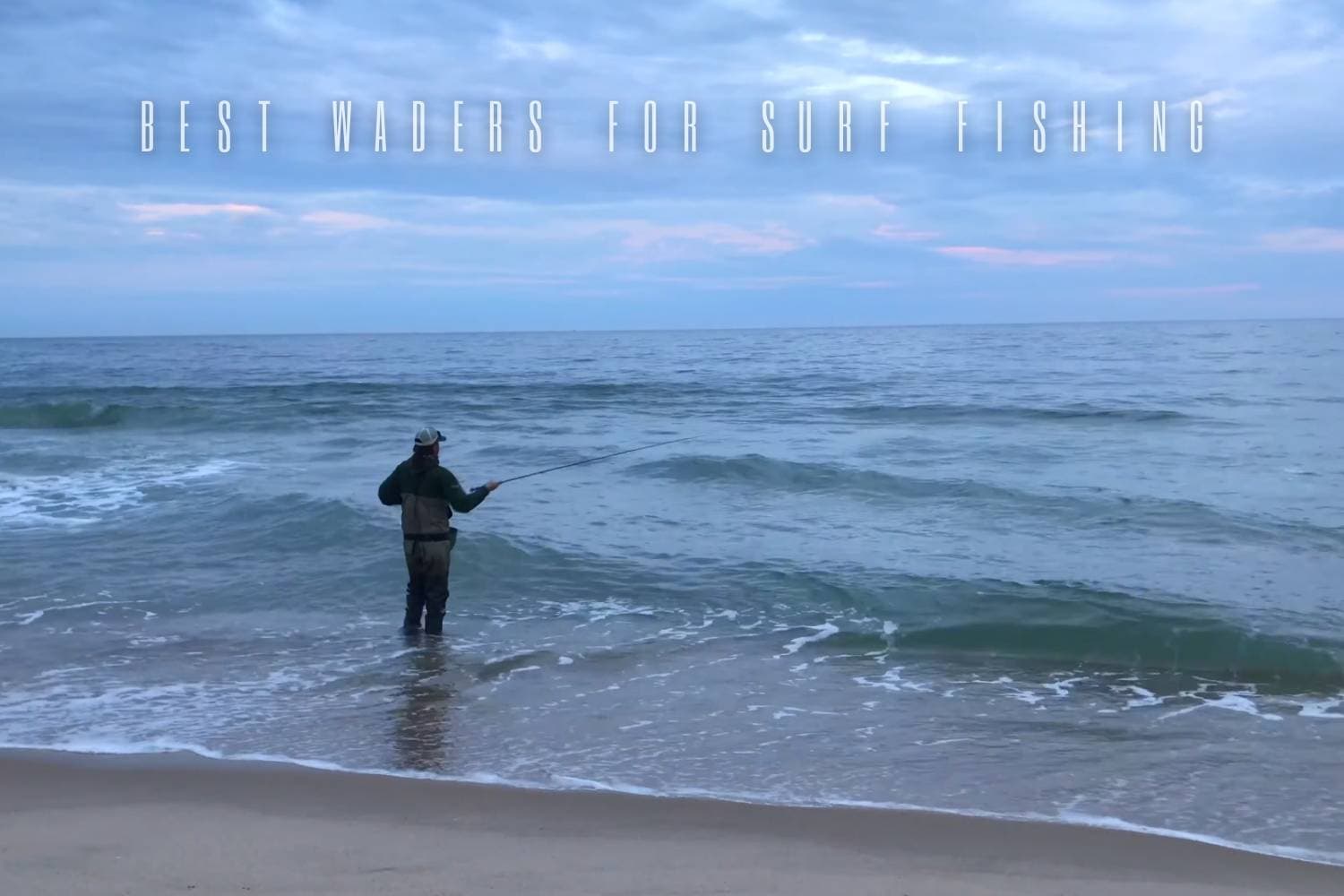
Quick answer: the Orvis Men’s PRO Waders are our best overall surf-fishing waders. The current Orvis PRO version is the same long-running model we used, with a tough 4-layer upper, 5-layer lower legs and a broad fit range. Pair them with supportive rubber-soled wading boots suited to the beach, rocks and access trail.
Choose the Frogg Toggs Hellbender PRO Lug Bootfoot when you want the speed and sand resistance of an integrated lug boot. The SteelHeader Felt is the coldest-weather option here, but only where felt is legal and appropriate for the shoreline.

Best surf-fishing waders at a glance
- Best overall: Orvis Men’s PRO Waders
- Best reinforced stockingfoot alternative: Simms Men’s G3 Guide
- Best lug-sole bootfoot: Frogg Toggs Hellbender PRO
- Best for extreme cold where felt is legal: Frogg Toggs SteelHeader Felt
- Best lower-cost stockingfoot with flexible fits: Caddis 2-Tone Taupe Deluxe
The best waders for surf fishing compared
Quick comparison
Five current waders for distinct surf-fishing needs, checked August 5, 2026.
| Wader | Best for | Foot style | Evidence | Action |
|---|---|---|---|---|
| Orvis PRO | Overall durability and fit | Stockingfoot | Exact Orvis PRO version used | Check Trident Price |
| Simms G3 Guide | Reinforced premium alternative | Stockingfoot | Current Spring 2022 manufacturer specifications | Check Trident Price |
| Hellbender PRO Lug | Integrated lug boot | Bootfoot | Current manufacturer specifications | — |
| SteelHeader Felt | Extreme cold where felt is suitable | Insulated felt bootfoot | Current manufacturer specifications for the exact felt model | — |
| Caddis 2-Tone Deluxe | Lower-cost flexible fit options | Stockingfoot | Current manufacturer specifications | View on Amazon |
How we tested and verified these waders
The waders used by the named author were bought or borrowed, never gifted. We assessed fit, mobility, layering room, bootie comfort, gravel-guard coverage, storage, durability and how the waders felt through full fishing days.
Our hands-on findings cover the current Orvis PRO version. The Simms G3, Hellbender PRO, SteelHeader Felt and Caddis Deluxe assessments use current manufacturer specifications.
Surf suitability is more than waterproofing. We also considered separate-boot support, sand entry, outsole type, cold-water layering, corrosion exposure, cleaning and the practical consequences of walking on beaches, rocks and access trails.
Current surf-wader picks
Pick 1 of 5
Orvis Men’s PRO Waders: Best overall
Evidence: Hands-on use of the current Orvis PRO version
Verdict: choose the Orvis PRO when durability, fit choice and a dependable repair pathway matter more than minimum weight. The lower legs use five layers of CORDURA fabric, while the upper uses four, giving exposed knees and shins additional protection around rocks and shell-strewn beaches.
We used the Orvis PRO Waders. Orvis still sells the current version with its low-profile seams, anatomical neoprene booties, reinforced gravel guards, chest storage and removable knee pads. It can also convert to waist height when conditions permit, although surf safety—not garment height—must control wading depth.
Reasons to choose it
- Five-layer lower legs for exposed areas
- Broad body and inseam options
- Removable knee pads and waist-high conversion
- Exact current version matches the tested construction
Reasons to skip it
- Heavier and bulkier than a lightweight wader
- Requires separate boots and careful sand control
Pick 2 of 5
Simms Men’s G3 Guide: Best reinforced stockingfoot alternative
Evidence: Current Simms specifications
Verdict: the current G3 Guide is a robust stockingfoot option for anglers who want a reinforced GORE-TEX lower and a detailed fit matrix. Its 3-layer upper and 4-layer GORE-TEX Pro lower are paired with abrasion-resistant gravel guards and anatomical neoprene stockingfeet.
The current G3 is the Spring 2022 generation. Simms lists a 50.1-ounce weight, current color options and its present size matrix for this model.
Reasons to choose it
- GORE-TEX Pro reinforcement below the waist
- Many torso, inseam and bootie combinations
- Separate boots let you choose surf-appropriate support and traction
Reasons to skip it
- Heavy for long beach walks and warm conditions
Pick 3 of 5
Frogg Toggs Hellbender PRO Lug Bootfoot: Best integrated lug boot
Evidence: Current Frogg Toggs specifications
Verdict: choose the Hellbender PRO Lug when you want a one-piece bootfoot wader without felt. The integrated boot reduces the gap where surf sand can work into a separate wading boot, and the lug outsole is more practical than felt across mixed beach, trail and mud.
The current model uses a 4-ply nylon upper, double-reinforced knees, a locking wading belt and adjustable X-back suspenders. Its neoprene-lined boot includes a steel shank, reinforced midsole, toe cap and heel kicker. That is useful structure for a bootfoot, but it is not a substitute for conservative footing in waves.
Reasons to choose it
- Fast one-piece setup
- Fewer openings for sand and fine debris
- Lug outsole avoids felt restrictions
- Reinforced boot and double knees
Reasons to skip it
- Boot and body fit cannot be chosen independently
- Bulkier to pack and dry than stockingfoot waders
Pick 4 of 5
Frogg Toggs SteelHeader Felt: Best for extreme cold where felt is suitable
Evidence: Current Frogg Toggs specifications for the exact felt model
Verdict: the current SteelHeader Felt is a specialist cold-weather choice, not the default surf wader. It combines a breathable 4-ply nylon upper with reinforced knees and seat, a removable insulated liner and a heavily insulated boot.
The felt outsole is intended for certain submerged rock conditions. It can be a poor match for sand, mud, snow, trails and mixed shoreline access, and felt is restricted in some destinations. Check the exact water and land manager before buying or traveling.
Reasons to choose it
- High cold-weather insulation
- Removable liner broadens the temperature range
- Reinforced knees and seat
Reasons to skip it
- Felt is restricted in some destinations
- Felt is poorly suited to many beach approaches
- Heavy insulation can be excessive outside severe cold
Pick 5 of 5
Caddis 2-Tone Taupe Deluxe: Best lower-cost stockingfoot
Evidence: Current Caddis Deluxe specifications
Verdict: the current Caddis Deluxe is the value choice when fit flexibility matters more than premium fabric claims. Its current catalog offers standard, stout, tall and short-stout configurations, which can help anglers avoid an overlong inseam or tight torso.
The polyester breathable construction includes doubled knees, adjustable suspenders, attached gravel guards and a multi-pocket chest. Caddis does not identify this as a Northern Guide successor and does not assign the old Northern Guide’s 240-denier guide-duty specification to it.
Reasons to choose it
- Several torso and inseam combinations
- Doubled knees and attached gravel guards
- Separate boots allow customized support and traction
Reasons to skip it
- Different construction and feature set from the retired Northern Guide
- Less detailed material and repair documentation than premium picks
Discontinued and older surf-wader models
- Redington Sonic-Pro: the reviewed 2016/17 regular Sonic-Pro family is discontinued, and Redington no longer sells waders. Sonic-Pro HD and HDZ were separate historical models, not successors.
- Caddis Northern Guide: the stockingfoot and separate bootfoot Northern Guide families are retired or unavailable for an evergreen buying guide. The Caddis Deluxe above is a current role alternative, not a renamed Northern Guide.
- Cabela’s Spring Run: the lug and felt bootfoot waders were separate products, and neither appears in the current catalog.
- Pre-2022 Simms G3: the discontinued Cinder generation differs from the current G3 Guide in weight, color and fit details; Fly Fisher Pro’s hands-on findings cover only the Cinder model used.
- SteelHeader Cleated and Lug: the cleated and lug models are discontinued. The current model uses a felt sole.
How to choose waders for surf fishing
Bootfoot or stockingfoot?
Bootfoot waders are fast to put on, warm, and have fewer gaps where sand or mud can work inside. They are convenient for cold beaches and short walks. The compromise is fit: boot size and wader-body size are tied together, ankle support is usually less precise, and the complete unit is bulky to transport and dry.
Stockingfoot waders let you fit the wader and boot separately. That usually gives better ankle support and a wider choice of rubber, stud-compatible or other legal traction systems. They take longer to assemble, and fine sand can enter around the boot unless the gravel guards and boot fit work well together.
Breathable fabric or neoprene?
Breathable fabric is the versatile choice for most surf anglers. It releases some internal moisture, layers more easily across seasons and is less bulky for walking. It still needs an appropriate base and insulating layer; “breathable” does not mean warm by itself.
Neoprene and heavily insulated bootfoot systems make sense in severe cold and for anglers who spend less time walking. They can become hot, heavy and restrictive when air or water temperatures rise. Dress for the water temperature and planned exposure, not the forecast high alone.
Chest height does not make deeper surf safe
Chest waders provide splash coverage and layering space, but deeper water increases the consequences of waves, troughs, drop-offs and seaward current. Keep your fishing position conservative and leave before an incoming tide or building surf compromises the exit.
Choose traction for the whole approach
Consider the parking area, dune or trail, wet sand, mud, jetties and submerged rock—not just one patch of riverbed. Rubber or lug soles are the practical default for mixed access. Use studs only when the exact boot supports them and exposed metal will not create a hazard on smooth surfaces.
Felt can grip certain submerged rock, but it is not universally better and is prohibited in some jurisdictions. It also performs poorly on many dry, muddy, sandy or snowy approaches. Review the current felt-sole rules guide and then verify the exact destination.
Get enough room without creating excess fabric
Measure the largest torso point, inseam and foot or bootie size using the manufacturer’s chart. Allow room for the layers you actually wear and enough inseam length to step, crouch and climb without straining seams. Excessively loose fabric can fold and abrade; a tight crotch or bootie can restrict movement and stress seams.
Check repair terms, not just warranty headlines
Modern wader policies commonly distinguish early failure, manufacturing defects, ordinary wear and paid repair. Read the current terms for the exact model and country before purchase. Salt exposure, accidental damage and normal material breakdown may be treated differently from a manufacturing defect.
Surf-wading safety checklist
- Wear flotation: use a properly fitted, serviceable USCG-approved life jacket when on, in or near hazardous water.
- Fasten the belt: a snug waist-level wading belt can limit how quickly water enters during a fall.
- Check the water, not just the air: cold shock can disrupt breathing and muscle control before hypothermia develops.
- Read conditions: check forecasts, tide timing, rip-current information, thunderstorms and local closures.
- Watch before entering: observe several wave sets and look for troughs, drop-offs, submerged hazards and changing exits.
- Stay away from high-risk structures: rough seas, inlets, piers and jetties can combine waves with powerful currents and hard surfaces.
- Use a buddy and exit plan: tell someone where you are fishing and decide what condition will send you back to shore.
- Know rip-current response: do not exhaust yourself fighting directly against the current. Stay calm, move parallel to shore until clear, then angle back; float and signal if you cannot return.
- Never turn your back on the ocean: changing waves can reach farther than the previous set.
Saltwater care after every trip
- Rinse the outside with fresh water, including seams, suspenders, zippers, gravel guards, boots and metal hardware.
- Remove sand and plant material. Follow Clean, Drain, Dry and any destination-specific decontamination procedure.
- Dry the outside fully, then turn the waders inside out and dry the interior and stockingfeet.
- Remove approved liners or insoles for separate drying.
- Store completely dry in a cool place without sharp folds or prolonged heat.
Salt left on fabric, seams and hardware can accelerate damage. A quick rinse at the end of the day is easier than trying to restore neglected equipment later.
Surf-wader FAQ
What are the best waders for surf fishing?
The Orvis Men’s PRO Waders are our best overall pick because they retain the reinforced construction and broad fit range we valued in use. Pair them with supportive rubber-soled boots. Anglers who prefer an integrated boot should compare the Frogg Toggs Hellbender PRO Lug.
Are bootfoot waders better for surf fishing?
They can be. Bootfoot waders are quick, warm and resist sand intrusion, but the combined boot/body sizing is less precise and they are bulky to pack. Stockingfoot waders offer better separate boot fit, ankle support and traction choice.
Should I wear a life jacket with waders?
Yes when conditions create an immersion risk. Waders do not provide reliable flotation. NPS guidance recommends a properly fitted USCG-approved life jacket when on, in or near water, and cold-water guidance emphasizes flotation after unexpected immersion.
Does a wading belt make surf fishing safe?
No. A snug belt can limit water entry during a fall, but it does not eliminate wave, current, cold-water or terrain hazards. Use it together with flotation, conservative depth, condition checks and an exit plan.
Are felt waders good for the surf?
Only for selected conditions. Felt may help on some submerged rock but is poor on much sand, mud, snow and mixed shoreline access. It is also restricted in some places. Rubber or lug soles are the practical default for most surf trips.
How should surf-fishing waders fit?
They should allow your chosen layers and a full step or crouch without pulling at the crotch, knees or booties. They should not be so loose that folds rub continuously. Use the brand’s current torso, inseam and foot chart rather than street-clothing size alone.
How do I clean waders after saltwater fishing?
Rinse them thoroughly with fresh water after every saltwater use, remove sand and debris, and dry both the exterior and interior completely. Pay particular attention to seams, zippers, hardware, boots and removable liners.
Final recommendation
Our final recommendation is the Orvis PRO Waders.
Choose the Orvis PRO for the strongest combination of exact hands-on continuity, reinforced lower legs and fit choice. Choose the Hellbender PRO Lug for bootfoot convenience without felt, or the Caddis Deluxe when a lower-cost stockingfoot with several fit types makes more sense.
No wader compensates for unsafe surf. Match the garment to the water temperature, fit the traction to the entire approach, wear flotation and a belt, and turn back before waves, tides or fatigue remove your margin.
