
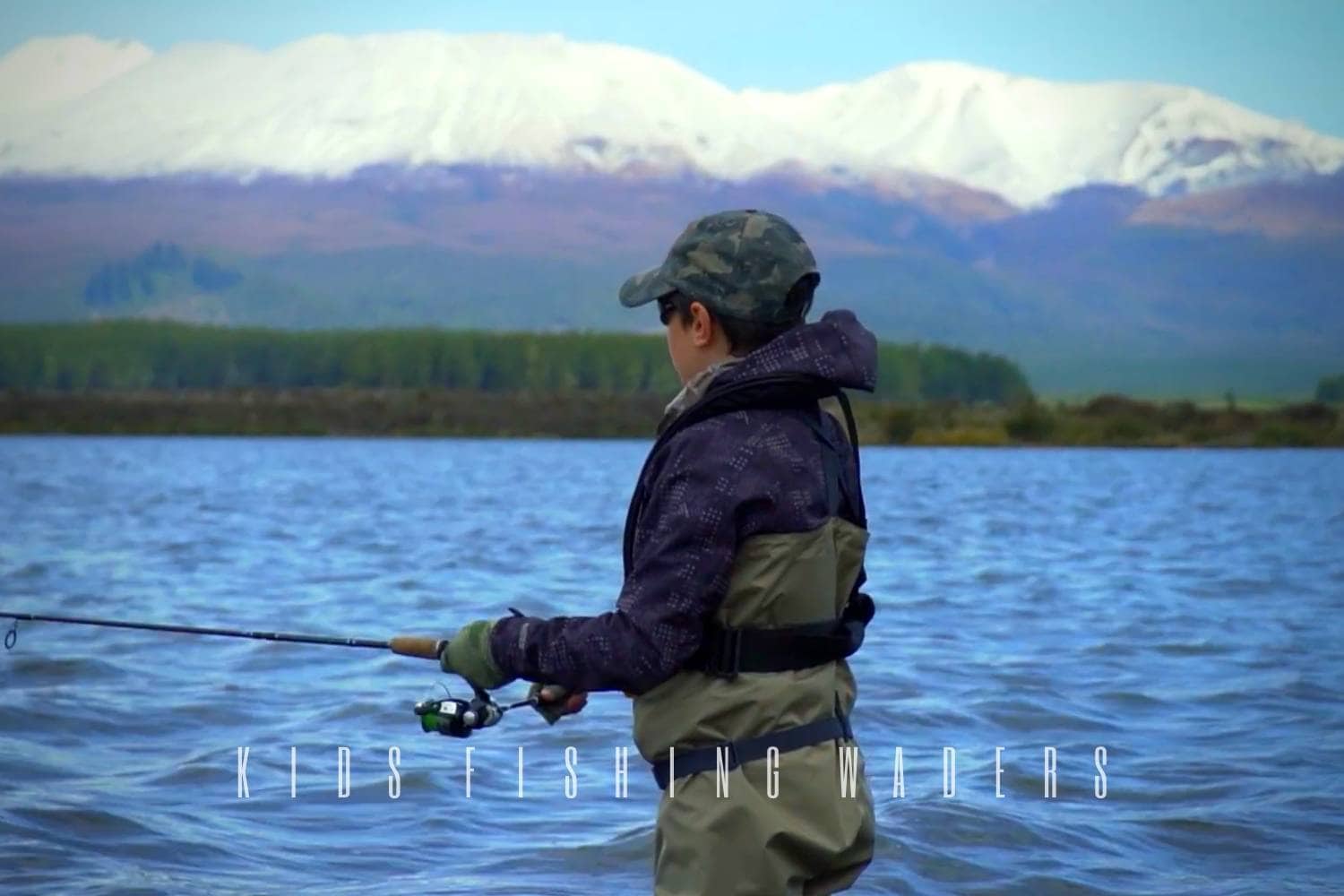
Quick answer: start with fit and the footwear your child needs, not an age printed on the size label. For most beginners, the HISEA AquaShell Mini is the best overall pick because its integrated boots keep setup simple. Choose the Frogg Toggs Hellbender PRO Youth when independent boot fit matters more, while the HISEA TinyTrek and Frogg Toggs Youth Amphib use neoprene uppers for parents prioritizing insulation over low bulk.
These four models cover separate-boot, nylon/PVC bootfoot and neoprene bootfoot needs. The only hands-on finding comes from adult use of the same HISEA TinyTrek family; the remaining details use current manufacturer specifications. For help planning the rest of a first outing, see our guide to fishing with kids.
Kids fishing waders compared
| Wader | Configuration | Construction | Best fit for | Action |
|---|---|---|---|---|
| HISEA AquaShell Mini | Chest bootfoot | Nylon/PVC upper; integrated waterproof boots | A simpler all-in-one setup | View on Amazon |
| Frogg Toggs Hellbender PRO Youth | Stockingfoot chest wader with separate boots | 4-ply nylon upper; double-taped 4 mm neoprene booties | Independent boot fit and replacement | — |
| HISEA TinyTrek | Chest bootfoot | Neoprene upper; rubber boots | Parents prioritizing neoprene insulation | — |
| Frogg Toggs Youth Amphib | Chest bootfoot | 3.5 mm neoprene; rubber boots with 200 g Thinsulate insulation | An insulated bootfoot package | View on Amazon |
How this shortlist was built
Each ranked model had to be a current manufacturer product family with a clear youth or kids identity, documented construction and usable size labels. Marketplace names alone were not enough. That boundary matters because similarly named adult models and older marketplace listings can lead to a different garment, material or generation.
We used an adult pair from the same family now sold as TinyTrek; that neoprene pair felt warm and not especially breathable. It was bought or borrowed, never gifted. Child-fit guidance comes from current manufacturer dimensions and the cited safety sources. The AquaShell Mini uses a different nylon/PVC construction.
The four current picks
Pick 1 of 4
HISEA AquaShell Mini Kids Nylon PVC Chest Waders: Best overall for most beginners
Evidence: Current HISEA AquaShell Mini specifications
Verdict: the AquaShell Mini combines a nylon/PVC upper with integrated waterproof boots. It removes the separate-boot decision, which can simplify getting ready, but the boot and garment must both fit within one selected size.
HISEA’s selector uses 3T, 4/5T, 6/7T, 8/9T, 10/11T, 12/13T and 14/15T labels. Those age-like labels are not body measurements. Use the manufacturer’s live chart, then try the wader with the socks and layers intended for the outing. Reject heel lift, toe pressure, an inseam that bunches around the legs, or a torso that restricts a squat and high step.
Reasons to choose it
- Integrated boots keep the setup simple
- Seven selectable youth and kids labels
- Current AquaShell Mini family has documented size options
Reasons to skip it
- Boot and torso fit cannot be chosen separately
- Age-like labels can encourage guesswork
- Nylon/PVC construction is not the neoprene option
Pick 2 of 4
Frogg Toggs Hellbender PRO Youth Stockingfoot Chest Wader: Best separate-boot fit
Evidence: Current Frogg Toggs product specifications
Verdict: choose the Hellbender PRO Youth when adjusting the footwear independently is more important than the speed of an integrated boot. Its 4-ply nylon upper ends in double-taped 4 mm neoprene booties, so a correctly sized pair of separate wading boots is required.
The manufacturer chart lists Youth Small at foot size 5–6, chest and waist 30–32 inches, and a 28-inch inseam; Youth Medium keeps foot size 5–6, moves chest and waist to 32–34 inches, and inseam to 30 inches; Youth Large lists foot size 7–8, chest and waist 34–36 inches, and a 32-inch inseam. Treat those as garment dimensions and compare all of them, not just the foot number.
Reasons to choose it
- Boot fit can be selected independently
- Separate boots can be replaced without replacing the wader
- Manufacturer publishes chest, waist, inseam and foot dimensions
Reasons to skip it
- Requires a separate boot purchase and fitting step
- Only three youth garment sizes
- Wrinkled booties or poorly fitted boots can create pressure points
Pick 3 of 4
HISEA TinyTrek Kids’ Neoprene Chest Waders: Best neoprene bootfoot option
Evidence: Current specifications plus adult use of an exact-family pair
Verdict: choose TinyTrek when you want HISEA’s neoprene bootfoot construction rather than the AquaShell Mini’s nylon/PVC upper. HISEA currently specifies a neoprene upper and rubber boots but gives no neoprene thickness, so compare it without relying on an unconfirmed thickness figure.
On the TinyTrek-family pair we used, the neoprene felt warm and not especially breathable. Plan layers around water temperature, air temperature and activity, and watch for overheating as well as cold. Current labels run 2T, 3T, 4/5T, 6/7T, 8/9T, 10/11T and 12/13T.
Reasons to choose it
- Documented continuity within the TinyTrek family
- Neoprene upper and integrated rubber boots
- Seven selectable size labels
Reasons to skip it
- The same-family pair used by Fly Fisher Pro was not especially breathable
- Current manufacturer page does not state neoprene thickness
- Boot and garment fit are tied to one size
Pick 4 of 4
Frogg Toggs Youth Amphib Neoprene Bootfoot Chest Wader: Best insulated bootfoot construction
Evidence: Current Frogg Toggs product specifications
Verdict: the Youth Amphib is the most explicitly insulated construction in this shortlist. Frogg Toggs specifies a 3.5 mm neoprene upper, rubber boots, 200 g Thinsulate boot insulation and a cleated outsole. That describes the garment; it does not guarantee warmth or traction in every condition.
The selector uses Youth 3, 4, 5 and 6, which are boot-size labels rather than a complete body-fit description. Confirm garment measurements with Frogg Toggs and test the integrated boots with intended socks. A secure heel, free toes, manageable inseam and unrestricted squat matter more than leaving large amounts of room for growth.
Reasons to choose it
- Documented 3.5 mm neoprene upper
- Integrated boots with 200 g Thinsulate insulation
- Cleated outsole is identified by the manufacturer
Reasons to skip it
- Only four boot-size labels
- Boot and garment dimensions must work together
- Neoprene adds insulation and bulk
How to fit kids waders
Measure the child in the layers they will wear
Measure chest, waist, inseam and foot size while the child wears realistic base layers and socks. Compare those numbers with the current model-specific chart. Our guide to what to wear under waders explains why moisture-managing layers and conditions matter more than simply adding bulk.
Check movement before accepting the fit
Ask for a controlled squat, a high step and several normal walking steps on dry, level ground. The crotch should not hang low, the knees should not be trapped by folds and the suspenders should not need extreme adjustment. In boots, look for heel control and toe room without slop. Suspenders allow modest torso adjustment; they cannot correct oversized boots or a long, bunching inseam.
Choose bootfoot or stockingfoot deliberately
Bootfoot waders are quicker and involve fewer pieces. Stockingfoot waders require separate wading boots, but that separation gives more control over boot support, outsole and replacement. Neither form is automatically best for every child.
Wading safety and care for families
- Assign one supervising adult: keep close, constant attention on the child around natural water, without phone or conversation distractions.
- Fit the life jacket separately: use the label’s child weight and chest guidance. A correctly worn foam device should fit snugly and should not rise above the chin or ears.
- Read conditions before gear: current, waves, rocks, vegetation, limited visibility, cold water, changing weather and upstream rain all matter. Turn around when footing or conditions are uncertain.
- Use the belt as directed: a snug wading belt can slow water entry after a fall, but it is not a seal or a substitute for supervision and flotation.
- Move slowly: use short, controlled steps and scout the route from shore. A wading staff can help probe footing, but it does not make unsuitable water safe.
Before each outing, inspect seams, buckles, suspenders, belt, boot attachment and outsole condition. Follow the current model’s manufacturer instructions for cleaning, drying and storage, plus any destination-specific decontamination rules when moving between waters.
If you are comparing chest coverage with another garment form, our hip-wader guide explains the taxonomy. Garment height still does not establish a safe wading depth.
Final recommendation
Our final recommendation is the HISEA AquaShell Mini.
Frequently asked questions
What are the best kids fishing waders?
The best choice is the one that fits the child’s foot, inseam, torso and intended layers without restricting movement. AquaShell Mini is the simplest all-in-one choice for most beginners; Hellbender PRO Youth offers separate boot fitting; TinyTrek and Youth Amphib are neoprene bootfoot options.
Can a child grow into oversized waders?
Do not rely on that plan. Suspenders can accommodate modest torso change, but they cannot remove heel slip, toe interference, excess inseam or loose fabric. Remeasure regularly and replace the waders when safe movement or boot control is compromised.
Are bootfoot waders better for kids?
They are simpler because the boots are integrated. Stockingfoot waders can provide a more precise separate boot fit and make boot replacement independent of the garment. Fit and intended use decide; neither configuration is universally better.
Are neoprene waders always warmer?
Neoprene provides insulation, but comfort still depends on water temperature, air temperature, activity, layers and fit. Check conditions, dress for water temperature and watch for overheating as well as cold.
How deep can a child safely wade in chest waders?
There is no universal safe depth, and chest height is not a rating. Current, footing, temperature, visibility, weather and downstream hazards can make shallow water dangerous. The supervising adult should choose conservative conditions and turn back whenever there is doubt.
How should kids waders be dried?
Follow the current model’s manufacturer directions for cleaning, drying and storage. Reinspect seams, boots, straps and buckles before the next use.
Official and safety sources checked
- Frogg Toggs Hellbender PRO Youth
- Frogg Toggs size charts
- HISEA AquaShell Mini
- HISEA TinyTrek
- Frogg Toggs Youth Amphib
- CDC drowning prevention
- U.S. Coast Guard child life-jacket guidance
- National Weather Service cold-water safety
- Take Me Fishing wader-safety guidance
- Take Me Fishing safe-wading techniques
