
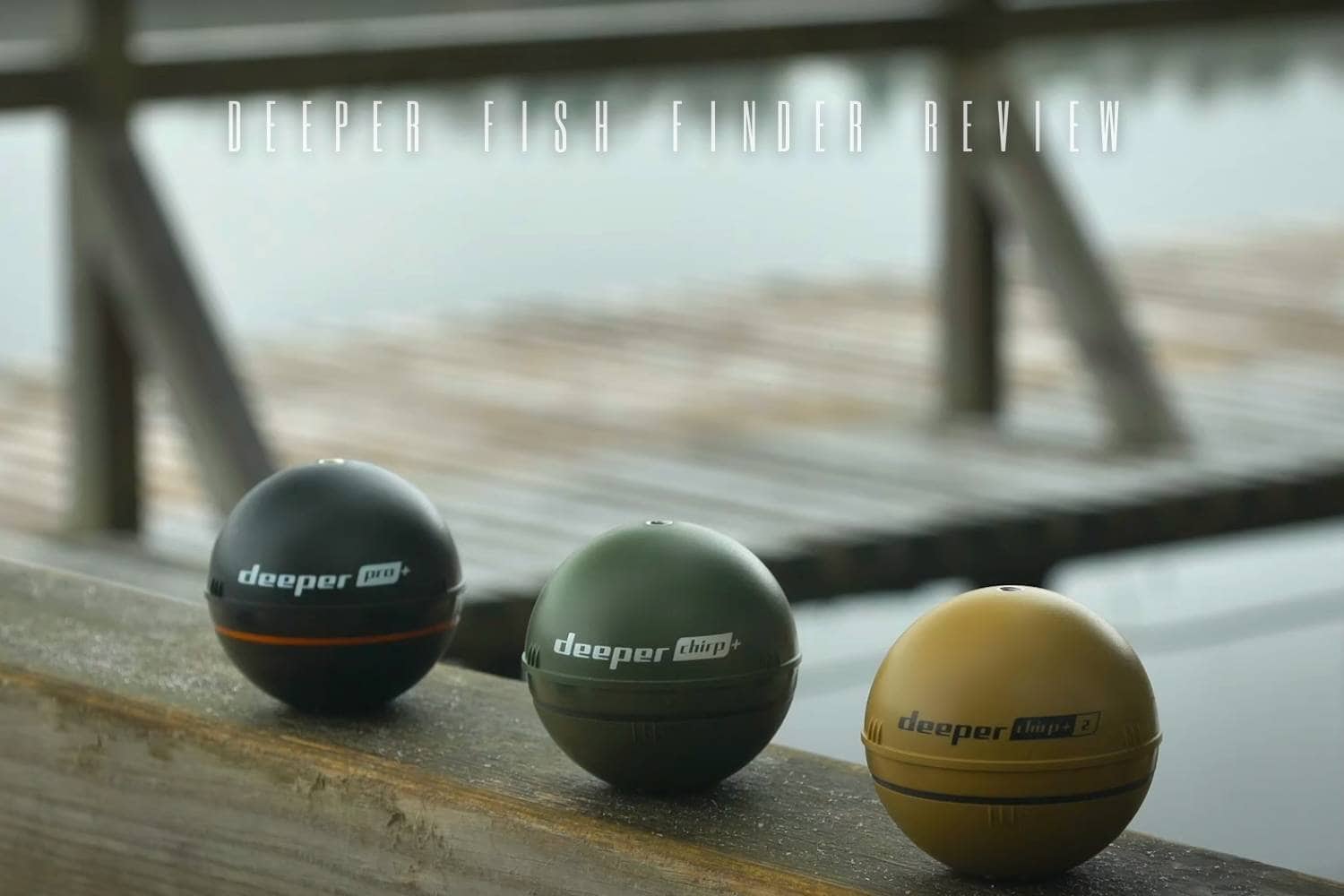
A castable sonar answers a question shore and small-craft anglers often ask: what is the water doing beyond the reach of a pole or paddle? The Deeper units described here sent sonar information to a phone, turning a cast or slow movement into a view of depth, bottom return, and targets in the water column. That can reveal structure, but it does not make fish bite and it does not interpret every mark for you.
This is historical context for the article-era Deeper CHIRP, Deeper Smart Sonar PRO+, and Deeper Smart Sonar PRO generations. Their mobile compatibility, wireless range, depth, charging, GPS, beam, and mapping claims are not presented as present-day facts. Confirm the exact unit and supported software before depending on any of those functions.
Keep the article-era generations separate
The three named units shared the portable, castable idea but did not have identical capabilities. The CHIRP model was described with three beam choices, fine target separation, fast charging, and a traditional ice-flasher display. The PRO+ was distinguished by built-in GPS for shore-based bathymetric mapping. For the article-era Deeper Smart Sonar PRO, treat GPS and mapping functions as unconfirmed. Verify both functions for the exact unit and the software version you intend to use.
| Article-era model | Recorded emphasis | Boundary to keep |
|---|---|---|
| Deeper CHIRP Smart Sonar | Three beam choices, fine target separation, fast charging, and portable use from shore or small craft. | Do not apply its beam or charging details to PRO or PRO+. |
| Deeper Smart Sonar PRO+ | Phone-connected sonar with built-in GPS emphasized for mapping from shore. | The plus generation must not be collapsed into the non-plus name. |
| Deeper Smart Sonar PRO | Portable phone-connected sonar for depth, targets, and mapping tasks. | Confirm GPS and mapping functions for the exact Deeper Smart Sonar PRO unit and supported software. |
For all three, the article-era setup referred to Android and iOS phones and a direct wireless connection. That is a historical compatibility statement only. Software support, operating-system requirements, and available functions can change even when the physical sonar still works.
Understand what the sonar picture represents
Sonar sends sound into the water and measures returning echoes. The view covers a cone-shaped area rather than a single vertical line. A wider beam samples more water but gives less exact lateral position. A narrower beam inspects a smaller area and can make individual returns easier to separate. The target shown on the screen is therefore somewhere inside the active cone, not necessarily directly beneath the device.
Surface bubbles, algae, or turbulence can create clutter near the top. The screen also scrolls with new information on the right and older information moving left, even when the unit is not traveling quickly. A repeated mark on a scrolling history is not automatically a stream of different fish. Watch the newest edge of the display and compare it with device movement.
Build a repeatable castable setup
A castable sonar adds weight and value to the end of a line, so the rod, line, connection, and attachment point all need to suit the exact unit. Use the fastening positions and rigging method specified for that model. Check the connection over a short distance before making a long cast, and keep the retrieval path clear of weed, branches, and boat traffic.
| Stage | Action | Why it helps |
|---|---|---|
| Before launch | Charge the unit, confirm the phone and software operate with it, and inspect the attachment. | Prevents a dead or unsupported setup from becoming the day’s first discovery. |
| First cast | Use a short, controlled cast and verify the live return. | Confirms connection and orientation with low retrieval risk. |
| Survey | Retrieve at a steady pace across deliberate lines. | Makes changes in depth and bottom return easier to compare. |
| Interpret | Relate marks to beam choice, movement, and screen history. | Reduces the temptation to label every arch or dot as a separate fish. |
| After use | Clean and dry the unit as directed, then organize saved information. | Keeps hardware and trip notes ready for the next session. |
Read movement, bottom returns, and CHIRP with restraint
A stronger, thicker bottom return can indicate a harder or denser bottom than a weak return, while changes in the contour show depth transitions. Fish moving through the sonar cone may draw full arches, partial arches, or shorter marks depending on the path through the beam and the motion of the device. Size on screen is influenced by return strength and presentation; it is not a perfect ruler for the fish.
The article-era CHIRP unit swept through frequencies rather than sending only one frequency at a time. The practical value was a more detailed set of returns for separating nearby targets. Even so, interpretation depends on beam, depth, movement, settings, and conditions. Start with a simple display, learn how known structure appears, and add features only when they answer a specific question.
Mapping can be more useful than chasing individual icons. A series of controlled passes can reveal a point, drop-off, channel, flat, or harder patch worth revisiting. Label saved places with enough context to remember what was observed and under what conditions, rather than treating every screen mark as permanent.
Who the castable format suits
This format makes the most sense for shore anglers, ice anglers, and users of kayaks, pontoons, or small boats who want portable depth and structure information without a fixed installation. It is less relevant when the technique keeps the angler moving rapidly through shallow river water or when casting the sonar would interfere with the fishing itself.
The key trade-off is simplicity versus interpretation. Hardware may be compact, but the complete system includes a suitable rod and connection, a charged phone, compatible software, wireless setup, and the skill to read a scrolling cone-based picture. If those steps fit your fishing, an article-era Deeper can still explain the value of castable sonar. If not, a simpler depth-finding or mapping approach may be more useful than another screen.
